
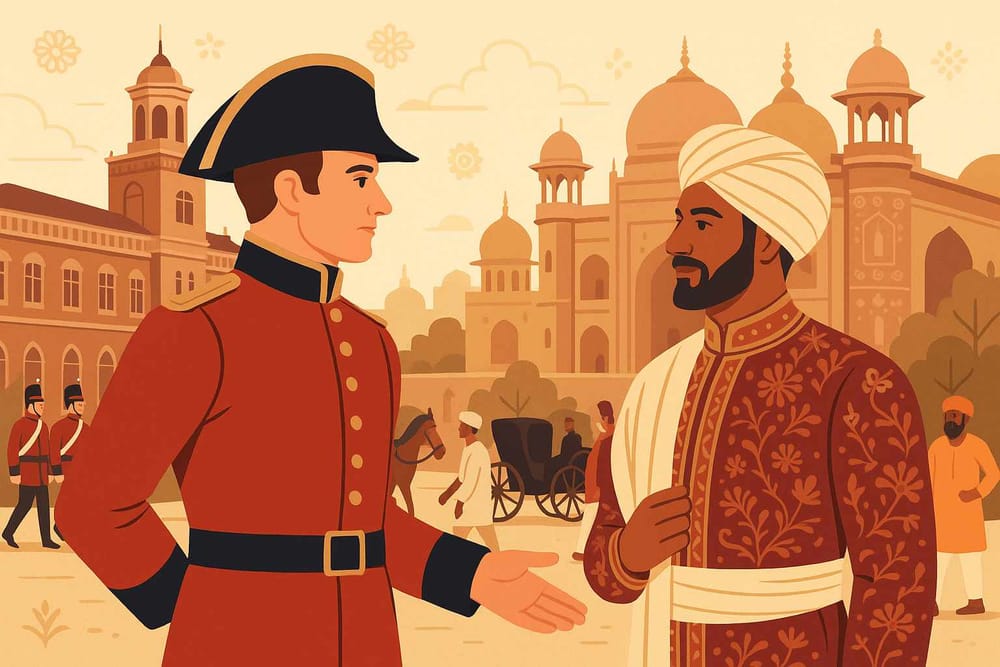
British Era in India: A 1803-1947 Exploration
Have you ever sat on a train, watching the countryside zip by, and wondered about the hands that first laid those tracks? Or perhaps, while dealing with official paperwork, you've marvelled at the sheer complexity of our administrative system? These everyday experiences are living remnants, echoes of a time that completely reshaped our land – the British Era in India. It wasn't just a chapter in a history book; it was a storm that churned our society, economy, and very soul for nearly 200 years, from the decisive Battle of Plassey in 1757 to the midnight hour of freedom in 1947.
This period is a story of profound change, of great loss, and of an even greater resilience that defines the Indian spirit. Let's walk through this history together, not as a lesson, but as a journey to understand who we are today.
One Land, One Ruler: The Political Remodelling of India
Before the British, India was a vibrant mosaic of hundreds of princely states and kingdoms. The British, with their methodical approach, sought to bring this entire subcontinent under a single, centralized authority. After the great uprising of 1857, the power shifted from the East India Company directly to the British Crown through the Government of India Act, 1858. This was a turning point. Suddenly, a foreign queen was the Empress of India.
To manage this vast land, they created a powerful administrative framework. The roles of District Collectors and the structured Indian Civil Service were their creations, a 'steel frame' that still forms the backbone of our bureaucracy today. They introduced a uniform legal system, with the Indian Penal Code (1860), which, for the first time, applied the same laws across different regions. But this control came at a cost. Policies like the infamous 'Doctrine of Lapse' were used to annex states like Jhansi and Satara, swallowing kingdoms and redrawing our map. Their 'divide and rule' strategy was not a myth; by creating separate electorates and formalising religious and caste divisions in censuses, they cleverly sowed seeds of discord to prevent a united front against them.
The Great Economic Drain: A Story of Lost Riches
India was once known as the 'Sone ki Chidiya' or the 'Golden Bird', famed for its exquisite textiles and spices. The British economic policies systematically dismantled this prosperity. Dadabhai Naoroji, the Grand Old Man of India, powerfully described this as the "Drain of Wealth," where India’s riches were relentlessly funnelled to Britain.
- From Producers to Suppliers: Our world-famous weavers and artisans were left jobless as cheaper, machine-made goods from British factories flooded our markets. India was transformed into a mere supplier of raw materials like cotton and indigo for their industries and a captive market for their finished products. This deliberate deindustrialisation crippled our self-sufficient village economies.
- Infrastructure with an Agenda: Yes, the British built an impressive network of railways, roads, and telegraph lines. But who did it truly serve? This infrastructure was primarily designed to transport raw materials from India's interiors to the ports quickly and to move troops swiftly to quell any signs of rebellion. It was a tool for exploitation, not for the welfare of the Indian people.
Harsh land revenue systems pushed farmers into a cycle of debt and poverty, leading to devastating famines that claimed millions of lives. The story of our economy under the British is a painful reminder of how our strengths were turned against us.
A Society in Flux: The Social and Cultural Shifts
The British presence brought about massive changes in our society, some of which were genuinely progressive, while others left deep scars. They introduced Western education and the English language, which, while intended to create a class of clerks to serve the empire, also gave us a common language to unite against them. Great minds educated in these new institutions would later become the vanguards of our freedom movement.
This era also saw the rise of great social reformers. Visionaries like Raja Ram Mohan Roy campaigned tirelessly against inhuman practices like Sati, and the British did pass legislation to abolish it. However, their influence wasn't always positive. They often viewed Indian culture through a lens of superiority, causing a decline in traditional arts and knowledge systems. The introduction of missionary activities also created social tensions in many parts of the country, impacting local traditions and faiths, something visible in regions like Bathinda and Sikar where local life was forever altered.
The Fire of Freedom: India's Struggle for Independence
The simmering discontent against foreign rule finally boiled over in 1857. What the British called a 'Sepoy Mutiny' was, for us, the First War of Independence—a massive, heartfelt cry for freedom. Though it was suppressed brutally, it lit a fire that could never be extinguished.
The 20th century saw this fire grow into a nationwide movement. Leaders like Mahatma Gandhi introduced the world to the power of truth and non-violence with movements like the Non-Cooperation (1920) and Quit India (1942). Millions of ordinary Indians—men, women, and even children—walked with him, facing batons and bullets with nothing but courage in their hearts. The Swadeshi movement encouraged economic self-reliance, urging people to boycott foreign goods and embrace what was proudly Indian.
This long and arduous struggle, filled with the sacrifices of countless freedom fighters, finally led to August 15, 1947, when we awoke to a new dawn of freedom.
Our Enduring Spirit: A Legacy of Resilience
The British have left, but their legacy remains in our laws, our language, our cities, and our institutions. It is a complex inheritance of both progress and pain. But the most important legacy of that era is not what they left behind, but what they could never take away: our spirit. The struggle for freedom united us and reinforced our deep-rooted cultural and spiritual identity.
Understanding this history helps us cherish the traditions and stories that survived against all odds. It’s this very spirit of preservation and devotion that we celebrate at Bhaktilipi. We are a space dedicated to the timeless devotional literature and stories that have been the bedrock of our culture, offering solace and strength through centuries of change.
We invite you to explore these treasures with us. At Bhaktilipi.in, we bring you carefully curated sacred texts and stories in their original languages and in translations, making our profound spiritual heritage accessible to everyone. Stay connected with our shared journey by following us on Facebook, Instagram, and YouTube.
A passionate group of people dedicated to preserving India's knowledge of Dharma, Karma, and Bhakti for ourselves and the world 🙏.
Comments
Related in

Exploring the British Era in India: 1803-1947- A Detailed Overview
Walk through any of our older cities, and you'll see it. A Victorian-era building standing next to a Mughal archway, the familiar rumble of a train on tracks laid over a century ago, or even the English words that have seamlessly woven themselves into our daily conversations. These