
Decoding the Halmidi Inscription- Ancient South India's Mysteries Explained
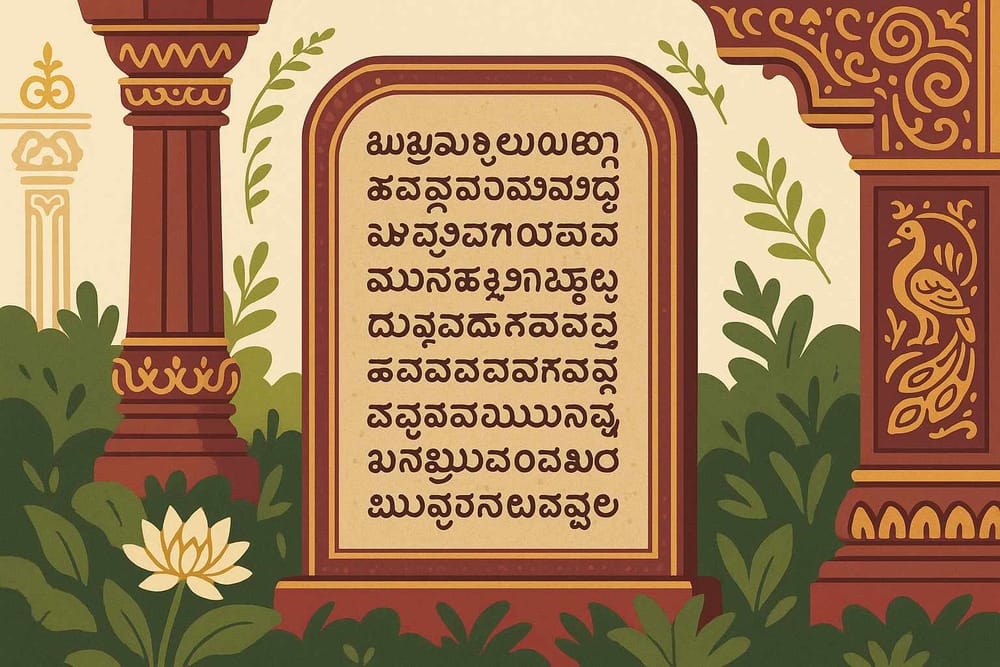
Imagine standing in a quiet village, the air filled with the scent of wet earth. Before you is a simple stone slab, but it's not just any stone. It’s a portal to the past. On its surface are letters carved over 1500 years ago, the very first time our beloved Kannada language was written down for the world to see. This isn't just history; it feels like connecting with an ancestor's voice. This is the magic of the Halmidi inscription, a treasure that tells us where we come from.
A Whisper from the Past: The Story of Its Discovery
For centuries, this stone lay hidden in plain sight in the small village of Halmidi in Karnataka's Hassan district. It was in 1936 that historian Dr. M.H. Krishna recognized its true worth. What he found was not just an old carving, but the oldest known evidence of Kannada as an official, written language. Dated somewhere between 450 and 500 CE, this sixteen-line inscription is like the birth certificate of written Kannada, a language that now flows through the hearts of millions.
What Do These Ancient Letters Say?
The message on the stone is deeply rooted in our culture. It begins not with a royal decree, but with an invocation, a small prayer to Lord Vishnu. This immediately tells us about the faith and values of the people of that time. The inscription then goes on to tell a very human story. It records a grant of land to a brave warrior named Vija-Arasa for his remarkable courage in battle. It speaks of kings from the Kadamba dynasty and how villages were gifted, with a portion of the revenue set aside for Brahmins. It’s a beautiful snapshot of society, honour, and devotion from a time long gone.
The Kadamba Kings and the Rise of a Language
The inscription gives us a glimpse into the world of the Kadamba dynasty, who were true patrons of local culture. In an era where Sanskrit was the dominant language of administration and literature, the Kadambas made a conscious choice to elevate Kannada. They understood the importance of using the people's language for official records. This support was the seed from which Kannada literature and identity would grow for centuries. The Halmidi inscription is the first beautiful fruit of that decision, a testament to how ancient Karnataka speaks through stone.
Just as this stone preserved a moment of our history, we at Bhaktilipi are passionate about keeping our timeless devotional stories alive. We believe these tales are the threads that connect our past to our present, offering wisdom and peace in today's fast-paced world.
Unravelling the Mysteries That Remain
Like any great historical treasure, the Halmidi inscription holds a few secrets. Scholars still discuss its exact date, with some suggesting a slightly later period based on the style of the script. There are also friendly academic debates about its direct link to the main Kadamba dynasty records. These ongoing discussions don’t diminish its importance; they make it even more fascinating! It reminds us that history is a living, breathing subject, and there is always more to learn and solve the mysteries of ancient Kannada.
Your Questions Answered: Getting to Know the Halmidi Inscription
Many people are curious about this foundational piece of our heritage. Here are some insights into the common questions that arise.
- What makes the Halmidi inscription so special?
Its profound importance comes from being the earliest confirmed inscription in the Kannada language. It marks the crucial shift from an oral tradition to a written one, providing the very first piece of evidence of Kannada being used for administrative purposes. It’s a cornerstone for understanding the evolution of the language and the history of the region. - Where was this historic stone actually found?
This priceless artifact was discovered in the village of Halmidi, nestled in the Hassan district of Karnataka. The village has now lent its name to this iconic piece of history, forever linking this small place to a giant leap in our linguistic heritage. - What is the inscription written on?
The message was carefully carved into a slab of sandstone. The durability of sandstone is one of the main reasons this record has survived for over fifteen centuries, allowing us to read its message so long after it was first inscribed. - If I want to see it, is it possible?
Yes, it is! To protect it from the elements, the original Halmidi inscription is safely preserved at the Office of the Director of Archaeology and Museums in Mysore. However, a beautifully made replica stands proudly in Halmidi village, allowing visitors to connect with its history right where it was discovered.
Our Heritage, Etched Forever in Stone
The Halmidi inscription is much more than a historical artifact. It is a symbol of identity, a proof of our deep linguistic roots, and a source of immense pride for every Kannadiga and Indian. It reminds us that our culture is built on a foundation of courage, devotion, and a deep love for language. By studying and cherishing such treasures, we honour our ancestors and ensure their legacy continues to inspire generations to come.
About Bhaktilipi
At Bhaktilipi, we are dedicated to this very mission of preservation and sharing. We bring India's vast ocean of timeless devotional literature and stories into the digital age, making them accessible for today's reader. We believe these narratives are sources of immense wisdom and inspiration.
Stay Connected with Our Heritage
Discover more about our rich history and devotional treasures on our platform. To stay connected with Bhaktilipi, subscribe to our newsletter for regular updates, and follow our journey on Facebook and Instagram. You can also explore our collection of stories and videos on YouTube.
© 2025 Bhaktilipi – Crafted with devotion.
A passionate group of people dedicated to preserving India's knowledge of Dharma, Karma, and Bhakti for ourselves and the world 🙏.
Comments
Related in

Halmidi Inscription: Decodes Past-Significance Reveals
Have you ever walked through an old temple or a historic site and wondered what stories the stones could tell if they could speak? In the heart of Karnataka, there is one such stone that does speak. It tells a tale from a time when a language, rich and full

Halmidi Inscription Reveals Ancient Indian History
Imagine walking through a quiet little village, where life moves at its own gentle pace. You pass by an ordinary-looking stone slab, unaware that it holds a secret centuries old—a voice from the past waiting to be heard. This is the story of the Halmidi inscription, a discovery that
Halmidi Inscription- Mysteries Explained
Imagine walking through a quiet village and stumbling upon a stone that holds the first-ever written words of your mother tongue. It’s like finding a family heirloom you never knew existed, a direct message from ancestors who lived over 1500 years ago. This is exactly the feeling that the