
Decoding the Past: Talagunda Inscription Reveals Language Legacy
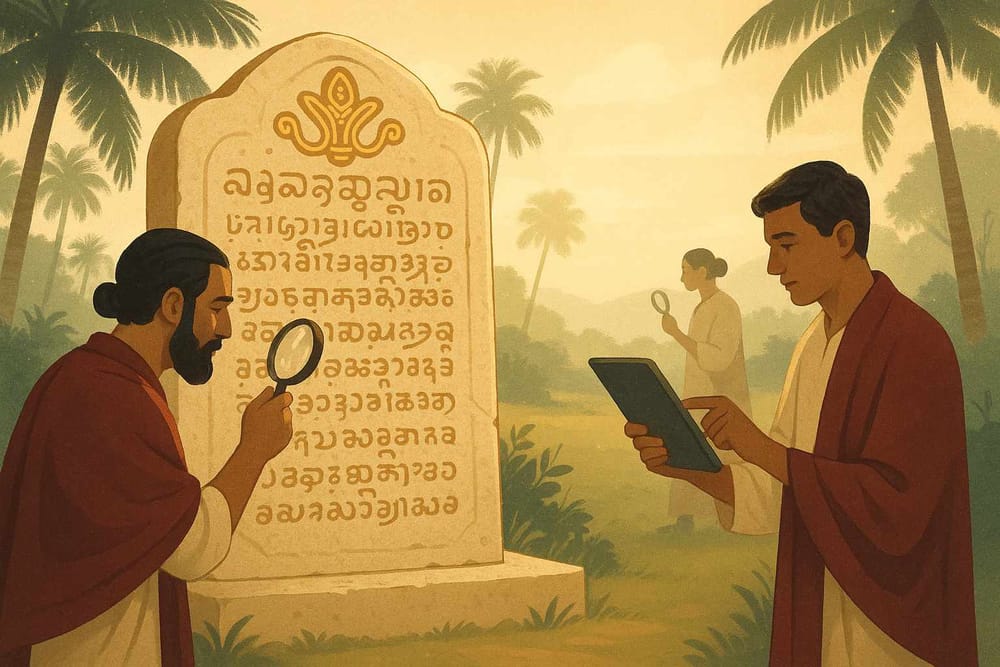
Imagine standing in an ancient temple compound in Karnataka, a gentle breeze carrying the fragrance of old stone and earth. Before you stands a pillar, not grand or imposing, but etched with stories from a time nearly 1600 years ago. This isn't just any stone; it's the Talagunda inscription, a silent witness to the rise of a great dynasty and the flourishing of dharma. It’s a profound connection to our roots, a whisper from the past that tells us who we were and what we valued.
This pillar, found in the Pranavalingeshwara temple in Talagunda, is more than just a historical record. It's a piece of our collective soul, a testament to the deep intellectual and spiritual currents that have shaped Bharat. Let's journey back in time and listen to the stories this stone has been waiting to tell us.
The Discovery and Its Deep Significance
For centuries, this granite pillar stood quietly until it was brought to the world's attention in 1894 by B. L. Rice. What he uncovered was a treasure trove of information from the reign of Kadamba King Śāntivarman, dating back to around 455-470 CE. The inscription doesn’t just list kings and dates; it paints a vivid picture of a society built on learning, devotion, and righteousness.
What makes the Talagunda inscription so special for devotees and history lovers alike is its profound spiritual context. It gives us the earliest epigraphical evidence in Karnataka of a temple dedicated to Lord Shiva in Talagunda. It speaks of the construction of a temple water tank and confirms the sacred practice of worshipping the Shiva Linga long before the 5th century. This isn't just history; it's the documented beginning of a devotional legacy that millions of us follow to this day.
The Language of Gods in the Script of the People
A Fusion of Sanskrit and Kannada
One of the most beautiful aspects of this inscription is its language. The verses are composed in flawless, classical Sanskrit—the language of our sacred texts and high philosophy. The poet, Kubja, who was in King Śāntivarman's court, crafted a masterpiece of literature. He wasn't just a scribe; he was an artist who engraved his own poetry onto the stone.
But here’s the fascinating part: the script used to write this sublime Sanskrit is an early form of our very own Kannada script, rendered in a beautiful floral box-style. This shows how our regional identities were beautifully intertwined with the larger cultural fabric of Bharat. It proves that classical Sanskrit had not just reached, but was deeply cherished in South India, serving as a bridge for intellectual and spiritual expression.
The Story of the Kadambas: A Dynasty is Born
The inscription narrates the inspiring origin of the Kadamba dynasty, starting with its founder, Mayurasharma. He was a Brahmin scholar who travelled to Kanchipuram, a great centre of learning (ghatika), to pursue his Vedic studies. The inscription tells a dramatic story of how an insult by a Pallava guard ignited a spark in him, transforming the scholar into a warrior who established the first indigenous kingdom of Karnataka.
This story, etched in stone, highlights the core values of the time: the importance of knowledge (Jnana), the warrior spirit (Kshatra), and the unwavering commitment to Dharma. The Kadamba rulers were not just conquerors; they were patrons of culture, language, and religion, and this pillar is their lasting legacy.
Talagunda: An Ancient Gurukul of Learning
The inscription proudly declares Talagunda as an Agrahara. An Agrahara was a sacred settlement granted to learned Brahmins, essentially making it an ancient university town. This wasn't just a place for ritual; it was a vibrant hub where the Vedas, Vedanta, grammar, and philosophy were taught and debated. These centers were the guardians of our oral and written traditions, ensuring that the flame of knowledge was passed down through generations.
The Kadamba kings' support for Agraharas shows their wisdom. They understood that a kingdom's true strength lies not just in its army, but in its intellectual and spiritual wealth. It is this very wealth of stories and timeless literature that we at Bhaktilipi are passionate about preserving. We believe that understanding our history enriches our devotion. For more such deeply rooted stories from our heritage, you can explore our collection at Bhaktilipi.in.
The Whispers Continue: New Discoveries
The story of ancient Karnataka's inscriptions doesn't end with the Talagunda pillar. History is always revealing more of its secrets. In recent years, another inscription was found at the same temple complex that might be even older, possibly from 370 CE! This one is a dual-language record in both Kannada and Sanskrit, documenting a land grant.
These discoveries remind us that our past is not a closed book. There is always more to learn, more to understand. Each inscription, like the famous Halmidi inscription, is a voice from the past, speaking to us through stone. By studying them, we aren't just decoding old scripts; we are connecting with the lives, beliefs, and aspirations of our ancestors, and realizing the incredible depth of our civilization. The ongoing effort to solve the mysteries of ancient Kannada continues to bring new light to our shared past.
A Legacy Carved in Stone
The Talagunda inscription is far more than an archaeological artifact; it is a source of immense pride and inspiration. It shows us a time when language was poetic, rulers were righteous, and learning was revered. It connects us to the very soil of our land and the spiritual traditions that continue to nourish us.
This pillar stands as a timeless reminder that our heritage is not meant to be forgotten in museums, but to be lived, cherished, and celebrated in our hearts every day. It teaches us that our identity is carved from the wisdom of sages, the courage of kings, and the unwavering devotion of countless generations.
A passionate group of people dedicated to preserving India's knowledge of Dharma, Karma, and Bhakti for ourselves and the world 🙏.