
Exploring Karbis- Culture and Region Explained
There are places in our incredible country that hold stories so ancient, you can almost hear them whispered on the wind. Karbi Anglong in Assam is one such place. It's not just a district on a map; it's a living, breathing tapestry of culture, nature, and traditions that have been passed down through generations. To truly understand the beauty of Northeast India, one must get to know its people, and the Karbi community, who call themselves Arleng (meaning 'man'), offer a warm and profound glimpse into this world.
Let's take a walk together through the green hills and vibrant villages of Karbi Anglong, to understand the lifestyle, beliefs, and the very soul of the Karbi people.
Where the Hills Whisper Stories: A Look at Karbi Anglong
Nestled right in the centre of Assam, Karbi Anglong feels like the heart of the region, sharing its borders with the beautiful states of Meghalaya and Nagaland. This unique position has made it a melting pot of cultures for centuries. The land is a canvas of rolling hills, dense forests, and sparkling rivers, creating a paradise for nature lovers. It's so rich in biodiversity that a part of the world-famous Kaziranga National Park, a UNESCO World Heritage Site, falls within its territory.
- A Treasure of Nature: The forests here are not just home to rare wildlife but are also a natural pharmacy, filled with countless medicinal plants that have been used in traditional healing for ages. The Karbi people share a deep, spiritual connection with their environment, a respect that is woven into their daily life and sustainable practices.
- The Rhythm of the Land: Agriculture is the backbone of the Karbi way of life. The fields, rich with crops like paddy, ginger, and turmeric, paint the landscape in shades of green and gold. Rivers like the Kopili are the lifelines, nourishing the fields and supporting the community in countless ways.
While modern challenges like deforestation pose a threat, the inherent respect the Karbis have for 'Mother Nature' continues to be a guiding force in protecting this precious ecological haven.
The Arleng People: Pillars of Tradition and Identity
Who are the Karbi people? Their story begins long ago. It is believed that the Karbis, belonging to the Tibeto-Burman linguistic family, originated in the vast river valleys of western China. Their ancestors journeyed through the Brahmaputra and other great rivers to find a home in these hills, making them one of the oldest communities in Northeast India.
The social fabric of the Karbi people is strong and deeply rooted. Theirs is a patriarchal society, where the father is the head of the family and lineage is traced through him. What’s truly heartwarming is their approach to marriage. They follow strict rules of clan exogamy, meaning marriage within the same clan is forbidden, ensuring a transparent and healthy social structure. There is no system of dowry or bride price, and love marriages are widely accepted, reflecting a progressive and respectful view of relationships.
A moment of immense pride for the community came in early 2025 when the Karbi language was declared the official language within the Karbi Anglong Autonomous Council's jurisdiction. This step is a powerful affirmation of their identity and ensures their mother tongue will thrive for generations to come.
Weaving Life with Rituals and Festivities
The spiritual world of the Karbis is deeply connected to nature and their ancestors. Many follow Animism, a faith that sees the divine in all things, from the trees to the rivers. Their rituals are a beautiful expression of this belief, focused on honouring their ancestors and the deities that protect their homes and lands.
Their calendar is dotted with vibrant festivals that bring the entire community together. One of the most important is Rongker, a festival performed to please the gods and goddesses for the well-being of the entire village. It’s a powerful ceremony where everyone prays for a bountiful harvest, and protection from harm. Then there’s Botor Kekur, a unique festival where the community comes together to invoke rain, essential for their crops to grow.
And one cannot talk about Karbi culture without mentioning the spectacular Karbi Youth Festival. This grand celebration, which recently marked its Golden Jubilee in 2024, is a vibrant showcase of their traditional songs, folk dances, and colourful attire. It's an event where the youth connect with their roots and proudly carry their heritage forward.
Threads of Heritage: The Soulful Karbi Attire
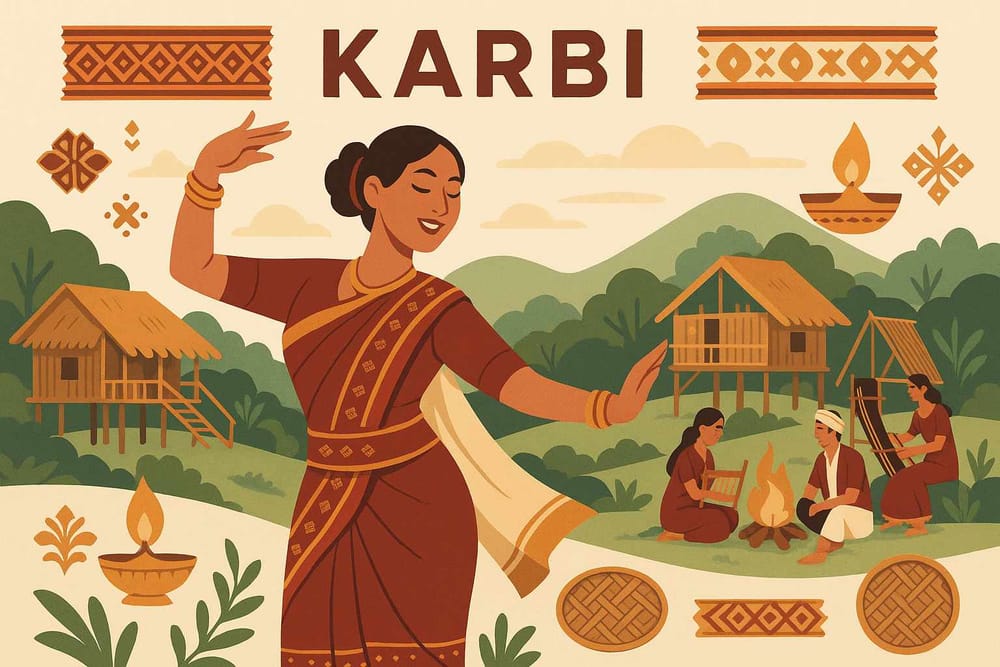
The traditional dress of the Karbi people is more than just clothing; it’s a story woven in thread. The women look elegant in the Pini, a type of sarong, paired with a Pekok, a beautifully embroidered cloth that covers the upper body. The intricate patterns and vibrant colours often draw inspiration from the nature around them. You can delve deeper into this beautiful aspect of their culture by reading about Karbi Anglong's rich weaving techniques.
A Life Rooted in the Land: Livelihood and Skills
The primary occupation of the Karbi people has always been agriculture. Those living in the hills traditionally practice jhum or shifting cultivation, a method perfectly adapted to the hilly terrain. In the plains, they are engaged in settled farming, growing rice, maize, and various vegetables. Their skill doesn't end in the fields. The Karbis are master artisans, especially when it comes to bamboo.
Bamboo is truly the lifeblood of Karbi culture. This versatile grass is used for almost everything—from building their sturdy homes and crafting everyday tools to weaving intricate baskets and even creating soulful musical instruments. It’s a symbol of their resourcefulness and their ability to live in perfect harmony with the resources their land provides.
Connecting with a Timeless Heritage
Exploring the world of the Karbis is a journey that enriches our own understanding of India's incredible diversity. It reminds us that culture isn't just in monuments or museums; it's in the songs people sing, the stories they tell, and the way they live with respect for each other and the earth.
Just as we uncover the profound stories of communities like the Karbis, we at Bhaktilipi are dedicated to bringing such timeless narratives of devotion and culture to you. We believe these stories are bridges that connect us to our roots and inspire us in our daily lives. For more insights into our country's rich traditions, you can explore the cultural history of the Karbis on our platform.
Stay connected with our mission to preserve and share this wisdom. You can follow us for more inspiring content on Facebook, Instagram, and YouTube. Join our community and let's keep the flame of bhakti and culture burning bright together!
A passionate group of people dedicated to preserving India's knowledge of Dharma, Karma, and Bhakti for ourselves and the world 🙏.
Comments
Related in

Exploring Karbi Culture: Traditions and Heritage Defined
Beyond the sprawling tea gardens and the mighty Brahmaputra, nestled in the emerald green hills of Assam, lies a world rich with ancient stories and traditions. This is the home of the Karbi people, also known as the Arleng, a community whose way of life is woven with deep respect

Karbi Culture and Traditions - A 2025 Exploration
Kabhi socha hai, shehron ki bhaag-daud se door, hamare hi desh ke ek kone mein, prakriti ki god mein kuch sanskritiyan aaj bhi usi saadhgi aur gehrai se saans le rahi hain, jaise sadiyon pehle leti thin? Aisi hi ek anmol dharohar hai Assam ki Karbi janjati ki sanskriti. Yeh
The Karbi Story: Explore Culture and Traditions of Assam's Indigenous People
Deep within the emerald green hills of Assam, a story lives and breathes. It’s a story carried on the wind that rustles through bamboo groves, a tale sung by the rivers, and a legacy etched into the very soul of the land. This is the story of the Karbi