
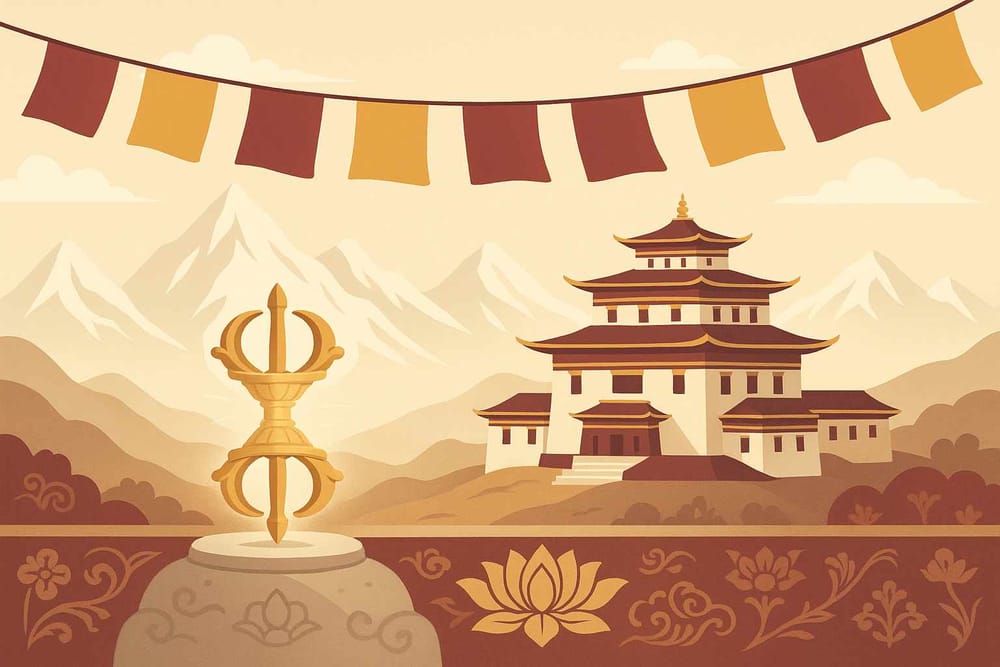
Exploring Vajrayana Buddhism-Diamond Path Defined
Have you ever felt a calling for a spiritual path that is both deeply ancient and incredibly potent? A path that doesn’t ask you to renounce the world, but to transform your very perception of it? This is the heart of Vajrayana Buddhism, a tradition so profound and powerful, it is often called the Diamond Path. It's a journey not just of the mind, but of the soul, one that promises the incredible possibility of enlightenment within a single lifetime.
For many of us in India, our roots are steeped in spirituality. We look for wisdom that resonates with our culture, a practice that feels like coming home. Let’s embark on a journey together to explore this luminous path, which began in our own land and blossomed into a world-renowned tradition of inner transformation.
The Ancient Roots and Himalayan Journey of the Diamond Path
The story of Vajrayana begins right here, in the fertile spiritual soil of India, around the early centuries CE. It drew its life force from profound Tantric traditions, with seminal texts like the Guhyasamaja Tantra laying its philosophical foundation. It was from here that great masters, like the revered Guru Padmasambhava, carried these precious teachings across the mighty Himalayas to Tibet.
In the quiet solitude of the mountains, these Indian teachings didn't just find a new home; they merged beautifully with local Tibetan beliefs and spirituality. This sacred synthesis gave birth to what we know today as Tibetan Buddhism. The establishment of great monasteries and the painstaking compilation of sacred texts ensured that this wisdom wasn't lost to time, but preserved for generations of seekers. In fact, recent discoveries at the Ratnagiri monastery site in Odisha, unearthing ancient Buddhist artifacts, remind us just how deep and widespread these roots are in our own motherland.
The Core Wisdom: Understanding Vajrayana Principles
At its heart, Vajrayana is about 'upaya' or skillful means. It teaches that instead of running away from life's challenges and emotions, we can use them as fuel for our spiritual growth. A central idea is the concept of the three bodies of a Buddha (Trikaya), which helps us understand the nature of reality:
- Dharmakaya (The Body of Truth): Imagine this as the ultimate, formless reality, the pure, empty space from which everything arises. It is the unmanifested potential, the absolute truth that is beyond our ordinary senses but is the essence of everything.
- Sambhogakaya (The Body of Enjoyment): This is the blissful, radiant form that enlightened beings manifest in celestial realms. Think of it as the divine, energetic expression of the Dharmakaya, a bridge between the ultimate and the earthly.
- Nirmanakaya (The Body of Emanation): This is the physical form that a Buddha takes in the world, like Siddhartha Gautama, to guide and teach beings out of compassion. It is the truth made manifest in a way we can see, hear, and learn from.
The path to experiencing this reality is through Tantra, which involves channeling our inner energies for spiritual transformation. The very word 'vajra' means both diamond and thunderbolt – symbolising the indestructible, crystal-clear nature of our true mind and the sudden, powerful flash of enlightenment. The guidance of a qualified Guru is paramount here, continuing the sacred guru-shishya parampara so vital in Indian traditions.
Awakening the Divine Within: Deities and Visualizations
One of the most beautiful aspects of the Diamond Path is its use of deity visualization. But these are not external gods to be worshipped; they are seen as manifestations of our own enlightened qualities. When a practitioner visualizes Avalokiteshvara, they are awakening the boundless compassion already within their own heart. Meditating on Tara is a way to connect with our innate quality of fearless protection.
Mandalas, those stunningly intricate cosmic diagrams, are used as maps for these inner journeys. They represent the sacred universe and the perfected palace of the deity, guiding the meditator towards the center, towards their own enlightened nature. And then there are mantras, like the world-renowned "Om Mani Padme Hum". These are not just words but sacred vibrations that resonate with the energy of the deities, purifying our mind and speech, and connecting us to a higher state of consciousness.
Rituals and Sacred Objects: Tools for the Soul's Journey
The practices of Vajrayana are rich with meaning, using tangible objects to convey profound spiritual truths. These aren't just decorative items; they are active tools for awakening.
The Dance of Wisdom and Compassion
During ceremonies, you will often see the practitioner holding a dorje (or vajra) in one hand and a bell in the other. The dorje symbolises the indestructible power of compassion and skillful means, while the bell represents the profound wisdom of emptiness. Using them together signifies the ultimate goal of the path: the perfect, inseparable union of wisdom and compassion.
Sacred Companions in Practice
Mala beads are a constant companion, used to count mantras, helping the mind stay focused and infusing each bead with prayerful energy. Thangka paintings, with their vibrant and detailed depictions of deities and mandalas, are not mere art. They are sacred windows into the spiritual realm, visual guides that teach and inspire the practitioner during meditation.
And who hasn't been moved by the sight of Tibetan prayer flags fluttering in the wind? Each flag carries sacred mantras, and it is believed that as the wind touches them, it carries their blessings of peace, compassion, and wisdom to all corners of the world, a beautiful, silent prayer for all beings.
A Path for Our Times: Vajrayana in Modern India
In today's world, where we juggle demanding careers, family responsibilities, and the constant hum of technology, the Diamond Path offers a surprisingly relevant and practical approach. Its promise of rapid spiritual progress is not a shortcut, but an efficient method for those who are sincere. It teaches us to find our spiritual practice not by escaping life, but right in the middle of it.
For many culturally-rooted Indians, this path feels both familiar and refreshingly direct. The emphasis on compassion, inner strength, and wisdom connects deeply with our native spiritual ethos. It shows that one can honour tradition while embracing a modern lifestyle. This balance is something many of us seek. In fact, just as Buddhism has seen modern expressions like Navayana Buddhism to address contemporary social needs, Vajrayana provides a powerful toolkit for deep inner transformation in today's complex world.
At Bhaktilipi, we understand this quest. We believe in preserving the timeless essence of our spiritual traditions while making them accessible. Our platform is a space to explore these profound philosophies and find authentic knowledge to guide your journey.
Your Journey, Your Companion: Bhaktilipi
Whether you are taking your first steps or are deep into your spiritual path, Bhaktilipi.in is here to support you. We bring you timeless devotional stories, clear explanations of complex philosophies, and a community of fellow seekers. We invite you to explore, learn, and grow with us.
Common Questions on the Diamond Path Answered
Many who are new to this path have questions. Let's explore some of them in a more conversational way, as if we were sitting together and talking about this wonderful tradition.
What really makes Vajrayana the "Diamond Path"?
Think of a diamond. It's both incredibly strong and perfectly clear. The name "Diamond Path" is used because its teachings are seen as indestructible and capable of cutting through the deepest layers of ignorance to reveal the pristine, luminous nature of our own mind. It’s a path of clarity and strength.
How is it different from other Buddhist paths?
While all Buddhist paths lead to the same goal of enlightenment, their methods differ. Vajrayana is unique in its use of tantric techniques—visualizations, mantras, and mudras—to accelerate the journey. It uniquely emphasizes the idea that enlightenment is not a distant goal but is possible right here, in this very lifetime, by transforming our ordinary perceptions into profound wisdom.
Can someone new to Buddhism start with Vajrayana?
Absolutely, but with a word of guidance. Because these practices are so powerful, it's highly recommended to learn them from a qualified and experienced teacher (a Guru or Lama). A good teacher provides the necessary initiations and personalized instruction, ensuring you walk the path safely and effectively. It’s about building a strong foundation before constructing a beautiful house.
What is the true role of mantras?
Mantras are far more than just repetitive chants. In the Vajrayana view, they are sacred sound vibrations that embody the essence of enlightened energy. When you chant a mantra, you are not just making noise; you are aligning your own energy with the divine quality of a Buddha or Bodhisattva, purifying your mind, and creating a powerful internal shift.
Embracing the Wisdom of the Diamond Path
The journey into Vajrayana Buddhism is a journey into yourself. It's a path that honours every part of your being and teaches you to see the sacred in everything. Rooted in Indian wisdom and nurtured in the Himalayas, it offers a timeless yet incredibly relevant way to navigate our modern lives with grace, compassion, and profound insight.
By embracing its principles, we can learn to transform everyday challenges into stepping stones for growth. The Diamond Path is not about becoming someone else; it is about courageously uncovering the brilliant, enlightened being that you already are. May this timeless wisdom light up your path and guide you home.
Continue your exploration of timeless spiritual wisdom. Follow Bhaktilipi for more inspiring content:
Subscribe to our newsletter for regular doses of devotional knowledge delivered straight to your inbox!
A passionate group of people dedicated to preserving India's knowledge of Dharma, Karma, and Bhakti for ourselves and the world 🙏.
Comments
Related in
The Mystical Path: Understand Vajrayana Buddhism
In our hearts, we all carry a deep-seated desire for transformation, a longing to find a path that doesn't just promise peace someday, but offers a powerful, direct way to awaken our inner light right now. Imagine a spiritual journey that is as swift and powerful as a
Practices and Beliefs of Vajrayana Buddhism: A Guide
In our spiritual quests, some of us seek a gentle stream, while others are drawn to a powerful river that promises to carry us swiftly to the ocean. If you've ever felt that pull towards a path that is intense, profound, and deeply transformative, you may have unknowingly
The Mystical Path of Vajrayana- Secret Practices Defined
In the vast landscape of Indian spirituality, there are paths that are walked by many, and then there are hidden trails, meant for the truly dedicated seeker. Imagine a spiritual journey so powerful and direct that it's called the "Diamond Vehicle" or Vajrayana—a path that