
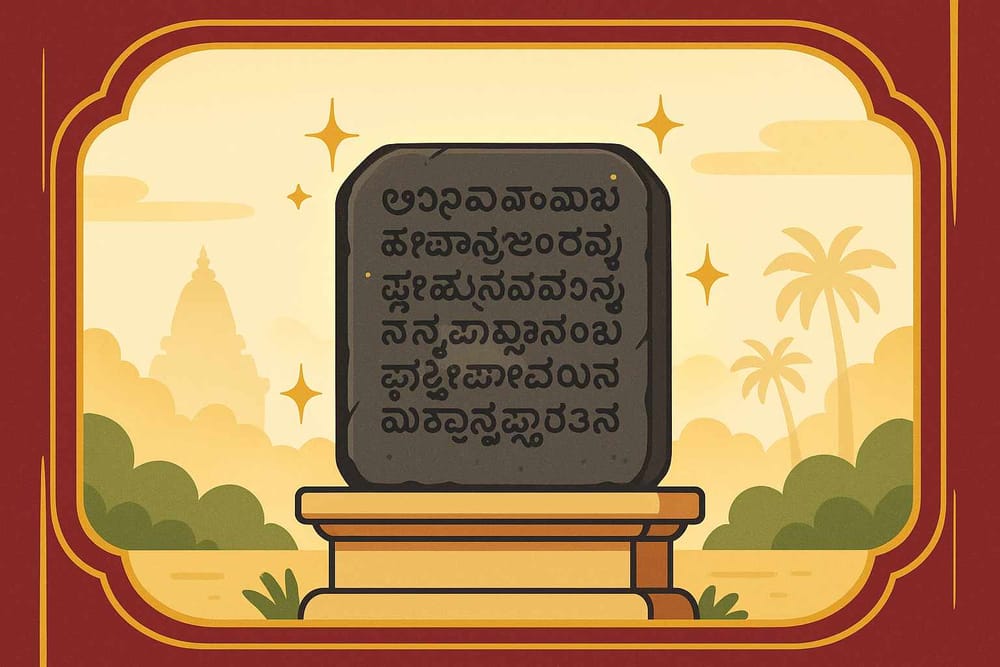
Halmidi Inscription: Explore Ancient Kannada's Origins
There are moments in history that feel like a quiet whisper from the past, a gentle reminder of where we come from. For anyone who holds the Kannada language dear to their heart, the discovery of the Halmidi inscription is one such profound moment. It’s not just an old rock with carvings; it’s the very first time our mother tongue, Kannada, was written down and immortalised, a linguistic fingerprint from around 450 CE. It feels like finding an old family album, a tangible connection to our ancestors that tells us, "We were here, and this is how we spoke."
A Discovery by Chance, A Treasure for Eternity
The story of the Halmidi inscription doesn’t begin with a grand archaeological dig. Instead, it was found quite by accident in 1936 in the small village of Halmidi in Hassan, Karnataka. It was a local resident who stumbled upon this sandstone slab, not knowing it would rewrite history. Soon, its immense value was realised by scholars like Dr. M. H. Krishna, who understood that this was the oldest complete evidence of written Kannada.
Think about it – a message carved over 1500 years ago, surviving through seasons and centuries, waiting to be found. The Archaeological Survey of India (ASI) took great care to preserve this priceless artifact. While the original stone is now safely housed in the Office of the Director of Archaeology and Museums in Mysore, a faithful replica stands in Halmidi village, ensuring that this piece of our heritage remains accessible to everyone who wishes to pay their respects to the dawn of their language.
More Than Just an Ancient Proclamation
So, what makes this 16-line inscription so incredibly important? It’s not just that it’s old. The Halmidi inscription is living proof that Kannada was the language of administration and governance during the mighty Kadamba Dynasty. Before this, many might have assumed that only Sanskrit held such an official status. This stone tells a different story. It shows a society where the local language was respected and used for important matters like recording a land grant. The inscription details the gifting of two villages to a brave warrior named Vija-Arasa, a reward for his valour.
This single act of carving a proclamation in Kannada marks a pivotal shift from an oral tradition to a written one. It gives us a peek into the world of our ancestors—their societal structures, their reverence for heroes, and their organised governance. For a deeper dive into how this ancient script evolved, you might find our article on the emergence of the Kannada script an interesting read.
The Beautiful Language of Our Forefathers
The language you see on the slab is a form of ancient Kannada, often called ‘Puruvada-Hala Kannada’ or pre-old Kannada. It’s the ancestor of the rich, poetic language spoken by millions today. The script itself is a beautiful evolution from the ancient Brahmi, which was skillfully adapted by the Kadambas to capture the unique sounds of Kannada. This wasn't just writing; it was an act of cultural assertion and innovation.
By studying the words and grammar, we can trace the journey of our language. The text begins with an invocation to Lord Vishnu, showing the deep spiritual roots of the people, before moving on to administrative details. This blend of devotion and governance is a hallmark of our ancient Indian culture.
The Kadambas: Royal Guardians of Kannada
We cannot talk about the Halmidi inscription without honouring its creators, the Kadamba dynasty. Ruling from the 4th to the 6th centuries CE, they were true visionaries. By choosing to use Kannada for official records, they gave the language a status and a platform to flourish. They understood that a kingdom’s identity is deeply tied to its language.
Their patronage was the fertile ground in which Kannada literature and culture began to formally grow. This royal support laid the foundation for future dynasties to build upon, leading to the golden age of Kannada literature. The Kadambas didn't just build temples; they built a linguistic legacy. Understanding their contribution is key to understanding the Halmidi inscription's context and its place in our history.
A Legacy That Lives On
The Halmidi inscription is more than just a historical artifact; it is the seed from which a mighty tree of literature, poetry, and identity has grown. It reminds us that our language has deep, strong roots and a history to be proud of. It connects every Kannada speaker today to that ancient warrior, Vija-Arasa, and the king who honoured him in his own mother tongue.
This spirit of preserving our heritage is what drives us at Bhaktilipi. We believe that stories, scriptures, and spiritual wisdom are timeless treasures that need to be shared in ways that resonate with us today. Just as the Kadambas used stone to preserve their legacy, we use the digital world to keep our traditions alive.
Explore Our Roots with Bhaktilipi
At Bhaktilipi.in, we are dedicated to bringing you the timeless stories and devotional literature that form the bedrock of our culture. Whether you are curious about ancient inscriptions or seeking solace in the words of saints, our platform is a space for you to connect with your spiritual roots.
Join our community and help us keep the flame of devotion and heritage burning bright. You can stay updated by subscribing to our newsletter and following us on Facebook, Instagram, and YouTube for more soul-stirring content.
A passionate group of people dedicated to preserving India's knowledge of Dharma, Karma, and Bhakti for ourselves and the world 🙏.
Comments
Related in

Halmidi Inscription: Decodes Past-Significance Reveals
Have you ever walked through an old temple or a historic site and wondered what stories the stones could tell if they could speak? In the heart of Karnataka, there is one such stone that does speak. It tells a tale from a time when a language, rich and full
Decoding the Halmidi Inscription- Ancient South India's Mysteries Explained
Imagine standing in a quiet village, the air filled with the scent of wet earth. Before you is a simple stone slab, but it's not just any stone. It’s a portal to the past. On its surface are letters carved over 1500 years ago, the very first
Halmidi Inscription Reveals Ancient Indian History
Imagine walking through a quiet little village, where life moves at its own gentle pace. You pass by an ordinary-looking stone slab, unaware that it holds a secret centuries old—a voice from the past waiting to be heard. This is the story of the Halmidi inscription, a discovery that