
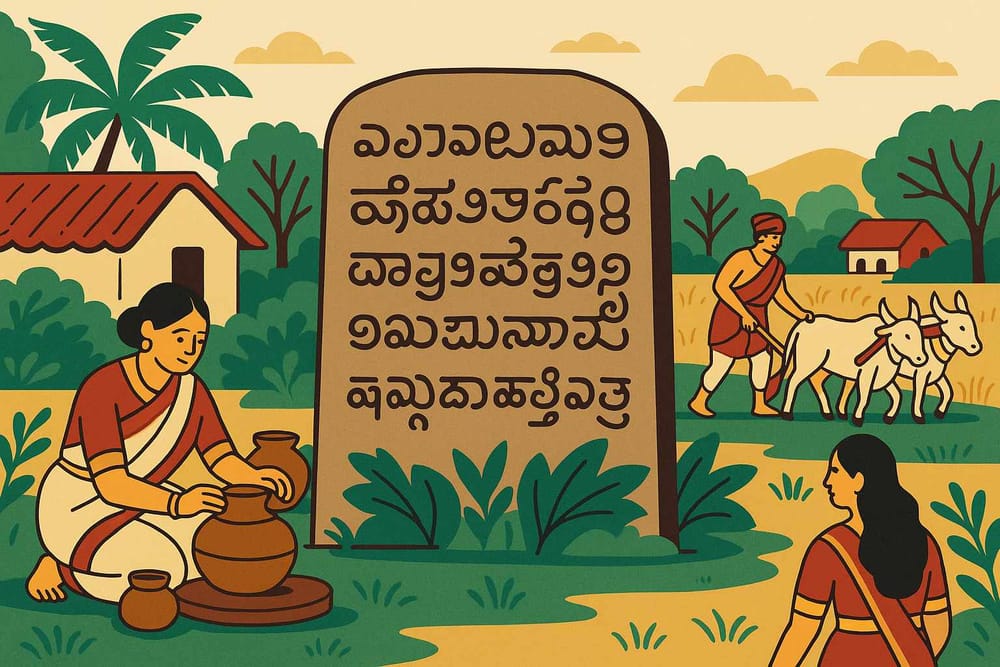
Halmidi Inscription Reveals Ancient Indian History
Imagine walking through a quiet little village, where life moves at its own gentle pace. You pass by an ordinary-looking stone slab, unaware that it holds a secret centuries old—a voice from the past waiting to be heard. This is the story of the Halmidi inscription, a discovery that felt like finding the first page of Karnataka's grand historical novel.
Found in 1936 in the unassuming village of Halmidi in Hassan district, this sandstone slab wasn't just a piece of rock. It was a time capsule. For years, it lay there, its true value hidden in plain sight. It took the keen eye of Dr. M.H. Krishna, the then Director of Archaeology for Mysore State, to recognize that this was something truly special. What he and other scholars uncovered was nothing short of monumental: the earliest known comprehensive record of the Kannada language, dating all the way back to around 450-500 CE.
A Voice from the Kadamba Era
So, what does this ancient stone tell us? It speaks of a time when the Kadamba dynasty ruled the land, a period of great cultural and linguistic change in South India. The sixteen lines carved into the stone begin with a reverent invocation to Lord Vishnu, a beautiful reminder that faith and governance have always been intertwined in our land. It’s a connection we at Bhaktilipi cherish, as we strive to bring these timeless threads of devotion into our modern lives.
The inscription is essentially a royal decree. It records a grant of two villages to a brave warrior named Vija-Arasa. This reward was for his exceptional valour in a battle against the Pallavas. The name of the great Kadamba king, Kakutsa Varma, is also mentioned, giving us a direct window into the administration of that era. It shows a society that valued courage, rewarded loyalty, and had a sophisticated system for recording important events. You can explore more about how this stone relic allows us to listen to ancient Karnataka speak through stone.
The Birth of a Written Language
The Halmidi inscription is more than just a historical record; it’s a love letter to the Kannada language itself. Before its discovery, no one knew for sure how far back the written tradition of Kannada went. This inscription provided the proof.
- A Script in Transition: The script used is a beautiful blend, a form of pre-old Kannada that uses characters similar to Brahmi. It’s like looking at a family photograph and seeing the features of both the grandparents and the children. This script is the ancestor of the modern Kannada we know and love today.
- A Shift in Culture: The language itself is a mix of early Kannada with some Sanskrit words woven in. This shows us that while Sanskrit was the language of rituals and scholarship, regional languages like Kannada were gaining prominence and becoming the language of the people and their administration. It was a proud moment when the local tongue found its official voice.
This discovery fills the heart of every Kannadiga with immense pride. It’s a testament to the deep, ancient roots of their culture and language. Just as we read these ancient words carved in stone, we can feel a connection to our ancestors. If you wish to delve deeper into this topic, you can read our article on understanding the Halmidi inscription and India's oldest Kannada script.
From a Forgotten Stone to a National Treasure
For a long time after its discovery, the inscription didn't get the widespread attention it deserved. But as scholars continued to study it, its profound importance became clear. Today, the original Halmidi inscription is carefully preserved in the Office of the Director of Archaeology and Museums in Mysore, protected as a national treasure. To ensure its legacy reaches everyone, a fibreglass replica has been installed in Halmidi village, turning this quiet place into a pilgrimage site for history lovers.
In fact, the government has recently decided to install replicas of the Halmidi Shasana in all 31 district headquarters of Karnataka. It’s a wonderful initiative to celebrate our heritage and remind us of the rich tapestry of our history.
At Bhaktilipi, we are inspired by such efforts to preserve our heritage. Our mission is to do the same in the digital world—to safeguard and share the timeless stories and devotional literature of India. We believe that understanding our past is the best way to enrich our present and future. For authentic devotional content that connects you to your roots, you can explore our platform at Bhaktilipi.in.
Frequently Asked Questions About the Halmidi Inscription
Many people are curious about this cornerstone of Kannada heritage. Let's explore some common questions.
People often ask about the true identity of the Halmidi inscription. Simply put, it is the oldest known written record in the Kannada language. It's a stone edict discovered in Halmidi village, Karnataka, that provides the first concrete evidence of Kannada being used for official purposes.
Its importance cannot be overstated. The inscription is a crucial piece of the puzzle for historians and linguists. It offers invaluable insights into the early evolution of the Kannada script and language, and it shines a light on the social and administrative systems of the Kadamba dynasty in the 5th century CE.
A common query is about the language used on the stone. The inscription is written in a form known as pre-old Kannada. It’s fascinating because it also includes some Prakrit and Sanskrit influences, showing how languages interacted and evolved during that period in ancient Indian history.
As for its current location, while a replica stands proudly in Halmidi for all to see, the original, priceless artifact is safely preserved by the state's archaeological department in Mysore. This ensures that this link to our past is protected for generations to come, reminding us of the profound stories that even a single stone can tell.
Just as this inscription preserves the voice of our ancestors, Bhaktilipi is dedicated to preserving the devotional voices that have guided our culture for centuries. Stay connected with our efforts to keep this sacred heritage alive.
You can subscribe to our newsletter for regular updates, and follow our journey on Facebook, Instagram, and YouTube. Let's cherish our past together.
A passionate group of people dedicated to preserving India's knowledge of Dharma, Karma, and Bhakti for ourselves and the world 🙏.
Comments
Related in
Halmidi Inscription: Decodes Past-Significance Reveals
Have you ever walked through an old temple or a historic site and wondered what stories the stones could tell if they could speak? In the heart of Karnataka, there is one such stone that does speak. It tells a tale from a time when a language, rich and full
Decoding the Halmidi Inscription- Ancient South India's Mysteries Explained
Imagine standing in a quiet village, the air filled with the scent of wet earth. Before you is a simple stone slab, but it's not just any stone. It’s a portal to the past. On its surface are letters carved over 1500 years ago, the very first
Halmidi Inscription- Mysteries Explained
Imagine walking through a quiet village and stumbling upon a stone that holds the first-ever written words of your mother tongue. It’s like finding a family heirloom you never knew existed, a direct message from ancestors who lived over 1500 years ago. This is exactly the feeling that the