
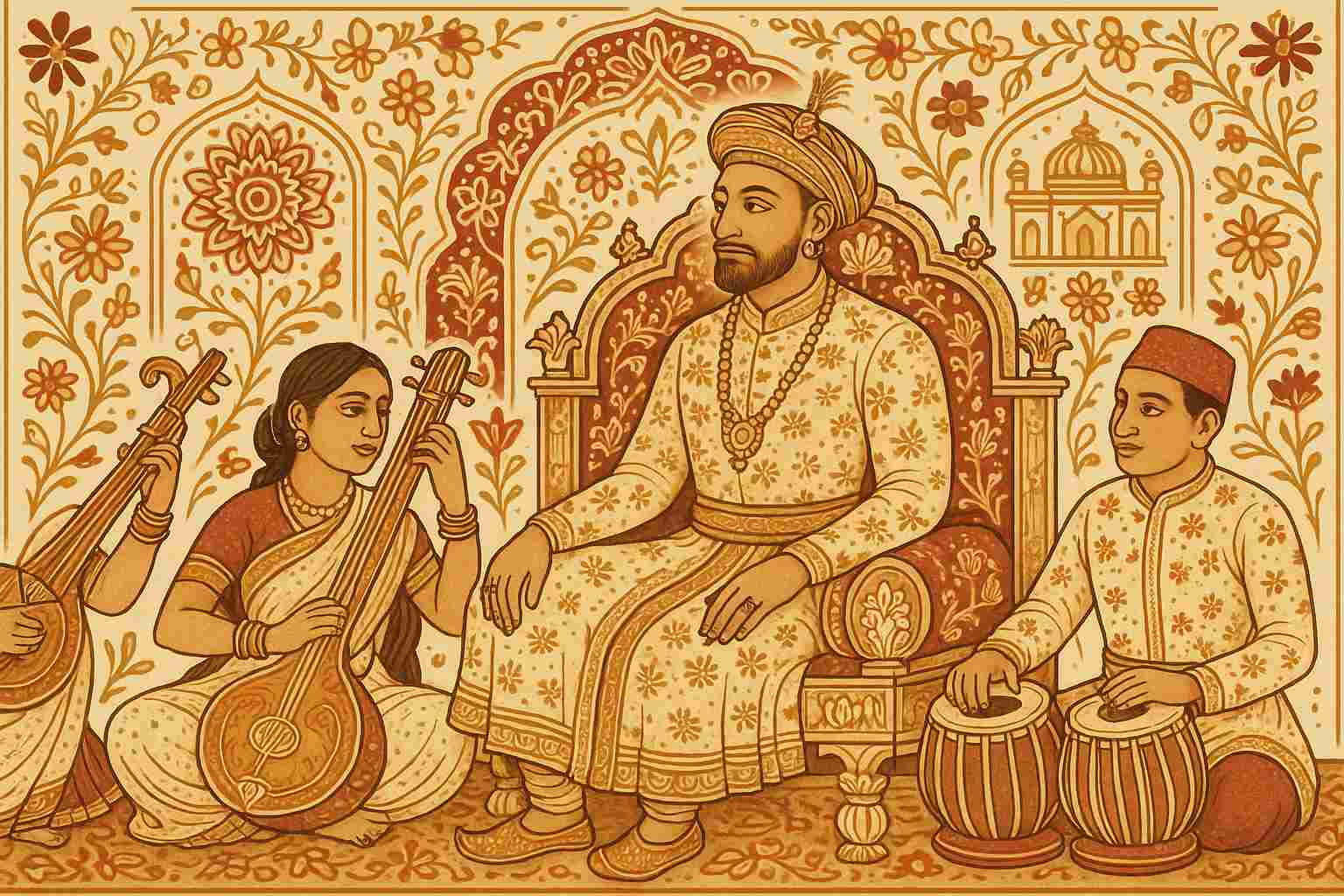
Ibrahim Adil Shah II: How He Uses Hindu Titles to Forge a Cultural Legacy
History isn't just a collection of dates and battles, is it? Sometimes, a story from centuries ago feels so vibrant, so full of heart, that it speaks directly to us today. It feels less like a lesson from a textbook and more like a tale shared by a grandparent. The reign of Ibrahim Adil Shah II of the Bijapur Sultanate is one such story—a beautiful reminder of a time when a ruler built an empire not just of land, but of shared culture and mutual respect.
The Deccan: A Melting Pot of Cultures
To truly understand this visionary king, we must first travel back to the 16th-century Deccan. This region wasn't just a piece of land; it was a thriving crossroads of ideas. Imagine a vibrant bazaar where Persian poetry mingled with local Dakhani dialects, and Turkish traditions danced with ancient Indian philosophies. The Bijapur Sultanate, born from the once-mighty Bahmani Kingdom, was at the very heart of this cultural confluence. It was into this world, rich with diversity and alive with possibility, that Ibrahim Adil Shah II came to the throne in 1580. He inherited a kingdom of many faiths and traditions, a challenge for many rulers of that era, including figures like Muzaffar Shah III in other parts of India. But for Ibrahim, this diversity was not a weakness to be managed, but a strength to be celebrated.
A Ruler with the Heart of a Bhakt
What truly set Ibrahim Adil Shah II apart was his incredible ability to see beyond the boundaries of religion. He didn't just tolerate Hinduism; he embraced its wisdom and beauty with an open heart. This wasn't a political tactic; it felt like a deep, personal conviction. He lovingly adopted the title ‘Jagadguru Badshah,’ meaning the 'Universal Preceptor' or 'Teacher of the World'. By doing so, he wasn't just a Sultan for his Muslim subjects but a guiding light for everyone in his kingdom.
His reverence for Hindu deities was profound and heartfelt. It is said that he considered the goddess of learning, Saraswati, his mother and Lord Ganapati, the remover of obstacles, his father. His magnum opus, a book of songs in the Dakhani language called Kitab-i-Nauras (The Book of Nine Rasas), beautifully captures this spirit. The book, a masterpiece exploring the Indian philosophy of aesthetic emotions (rasas), begins not with praise for a single faith, but with an invocation to Goddess Saraswati. Imagine that—a Sultan's greatest literary work starting with a prayer to a Hindu deity! He also earned the loving moniker ‘Abla Baba,’ or the 'friend of the poor,' showing that his rule was based on compassion for all.
Where Art and Unity Became One
A king's legacy is often written in stone, and in Bijapur, the stones themselves sing a song of unity. Ibrahim Adil Shah II was a magnificent patron of the arts, and his court was a haven for poets, painters, and musicians from all backgrounds. This tradition of royal patronage for arts has been a cornerstone of our culture, much like how the Maharaja shaped Karnataka's cultural landscape in later centuries.
- A Symphony of Styles: Under his reign, architectural marvels like the Ibrahim Rauza were built. These structures weren't just Islamic or Hindu; they were a breathtaking fusion. You could see elegant Islamic arches seamlessly incorporating intricate Hindu motifs, creating a unique Deccani style that was a visual representation of his inclusive philosophy.
- The Celebration of Navras: He championed the ‘Navras’ tradition, bringing together music, poetry, and dance to express the deepest human emotions. He understood that art speaks a universal language that transcends faith. He encouraged compositions in the local Deccani tongue, giving a voice to the indigenous culture alongside the more formal Persian.
His deep understanding of Sanskrit was well-known, with some scholars even suggesting he knew it better than Persian. In some of his portraits, he is even seen wearing a rudraksha necklace, a symbol deeply associated with Hindu spirituality. These weren't small gestures; they were powerful statements of his belief in a shared heritage.
This commitment to preserving and sharing timeless knowledge is something that resonates deeply with us. Just as Ibrahim Adil Shah II used his Kitab-i-Nauras to bridge cultural worlds, at Bhaktilipi, we strive to bring devotional literature and soul-stirring stories to you in a way that connects with modern life. Our collections, crafted with devotion, are a tribute to this very idea of keeping our cultural treasures alive. You can explore some of these timeless tales on the Bhaktilipi.in website.
The Enduring Echo of a Harmonious Reign
So, why is the story of Ibrahim Adil Shah II so important for us today? Because his legacy shows us that true strength lies not in division, but in unity. He proved that respecting and embracing different traditions doesn't weaken our identity; it enriches it beyond measure. While his direct rule was centered in Bijapur, the spirit of his syncretic policies resonated across the subcontinent, inspiring a vision of harmony.
Many often wonder, how did he manage to promote such profound cultural unity? He did it by appointing Hindus to high positions, by celebrating festivals like Diwali and Holi with equal enthusiasm, by funding temples, and most importantly, by leading by example. He showed everyone that it was possible to be a devout Muslim while also holding deep respect and love for Hindu philosophy and culture. His rule serves as a timeless lesson in empathy, reminding us that knowledge and compassion are the most powerful tools a leader can possess to create a lasting, positive impact on society.
Stay Connected on a Journey of Faith and Culture
If the story of Ibrahim Adil Shah II inspires you, we invite you to continue your journey of discovery with us. Explore more such devotional and cultural content by subscribing to our YouTube channel, following us on Facebook, and joining our community on Instagram. Let's keep these beautiful stories of unity and faith alive together.
A passionate group of people dedicated to preserving India's knowledge of Dharma, Karma, and Bhakti for ourselves and the world 🙏.