
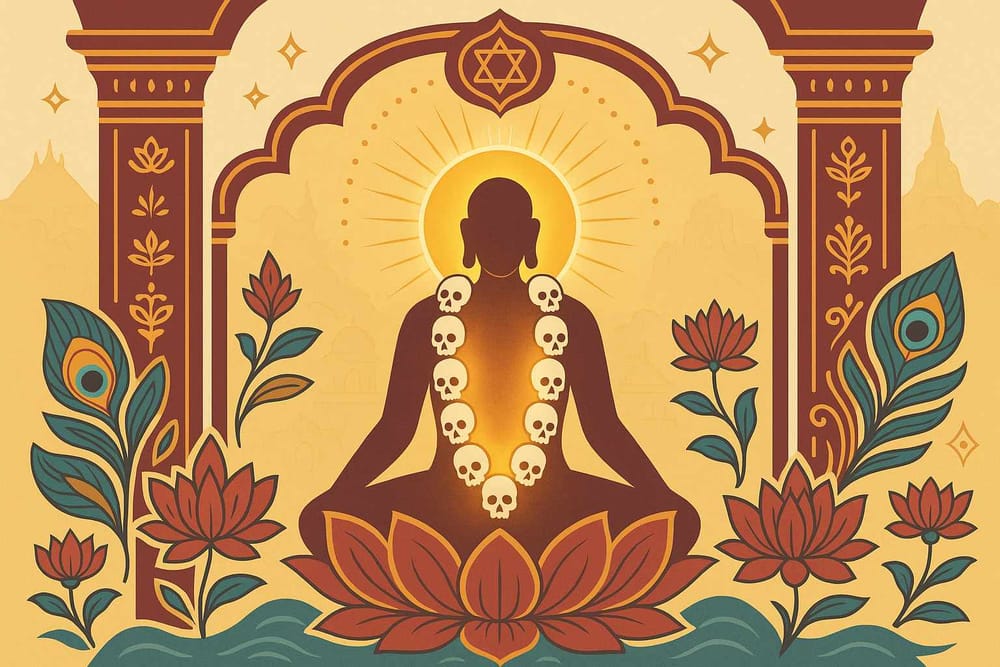
Legends of the Mundamala: Stories and Mysteries Emerge
Think for a moment about Lord Shiva, the Mahadev. We see him in deep meditation, a serene smile on his face, the crescent moon on his head, and Ganga flowing from his hair. But then our eyes travel down, and we see something startling: a garland of human skulls, the Mundamala. Or we picture Maa Kali, her tongue out, her eyes blazing with righteous fury, and around her neck, the same powerful, almost fearsome, ornament. It’s an image that can be unsettling, but like many things in our Sanatana Dharma, it holds a universe of meaning far beyond what we see at first glance.
This isn't just a grim accessory. The Mundamala, or Kapalamala, is a profound story woven with love, sacrifice, the cycle of life and death, and the ultimate truth of reality. It’s a story that speaks directly to the soul, and today, let's sit together and try to understand its whispers.
The Greatest Love Story Ever Told: Shiva, Sati, and the 108 Skulls
One of the most heart-touching stories behind the Mundamala is deeply connected to Shiva and his beloved consort, Sati. It is said that the garland Shiva wears contains 108 skulls. When a curious Mata Parvati (Sati's reincarnation) asked him about it, Shiva revealed a secret that was both beautiful and tragic. He explained that each skull belonged to her, from her 107 previous births.
In each of those lives, she was born, she loved Shiva, and she passed away, while he, being immortal, remained. He gathered each head after her mortal body perished and added it to his garland as a memento of their eternal love. He wears it as a constant reminder of their bond that transcends time and mortality itself. The 108th skull is missing because, in her current life as Parvati, she finally attained immortality after learning the Amarkatha, the secret of eternal life. So, far from being a symbol of death, Shiva's Mundamala is a testament to undying love and remembrance.
Maa Kali's Fierce Protection: The Garland of Vanquished Evil
When we see the Mundamala around Maa Kali's neck, the story takes a different, but equally powerful, turn. Here, the garland is a symbol of her role as the divine protector. Legend says that the skulls are those of demons she vanquished to save the worlds from their terror. Each skull is a trophy, a stark reminder of the inevitable victory of dharma over adharma.
It shows that Maa Kali, the divine mother, will go to any lengths to protect her children. Her form might be fierce, but her heart is filled with infinite compassion. The Mundamala she wears isn't about celebrating death; it's about celebrating the death of evil, ignorance, and ego, clearing the path for justice and peace.
Beyond the Stories: Unpacking the Deep Symbolism
The Mundamala is a powerful spiritual tool, especially in Tantra, and each element carries deep philosophical weight. It’s a sermon without words, teaching us some of life's most profound lessons.
- Victory Over Death and Time: Shiva is also known as Mahakaal, the master of time and death. By wearing the Mundamala, he shows us that he is beyond the cycle of birth and death that governs all mortal beings. He embraces what we fear most, showing us that true liberation comes from accepting impermanence.
- The Ultimate Renunciation (Vairagya): For an ascetic like Shiva, the Mundamala is the ultimate symbol of detachment. It signifies the renunciation of the ego (the "I" or "Ahamkara"), which is the source of all our worldly attachments and suffering. It's a call to look beyond our fleeting material existence towards a higher spiritual reality.
- The Sounds of Creation: Some ancient texts suggest that the 50 or 52 skulls in certain depictions of the Mundamala represent the letters of the Sanskrit alphabet (Varnamala). In this context, Shiva or Kali becomes the source of all sound, language, and creation itself, the origin of every mantra and every vibration in the cosmos.
The Mundamala in History and Ritual
This powerful symbol isn't confined to mythology alone. Its presence is felt in our history and living traditions. Imagine the fierce Rajput warriors of old, whose stories of bravery echo through the ages. Before heading into a life-or-death battle, they would seek the blessings of deities like Maa Kali. The image of her, adorned with the Mundamala, was not a source of fear but of immense strength and courage. It reminded them that they were fighting for a cause greater than themselves. These tales of divine courage are similar to the legends of Mewar, where faith and fortitude built kingdoms.
Even today, in tantric practices and certain Kali Puja rituals, the Mundamala is used symbolically to invoke divine energy and overcome inner demons. Understanding these deep-rooted symbols helps us connect with our own lineage and heritage, much like how exploring our Gotras reveals the mysteries of our ancestry. At Bhaktilipi, we believe that these stories are the threads that weave our cultural fabric together.
If you find solace and inspiration in these timeless tales, we invite you to explore more such stories on Bhaktilipi.in. Our collection of devotional literature is thoughtfully curated to bring you closer to your spiritual roots with authenticity and heart.
FAQs on the Legends of the Mundamala
What does the Mundamala truly mean?
Mundamala literally means "garland of skulls." But its true meaning is far deeper. It is a powerful symbol in our culture representing the cyclical nature of life and death, the victory of good over evil, ultimate renunciation, and even the eternal nature of love. It reminds us that to truly live, we must transcend our fear of death and ego.
Why is the Mundamala so important in our myths?
In our mythology, the Mundamala is worn by some of the most powerful deities, like Lord Shiva and Maa Kali. It serves as a visual representation of their core nature. For Shiva, it signifies his mastery over death and his detachment as the supreme ascetic. For Kali, it represents her fierce power to destroy evil and protect the innocent.
Is there one single story behind the garland of skulls?
No, and that is the beauty of our traditions! There are multiple stories and interpretations. The most popular one is of Shiva wearing the 108 skulls of Sati's past lives as a symbol of their eternal love. Another powerful narrative is of Maa Kali wearing the skulls of demons she has slain. Both stories, while different, teach us profound truths about life, love, and righteousness.
How does the Mundamala connect to ancient battles?
In many historical and mythological accounts, warriors would invoke fierce deities before a "Ghat Yudh" or a decisive, intense battle. The Mundamala, worn by these deities, symbolized ultimate power and the destruction of enemies. It was a source of inspiration, assuring warriors that they were fighting on the side of dharma.
Embracing the Legacy of the Mundamala
The Mundamala is so much more than a garland of skulls. It is a profound symbol of transformation, courage, and spiritual liberation. Its stories, steeped in mythology and philosophy, encourage us to look within and confront our own fears and attachments. It teaches us that true strength lies not in avoiding endings, but in understanding their place in the great, divine cycle.
By understanding its mysteries, we connect not just with our rich heritage, but with the timeless values that guide us toward a life of purpose and inner peace. It is a reminder that in every end, there is a new beginning.
Stay connected with these timeless traditions. For more stories that nourish the soul, subscribe to our newsletter and follow us on Facebook, Instagram, and YouTube. Join the Bhaktilipi family and continue your journey into the heart of devotion.
A passionate group of people dedicated to preserving India's knowledge of Dharma, Karma, and Bhakti for ourselves and the world 🙏.