
Lion Capital of Ashoka- Symbolism Endures
Have you ever paused while looking at an Indian currency note, or glanced at your passport, and truly seen the emblem there? That majestic sculpture of four lions standing back-to-back – the Lion Capital of Ashoka, or the Ashoka Stambh as we fondly call it. It's so familiar, yet how many of us know the powerful story it tells? This isn't just a symbol of government authority; it's a piece of our collective soul, a timeless echo from our glorious past that speaks directly to our present and future.
It's a story of a mighty emperor's transformation, of profound spiritual awakening, and of a vision for a nation built on truth and righteousness. Let's journey back in time together and uncover the deep meaning behind this incredible symbol of India's heritage.
A King's Change of Heart: The Story Behind the Pillar
The story of the Lion Capital begins with a story of profound change. In the 3rd century BCE, Emperor Ashoka of the Maurya dynasty was a formidable ruler, a conqueror who expanded his empire relentlessly. But the brutal Kalinga War, with its immense bloodshed, shook him to his core. It sparked a spiritual crisis that led him to embrace Buddhism and its path of non-violence (Ahimsa) and moral duty (Dharma).
From a fierce warrior, Ashoka transformed into a messenger of peace. He wanted to spread this message far and wide across his kingdom. So, he erected magnificent stone pillars in various places, inscribing them with his edicts of peace, morality, and justice. The most famous of these pillars was placed at Sarnath, the sacred ground where Gautama Buddha himself delivered his very first sermon after attaining enlightenment. Atop this pillar, he placed the Lion Capital – a masterpiece of art and a powerful declaration of his newfound principles. Rediscovered in 1905, this treasure is now safely housed at the Sarnath Museum, but its spirit continues to guide our nation.
Decoding the Sacred Symbolism: Every Detail Tells a Story
The Lion Capital is a masterclass in symbolism, where every single element is packed with deep meaning. It's a sculpture that needs to be read, not just seen.
The Four Majestic Lions
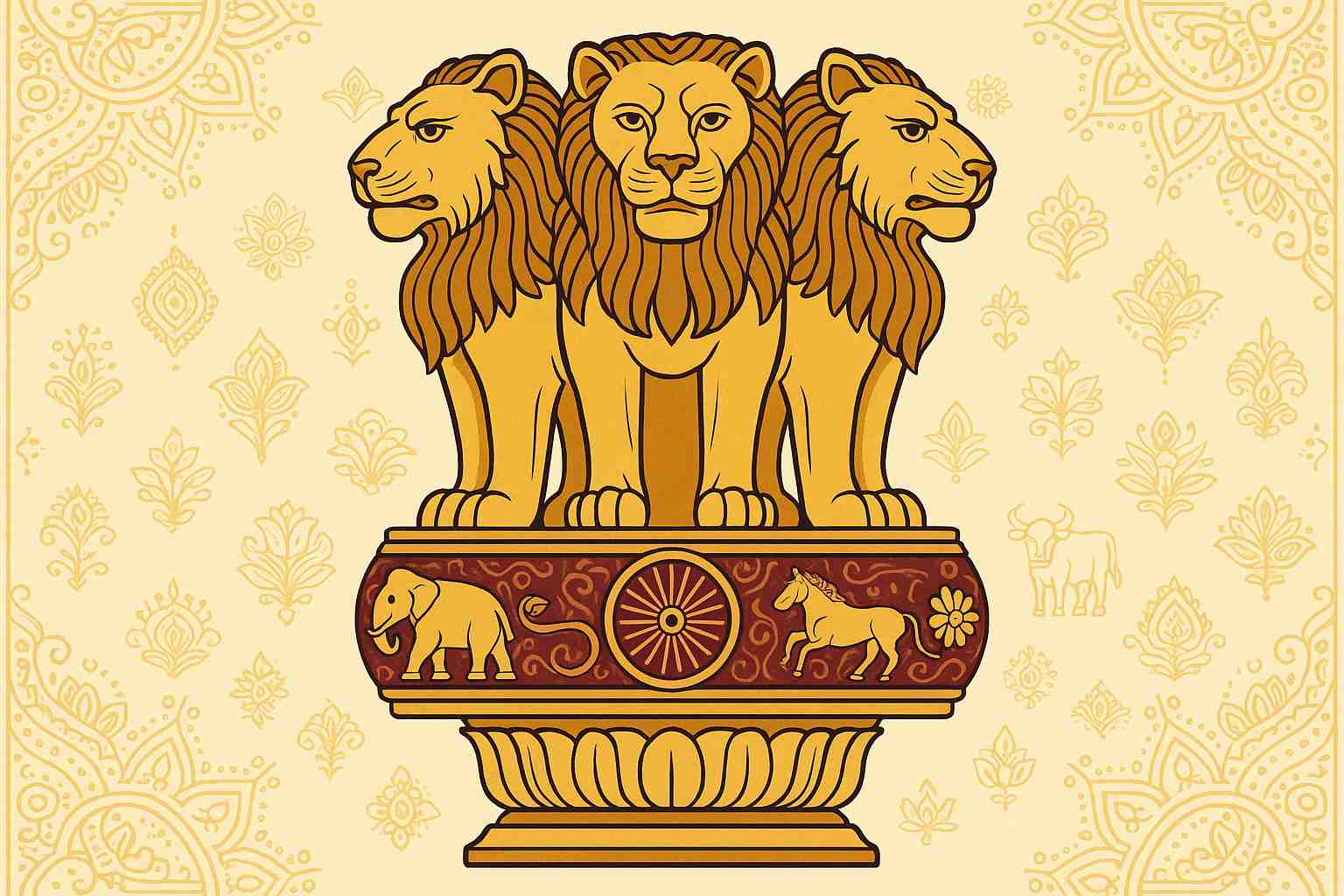
The most striking feature is, of course, the four Asiatic lions, standing proudly, facing the four cardinal directions. These lions are not just symbols of power, courage, and royalty, representing Emperor Ashoka's own authority. They are also deeply connected to the Buddha, who was known as 'Shakyamuni' (Sage of the Shakya clan) and 'Shakyasimha' (Lion of the Shakya clan). Their open mouths aren't roaring in aggression but are believed to be spreading the message of Dharma—the Four Noble Truths—to every corner of the world. They represent the peaceful proclamation of truth and righteousness for all to hear.
The Wheel of Dharma (Dharma Chakra)
Below the lions sits the Abacus or the base, which features a central wheel known as the Dharma Chakra. This isn't just any wheel; it's the "Wheel of Law." It symbolizes the eternal, universal moral law that governs all of existence. It represents movement, progress, and the nation's readiness to embrace the future with an open mind, all while being guided by righteous principles. For a deeper dive into its intricate meanings, you can explore the detailed symbolism of the Lion Capital of Ashoka and its various elements.
The Guardians on the Abacus
The circular base is adorned with the carvings of four other animals, each a powerful symbol in its own right:
- The Horse: Facing the west, the horse represents energy, loyalty, and speed. In Buddhist tradition, it can also symbolize Kanthaka, the horse that Buddha rode when he left his princely life behind in search of enlightenment.
- The Bull: Facing the east, the bull stands for strength, hard work, and determination. It is associated with the zodiac sign of Taurus, the month of Buddha's birth, making it a very auspicious symbol.
- The Elephant: Facing the south, the elephant is a symbol of wisdom, royalty, and mental strength. It is said to represent the dream Queen Maya had before giving birth to Prince Siddhartha, where a white elephant entered her womb.
- The Lion: Facing the north, the lion symbolizes courage and the attainment of enlightenment itself. The intricate symbolism of these animals truly showcases the depth of thought that went into this creation, and you can learn more about how each symbol tells a part of a larger story.
The Inverted Lotus Bell
The entire structure rests on an inverted lotus bell. The lotus is a profound symbol in Indian culture and spirituality. It grows in muddy water but blossoms beautifully above it, untouched by the grime. It represents purity, spiritual awakening, and the ability to rise above worldly troubles to achieve enlightenment.
From Ancient Edict to Modern India's Identity
When India gained independence in 1947, our founding fathers sought a symbol that would capture the spirit of our ancient civilization and our aspirations for a modern, democratic republic. On 26th January 1950, the Lion Capital of Ashoka was officially adopted as the National Emblem of India. It was a perfect choice. The four lions looking in all directions symbolize a nation that is vigilant, just, and equal for all its citizens.
Beneath the emblem, the words 'Satyameva Jayate' (सत्यमेव जयते) are inscribed. This powerful motto, taken from the sacred Mundaka Upanishad, means "Truth Alone Triumphs." It is a constant, humbling reminder that for our nation, the path of truth is the ultimate path to victory and governance.
Today, the Lion Capital stands as a bridge connecting our glorious past with our dynamic future. It reminds every Indian of our legacy of unity, peace, courage, and moral strength. It is a symbol that fills our hearts with pride and inspires us to uphold the timeless values it represents.
At Bhaktilipi, we are passionate about sharing these timeless stories and the profound wisdom embedded in our cultural symbols. We believe that understanding our traditions enriches our lives, connecting us to the very essence of Bhakti and our heritage. Our platform is a dedicated space for preserving and reimagining this devotional literature for today's world.
To explore more such insightful stories, hymns, and spiritual wisdom, we invite you to visit Bhaktilipi.in. Let's cherish and preserve our traditions together!
A passionate group of people dedicated to preserving India's knowledge of Dharma, Karma, and Bhakti for ourselves and the world 🙏.
Comments
Related in
Lion Capital of Ashoka-India's Heritage Explained
Have you ever held a coin in your hand or looked at your passport and truly seen the four lions seated majestically back-to-back? It’s a sight so familiar to us Indians, a part of our daily lives. But this isn't just a design; it's a
The Historical Significance of the Lion Capital of Ashoka: Understand its Enduring Legacy
There are some symbols that are etched into the very soul of a nation. For us in India, the Lion Capital of Ashoka is one such powerful emblem. We see it on our currency notes, on our passports, and on every official government letterhead. But have you ever paused to
The Significance of the Lion Capital of Ashoka: Explores Indian History
Have you ever paused for a moment, holding a currency note or looking at your passport, and truly looked at the four lions standing so majestically? That symbol, the Lion Capital of Ashoka, is something we see almost every day. But how often do we think about its story? It’