

Minor Rock Edicts: Ancient Inscriptions Reveal Significance
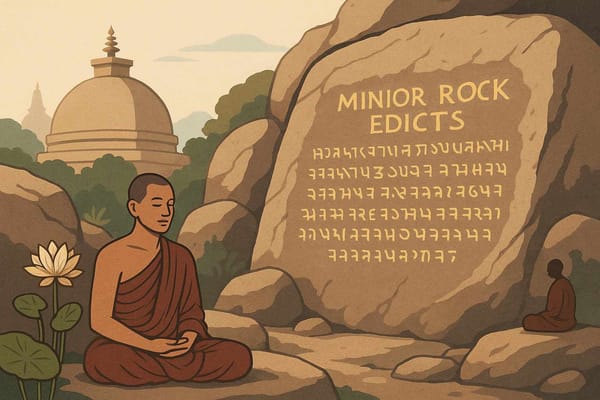
Imagine wandering through the rugged landscapes of India, and your eyes fall upon a rock. Not just any rock, but one that has been carrying a message for over two thousand years. A message carved not for kings or scholars, but for everyday people like you and me. This isn't a scene from a movie; it is the living legacy of Samrat Ashoka and his remarkable Minor Rock Edicts.
These aren't grand announcements of victory or complex legal codes. Instead, they are quiet, heartfelt conversations etched in stone. They reveal the profound inner transformation of a mighty emperor who, after the heart-wrenching Kalinga War, chose the path of Dharma over dominance. These inscriptions are a window into his soul, offering lessons in morality and compassion that feel just as relevant today as they did in the 3rd century BCE.
A Message Straight from the Heart of a King
What makes these edicts so special is their beautiful simplicity and personal touch. Ashoka wanted to speak directly to his subjects, his *praja*. To do this, he didn't use the scholarly Sanskrit of the court. Instead, he chose Prakrit, the language of the common people, and had it written in the elegant Brahmi script. It was a revolutionary act of communication, ensuring that his message of ethical living reached every corner of his vast Mauryan Empire.
In these inscriptions, Ashoka doesn't present himself as a distant, all-powerful ruler. He often refers to himself as a humble "lay disciple" (*upasaka*) of the Buddha. This wasn't about enforcing a religion; it was about sharing a way of life. He spoke of kindness to all living beings, respect for elders, truthfulness, and gentle behaviour. It was his vision for a society bound not by fear, but by love and mutual respect.
The Pillars of Dharma: More Than Just Rules
The core of Ashoka's messages revolves around his deep commitment to Dharma. But his idea of Dharma wasn't just about religious rituals. It was about a moral code for humanity.
- Ahimsa (Non-violence): After witnessing the devastation of war, Ashoka's heart changed forever. His edicts are a powerful call for non-violence, urging his people to abandon cruelty towards both humans and animals. This principle became the very foundation of his governance.
- Compassion and Welfare: The edicts talk about planting trees along roads for shade, digging wells for travellers, and providing medical care for all. This shows a ruler deeply concerned with the well-being of his people, treating them like his own children. It was a governance rooted in empathy.
- Respect and Harmony: Ashoka encouraged respect for parents, teachers, and elders. He also promoted harmony between different religious sects, asking people to honour not just their own faith, but the faiths of others as well. It’s a timeless lesson in tolerance and unity.
These ancient teachings on stone are a critical part of our heritage. Understanding their true significance helps us connect with the profound philosophies that shaped ancient India.
Uncovering History, One Inscription at a Time
For a long time, historians knew of a great king called 'Devanampiya' (Beloved of the Gods) from ancient texts and inscriptions. But who was he? The mystery was finally solved when archaeologists discovered edicts at sites like Maski in Karnataka and Gujarra in Madhya Pradesh. In these inscriptions, the king was named: 'Devanampiya Ashoka'. It was a moment that sent ripples through our understanding of Indian history!
These discoveries are not just a thing of the past; even recently, a new Minor Rock Edict was found in Bihar, reminding us that our land still holds many secrets. Each inscription, whether it's one of Ashoka's edicts or another historical carving like the famous Halmidi Inscription, acts as a precious piece of a puzzle, helping us build a clearer picture of our rich and complex past.
At Bhaktilipi, we believe that preserving and sharing this ancient wisdom is our sacred duty. The stories, philosophies, and devotional treasures of our land deserve to be cherished and made accessible for generations to come. We are a digital space dedicated to bringing you the timeless literature that has inspired millions, ensuring these cultural flames continue to burn brightly.
If you feel a connection to this heritage, we invite you to explore our world. Follow us on Facebook, Instagram, or YouTube, and join our community in celebrating the profound spiritual and cultural legacy of India.
Answering Your Curiosities about Ashoka's Stone Sermons
Many people have questions about these fascinating relics of our past. Let's explore some of the common curiosities.
So, what exactly are these Minor Rock Edicts?
Think of them as public announcements of morality from Emperor Ashoka, carved onto large rocks and boulders for everyone to see. Unlike his Major Rock Edicts which dealt with administration, these shorter inscriptions are more personal, focusing on promoting good values, non-violence, and the general welfare of his people.
Who was the great king behind these messages?
These timeless messages were inscribed by Emperor Ashoka of the Mauryan Dynasty, one of the most revered rulers in Indian history. He created them after his profound spiritual awakening following the Kalinga war, dedicating the rest of his reign to spreading Dharma.
Why do these ancient carvings hold so much importance today?
Their historical significance is immense. They offer direct, first-hand insight into Ashoka’s philosophy, his governance, and the cultural values of his time. They are crucial evidence of the spread of Buddhist thought and Ashoka's sincere efforts to create a just and ethical society.
Where can one feel the presence of these edicts in India?
These precious inscriptions are scattered across India, often found near ancient trade routes or on prominent hillsides. You can find them in states like Karnataka, Madhya Pradesh, Bihar, Gujarat, and Andhra Pradesh, each one a silent witness to our history.
What language did Ashoka use to speak to his people?
To ensure his message was understood by all, Ashoka used Prakrit, the common language of the people, rather than the elite Sanskrit. The script used was primarily Brahmi, the mother of many modern Indian scripts.
How do these inscriptions reflect Ashoka's contribution to our history?
They beautifully capture his journey from a fierce conqueror to a benevolent, compassionate ruler. They showcase his lifelong commitment to peace, welfare, and ethical governance, leaving a legacy of enlightened leadership that continues to inspire India.
A Legacy That Endures
The Minor Rock Edicts of Emperor Ashoka are more than just archaeological artifacts; they are enduring lessons in humanity. These whispers in stone have survived centuries, carrying a message of compassion, tolerance, and peace. By taking the time to understand their meaning, we don't just learn about our history; we connect with the very soul of our heritage.
They remind us that true greatness lies not in power, but in kindness. As we walk forward into the future, let's carry these ancient lessons in our hearts, strengthening our cultural roots and building a more harmonious world, just as Ashoka envisioned.
A passionate group of people dedicated to preserving India's knowledge of Dharma, Karma, and Bhakti for ourselves and the world 🙏.
Comments
Related in
Minor Rock Edicts in Ancient History- Their True Significance
Imagine journeying through the serene landscapes of India, perhaps in Karnataka or Madhya Pradesh, and coming across an ancient boulder. It looks ordinary at first, but as you get closer, you see faint carvings—a script you don't recognise, yet you can feel its immense age. This isn&