Symbols and Rituals Define Navayana Buddhism
In the vast spiritual landscape of India, every now and then, a path emerges that doesn't just guide the soul but also challenges the world around it. This is the story of Navayana Buddhism, a path carved out by the great Dr. B.R. Ambedkar. It’s not just another "school" of thought; it was born from a deep-seated need for social justice, a powerful response to centuries of inequality. It’s a call to see the Buddha's teachings not just as a way to personal enlightenment, but as a blueprint for creating a society based on equality, liberty, and fraternity.
Many of us think of Buddhism and picture serene monks and elaborate rituals. But Navayana, or the "New Vehicle," asks us to look deeper. It consciously moves away from complex ceremonies, which Dr. Ambedkar saw as potential distractions, and instead focuses on the core message: transforming oneself to transform society.
Symbols That Speak Volumes: The Visual Language of Navayana
While Navayana simplifies rituals, it embraces symbols that carry immense power and meaning. These aren't just decorative elements; they are constant reminders of the path's core values, a visual language of revolution and hope.
The Dhamma Chakra Reimagined
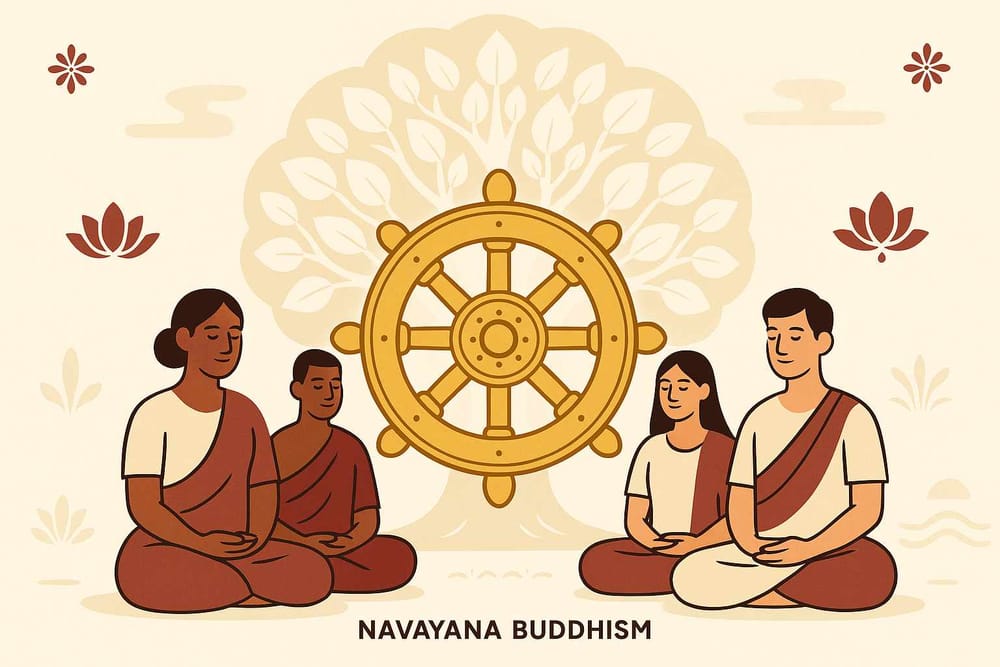
The Wheel of Dharma, or the Dhamma Chakra, is a symbol every Indian recognizes from our national flag. In Navayana, this ancient emblem is given a profound new life. It’s not just about a spiritual cycle; it represents a forward-moving wheel of social righteousness and progress. Dr. Ambedkar’s interpretation often highlights eight spokes for the Noble Eightfold Path, with a crucial ninth spoke at the center symbolising the principle of equality that holds everything together. It’s a powerful message: without justice and equality, the wheel of dharma cannot turn correctly.
The Buddha in Action: A Standing Inspiration
Think of a Buddha statue. Most of us imagine a calm, seated figure, deep in meditation. Navayana often prefers a different image: the Buddha in a standing pose. This isn’t a small detail. It symbolises a Buddha who is active, engaged with the world, and ready for change. He is not detached from society’s problems but is walking among the people, teaching, and inspiring action. This depiction perfectly captures the proactive, socially-engaged spirit of Navayana.
The Power of Blue: A Sky of Equality
The colour blue is deeply intertwined with the Ambedkarite movement and Navayana Buddhism. You’ll see it on flags waving proudly at gatherings and ceremonies. Blue represents the sky—vast, endless, and covering everyone without discrimination. For communities that have long been marginalised, this colour has become a symbol of their struggle for dignity, their unity, and their rightful place under the sun. The blue flag with the Dhamma Chakra at its center is a powerful declaration of identity and justice.
A Path of Action, Not Just Old Rituals
So, if Navayana steps away from traditional rites and ceremonies, what takes their place? The answer lies in practices that build character, foster community, and drive social change. The focus shifts from pleasing deities to empowering human beings.
This is a significant departure from many traditions that involve intricate ceremonies. While many paths have detailed rituals for every life event, as explored in practices like Dashakarma across India, Navayana charts a different course. Its "rituals" are acts of conscious living and commitment.
- The 22 Vows: A Sacred Promise
Perhaps the most important ceremony in Navayana is the one that Dr. Ambedkar himself initiated at the historic Dhammachakra Pravartan Din in Nagpur. Followers take 22 powerful vows. These aren’t just simple promises; they are a social contract to break from the chains of caste hierarchy and superstition, and to embrace a life guided by reason, equality, and compassion. Reciting these vows is a daily reminder of one's commitment to self-dignity and social reform. - Meditation and Study: The Inner Work
Instead of elaborate chanting, the emphasis is on quiet contemplation and the deep study of the Buddha’s teachings. The goal is to understand the principles of mindfulness and compassion and apply them to everyday life. This isn't about escaping the world; it's about gaining the inner clarity and strength needed to face and change the world. It’s a personal journey of self-improvement for the sake of collective well-being. - Social Engagement as Spiritual Duty
This is where Navayana truly stands apart. The highest form of spiritual practice is seen as social activism and striving for justice. To fight for the rights of the oppressed, to educate one's community, and to work towards dismantling inequality—these are considered the truest expressions of faith. True spiritual growth is seen as inseparable from creating a just and humane society for all.
A Faith for Modern India: Bringing It All Together
Navayana Buddhism is a living, breathing testament to the idea that spirituality can and must evolve. It shows us that faith doesn't have to be confined to ancient texts and temples; it can be a powerful force for social transformation in the here and now. It redefines devotion as a commitment to human dignity and makes the path to enlightenment a collective journey towards a more just and compassionate world.
Just as Navayana offers a fresh, empowering perspective on an ancient path, we at Bhaktilipi are dedicated to making timeless wisdom accessible for today's world. We believe that understanding different spiritual traditions enriches our own journey.
Bhaktilipi is your space to explore and connect with timeless devotional literature. We bring sacred texts, hymns, and stories in original languages and translations, making them accessible for today’s readers. Our platform values tradition while embracing modern design to enhance your spiritual journey. We believe devotion is universal, so our content is inclusive, visually appealing, and thoughtfully curated to inspire and enrich your life with knowledge that heals, empowers, and guides.
Stay connected with us for more stories and reflections that bridge the past with the present. Follow our journey on social media:
Start your journey toward understanding devotion and tradition—one story at a time.
A passionate group of people dedicated to preserving India's knowledge of Dharma, Karma, and Bhakti for ourselves and the world 🙏.
Comments
Related in
Exploring the Navayana - Buddhism's Modern Path
In our hearts, many of us carry a quiet longing—a desire for a spiritual path that doesn’t ask us to leave our minds at the door. We seek a faith that speaks not only of inner peace but also of justice and dignity in the world around us.
Navayana Buddhism- Explores a New Perspective
In the vast tapestry of Indian spirituality, faith is often a legacy we inherit, a path our ancestors walked. But sometimes, faith becomes a choice—a powerful, conscious decision to forge a new path. It becomes a statement, a revolution. This is the story of Navayana Buddhism, the "New
Exploring Spiritual Heritage-Navayana and Iconic Temples in Faridabad
Sometimes, we think we know a city. We see the tall buildings, the busy roads, the rush of daily life, and we assume that’s the whole story. I used to think of Faridabad that way – a bustling industrial hub, a close cousin to Delhi. But beneath this modern surface,