
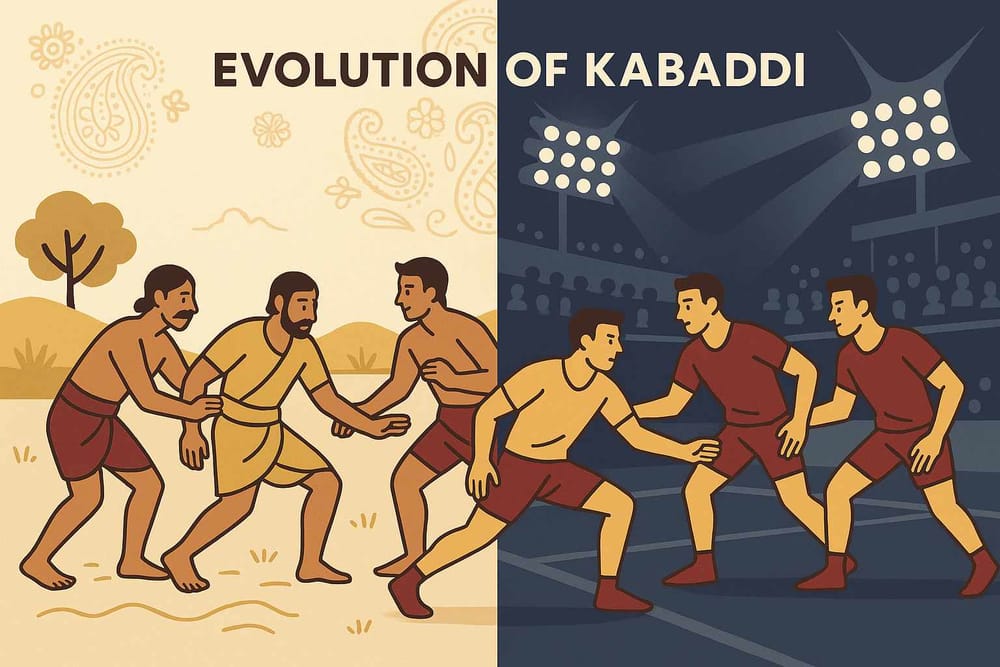
The Evolution of Kabaddi- Traces Ancient Roots, Defines Modern Sport
Imagine the feel of cool earth under your feet, the air thick with anticipation, and a single, rhythmic chant cutting through the evening quiet: “Kabaddi, Kabaddi, Kabaddi…” This is more than just a sound; it’s the heartbeat of a sport that flows in the veins of India. Kabaddi is not merely a game of tag and tackle; it’s a story of our strength, a testament to our unity, and a beautiful tradition passed down through generations. It’s a dance of power and strategy that began in our ancient villages and has now captured the world's imagination.
The Echoes of History: Where Kabaddi Was Born
A Legacy Woven into Ancient India
To truly understand Kabaddi, we must travel back in time, almost 4,000 years ago. Its story is so old that it finds mentions in our sacred texts. Many believe its roots are connected to the epic Mahabharata, where the strategic prowess of young Abhimanyu, navigating the chakravyuh, mirrors the tactical genius of a modern-day raider. It wasn't just a sport; it was a way of life, a training for self-defence and survival. Buddhist texts also speak of monks playing a similar game to keep their minds sharp and bodies strong. Legends even say that Lord Krishna himself played a form of Kabaddi in his youth!
The name "Kabaddi" itself is believed to have come from the Tamil words "kai" (hand) and "pidi" (to catch), hinting at its deep South Indian roots. But the game wore different names and colours across our diverse land. In Maharashtra, it was affectionately called "Hu-Tu-Tu," while in Punjab, its name was "Kauddi." Each region gave it a unique flavour, but the spirit remained the same – a celebration of courage, community, and raw physical strength.
More Than a Game: Kabaddi as a Symbol of Our Heritage
The Heartbeat of Rural Communities
Kabaddi truly represents the soul of rural India. It teaches us about endurance, teamwork, and the importance of a sharp mind—values that are central to our culture. It was never just a man's game either; women participated with equal fire, breaking barriers and showing that strength knows no gender. The game was a centrepiece of village festivals, a time when communities would come together, cheer for their teams, and build bonds that lasted a lifetime.
During our struggle for independence, Kabaddi became a metaphor for unity and resilience. It symbolised how a united group could overcome a powerful opponent through strategy and collective effort. This beautiful sport was woven into our folklore, our ceremonies, and our very identity, reminding us of who we are and the strength we hold when we stand together.
The Great Leap: Kabaddi's Modern Avatar
From Local Pastime to a Global Spectacle
For centuries, Kabaddi was a game of the soil. But the 20th century saw its incredible transformation. The first official rules were drafted in Maharashtra around 1921, and by 1950, the All India Kabaddi Federation was formed to give the sport a standardized structure. A huge moment came in 1936 when Kabaddi was showcased at the Berlin Olympics, giving the world a first glimpse of its magic. Its official entry into the Asian Games in 1990 cemented its place on the international stage.
But the real game-changer was the arrival of the Pro Kabaddi League (PKL) in 2014. Suddenly, our beloved village sport was on primetime television, with flashy mats, player auctions, and superstars. The 30-second raid rule replaced the traditional continuous chanting, making the game faster and more thrilling for modern audiences. This revolution didn't just bring glamour; it brought new respect and opportunities for the players, turning them into household names. To learn more about how Kabaddi has grown over the years, you can explore the complete history and origins of Kabaddi in India.
The Art and Soul of the Game
Mastering Strategy and Strength
Kabaddi looks simple, but it's a masterclass in strategy. It’s a constant tug-of-war between the raider and the defenders.
- The Raider's Quest: The raider is like a lone warrior entering enemy territory. Their goal is to touch as many defenders as possible and return to their side, all within 30 seconds. This requires not just speed and agility, but also incredible breath control and a sharp, calculating mind to spot a weak link in the defence.
- The Defender's Wall: The defenders must work as one solid unit. They form a chain, communicating with just hand gestures and eye contact, ready to pounce on the raider. A successful tackle isn't about individual strength; it’s about perfect timing and coordinated teamwork, a beautiful display of unity.
Modern training has blended age-old discipline with sports science. Players now undergo rigorous fitness routines and mental conditioning to stay at the top of their game. The evolution of these strategies is fascinating, and understanding these trends can show us where the game is headed by 2025.
A Legacy That Breathes On
From the dusty fields of ancient India to the bright lights of global stadiums, Kabaddi’s journey is nothing short of inspiring. It shows us that traditions can not only survive but thrive in the modern world. It carries the essence of our culture—resilience, community, and an unyielding spirit.
This powerful connection to our roots is something we cherish deeply at Bhaktilipi. We believe that, like Kabaddi, our ancient stories and devotional literature are timeless treasures that connect us to our heritage. They offer wisdom, peace, and a sense of belonging in today’s fast-paced world.
If you feel a connection to the stories that shape our culture, we invite you to explore Bhaktilipi.in. Here, you'll find a space dedicated to preserving and sharing our rich devotional traditions. Join our community and rediscover the timeless tales that inspire us all.
Stay connected with us on our journey:
A passionate group of people dedicated to preserving India's knowledge of Dharma, Karma, and Bhakti for ourselves and the world 🙏.
Comments
Related in
Understanding Kabaddi's Evolution: Trends Shape the Game by 2025
Do you remember the scent of the rain-soaked earth, the collective gasp of the crowd, and that one friend chanting "Kabaddi, Kabaddi, Kabaddi" until they were breathless? For so many of us in India, this isn't just a sport; it's a memory, a feeling