
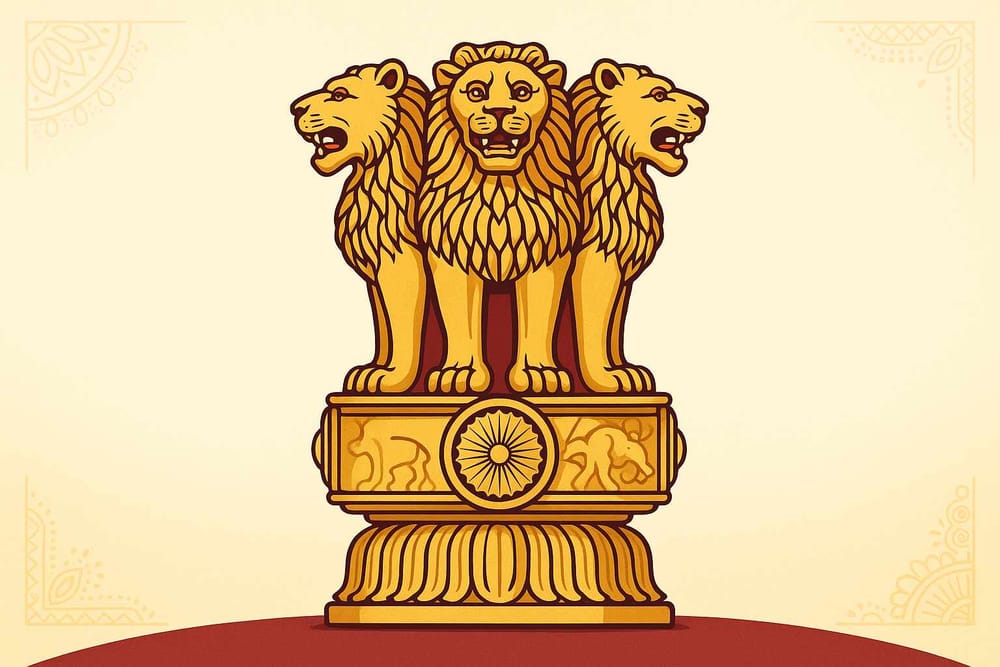
The Historical Significance of the Lion Capital of Ashoka: Understand its Enduring Legacy
There are some symbols that are etched into the very soul of a nation. For us in India, the Lion Capital of Ashoka is one such powerful emblem. We see it on our currency notes, on our passports, and on every official government letterhead. But have you ever paused to think about its journey? This isn't just a design; it's a profound story from our past, a message of peace and strength that echoes through centuries. It’s a symbol that connects us all, from the bustling streets of Mumbai to the serene ghats of Varanasi.
A King's Promise Carved in Stone: The Birth of the Lion Capital
The story of our national emblem begins around 250 BCE, with one of India's greatest emperors, Ashoka the Great. After the brutal Kalinga War, a heartbroken Ashoka embraced Buddhism and dedicated his life to Dharma, or righteous living. He wanted to spread this message of peace and compassion not through force, but through principles. To do this, he erected magnificent pillars across his vast empire, and the most famous of these was crowned with the Lion Capital at Sarnath.
Why Sarnath? Because this was the sacred ground where Lord Buddha gave his very first sermon after attaining enlightenment, setting the 'Wheel of Dharma' in motion. By placing this grand sculpture here, Ashoka was connecting his rule directly to the path of righteousness. The pillar and its capital were carved from a single block of polished sandstone, a testament to the incredible skill of Mauryan artisans. It was a declaration of a new kind of power—one rooted in morality, not just might.
Unpacking the Symbolism: What the Lions and Wheels Tell Us
The Lion Capital is a masterpiece of symbolism, where every single element has a deep meaning. It’s a visual guide to the ideals of a just and harmonious society. To truly appreciate it, we need to look closer at its parts.
- The Four Majestic Lions: Standing tall and back-to-back, the four lions face the four cardinal directions (north, south, east, and west). This isn't just for balance; it signifies the spread of Dharma in all directions, a universal message for all of humanity. The lions themselves are symbols of power, courage, and confidence. Their open mouths are believed to be spreading the Buddha's teachings—the Four Noble Truths—to the world.
- The Dharma Chakra (The Wheel of Law): The wheel, featured prominently on the abacus and now at the center of our national flag, is the Dharma Chakra. It represents the eternal wheel of law and the path of righteousness. For Ashoka, it also symbolised his role as a *Chakravartin*—a universal ruler who governs with justice and morality, whose chariot wheels roll unopposed across the land.
- The Animals on the Abacus: Between the wheels on the circular base are four other animals: a galloping horse, a powerful bull, a majestic elephant, and a lion. Historians believe these animals could represent different stages of Lord Buddha's life or even the four quarters of the world ruled by Ashoka. Each animal embodies a virtue—the horse for energy, the bull for hard work, the elephant for wisdom, and the lion for courage.
Below this entire structure, an inverted lotus, a symbol of purity and enlightenment in Indian traditions, originally formed the base. The complete sculpture is a beautiful representation of a kingdom built on a foundation of spiritual purity and moral strength. This rich layering of meaning is what makes it so special. You can delve deeper into the symbolism and significance of the Lion Capital of Ashoka to truly grasp its profound message.
From Ancient Pillar to Modern India's Identity
For centuries, this masterpiece lay forgotten until it was rediscovered during archaeological excavations in 1905. When India gained its independence, our founding fathers were looking for a symbol that would capture the spirit of our new republic—a symbol that spoke of our ancient heritage and our modern aspirations. On 26th January 1950, the Lion Capital was officially adopted as the National Emblem of India.
The motto inscribed below it in Devanagari script, 'Satyameva Jayate' (Truth Alone Triumphs), was taken from the Mundaka Upanishad. It serves as a constant reminder of the core principle that guides our nation. Today, the emblem stands for India's sovereignty, its commitment to peace, and the unity that binds our diverse cultures together.
Connecting with such powerful symbols from our past helps us understand who we are. It’s a journey of discovery that nourishes the soul. At Bhaktilipi, we are dedicated to sharing these timeless stories and ideals. By exploring our heritage, like the rich history and significance of the Lion Capital, we find inspiration for our daily lives and strengthen our connection to our roots.
Answers to Your Curiosities About the Lion Capital
So, what exactly is the Lion Capital of Ashoka?
The Lion Capital is a celebrated sculpture that originally sat atop a pillar erected by Emperor Ashoka around 250 BCE in Sarnath. It features four Asiatic lions standing back-to-back. Today, it is revered as the official National Emblem of the Republic of India, representing the nation's core values.
Why did Emperor Ashoka commission this magnificent sculpture?
After embracing Buddhism, Emperor Ashoka wanted to govern with Dharma (righteousness) and spread the message of peace and non-violence. The Lion Capital was created as a powerful symbol of his rule, which was based on moral law, and to mark the holy site where Buddha delivered his first teachings.
What do the different elements of the Lion Capital symbolize?
The emblem is rich with meaning. The four lions represent power, courage, and vigilance, while also symbolizing the spread of Dharma in all directions. The Dharma Chakra stands for the rule of law and righteousness. The animals on the abacus—the horse, bull, elephant, and lion—symbolize energy, diligence, wisdom, and courage respectively.
Where can one see the original Ashoka Lion Capital today?
While you see its image everywhere, the original, magnificent sculpture is carefully preserved and displayed at the Sarnath Museum in Uttar Pradesh. Seeing it in person is a truly humbling experience that connects you directly to our ancient past.
How is this ancient symbol connected to our modern Indian currency?
The Lion Capital is featured on all Indian currency notes and coins as a mark of sovereignty and authority. Its presence is a daily reminder of India’s rich heritage, its unity in diversity, and the enduring principles of truth and justice upon which the nation is built.
The Lion Capital of Ashoka is far more than just a historical artifact; it is a living legacy. It reminds us of an emperor's vision for a compassionate world and the timeless values that continue to guide India. It’s a symbol that encourages us to lead with courage, live with truth, and remain united in our journey forward.
At Bhaktilipi, we cherish these stories that form the bedrock of our culture. We invite you to continue this journey of discovery with us. Follow us on Instagram for daily inspiration, subscribe to our YouTube channel for deeper insights, and join our community. Let's keep our heritage alive together.
A passionate group of people dedicated to preserving India's knowledge of Dharma, Karma, and Bhakti for ourselves and the world 🙏.
Comments
Related in
Lion Capital of Ashoka-India's Heritage Explained
Have you ever held a coin in your hand or looked at your passport and truly seen the four lions seated majestically back-to-back? It’s a sight so familiar to us Indians, a part of our daily lives. But this isn't just a design; it's a
The Significance of the Lion Capital of Ashoka: Explores Indian History
Have you ever paused for a moment, holding a currency note or looking at your passport, and truly looked at the four lions standing so majestically? That symbol, the Lion Capital of Ashoka, is something we see almost every day. But how often do we think about its story? It’
Lion Capital of Ashoka-Symbolism Explained
How many times have we held a coin in our hand or looked at a government document and seen those four majestic lions, standing proud and strong? It’s a sight so familiar, it feels like a part of our own identity. But have you ever paused to think about