
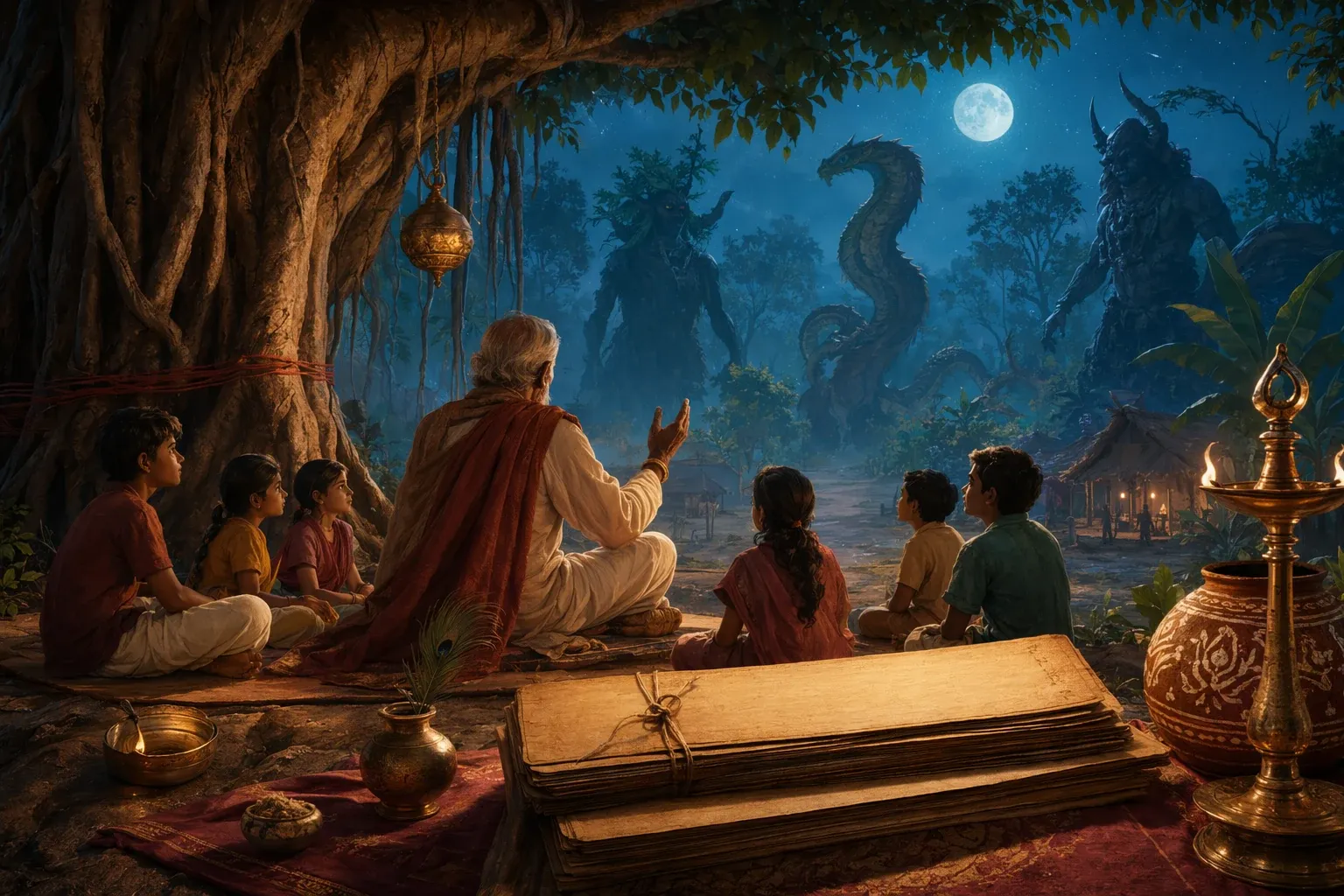
Indian folklore is full of beings that feel strange at first: serpent spirits, forest guardians, night wanderers, hungry ghosts, shape-shifting enemies, protective village deities, and clever spirits that test human pride. The internet often turns them into “monsters” for shock value. A better way to read them is to ask what fear, place, duty, and imagination are doing inside the story.
A folk creature is not always a creature in the modern fantasy-game sense. Sometimes it is a sacred being from textual tradition. Sometimes it is a local spirit remembered in one region. Sometimes it is a moral image used to warn children, protect water bodies, or explain danger. Sometimes it is simply a powerful character in a tale. The same name may also shift meaning between Sanskrit literature, Puranic storytelling, regional oral tradition, temple art, theatre, and modern films.
Nagas and the memory of water
Nagas are among the best-known serpent beings in Indian tradition. In many stories they are connected with water, fertility, subterranean realms, jewels, protection, danger, and royal power. They appear in Hindu, Buddhist, and Jain contexts, and their images can be seen in temple sculpture, local shrines, and seasonal worship practices. A naga is not just a scary snake. It can be guardian, ancestor-like presence, cosmic figure, or warning about disturbing nature.
In folk imagination, snake stories often carry ecological wisdom. A pond, grove, field boundary, anthill, or old tree may be treated with caution because people associate it with serpent presence. Modern readers do not need to turn every story into literal zoology. The cultural lesson is still meaningful: water sources and living habitats deserve respect, and careless greed can bring consequences.
Yakshas, yakshinis, and hidden abundance
Yakshas and yakshinis are often linked with nature, fertility, treasure, trees, thresholds, and guardianship. Ancient Indian art includes yaksha and yakshini figures, and later traditions remember them in many ways. They may be generous, dangerous, beautiful, testing, or protective depending on the story. Their power often sits near boundaries: forest and settlement, wealth and greed, desire and restraint, blessing and danger.
This is a useful pattern in folklore. A being at the boundary teaches humans how to behave at the boundary. Entering a forest, touching a sacred tree, taking wealth, breaking a promise, or ignoring hospitality rules is not just an action; it is a moral test. The creature makes the invisible rule visible.
Vetalas and the cleverness of difficult questions
The vetala is famous through the Vikram-Betal story cycle, where King Vikramaditya repeatedly carries a spirit that tells puzzling tales and asks sharp questions; this sits close to wider Indian storytelling traditions, including Panchatantra-style story worlds. The setting is eerie, but the purpose is not only horror. The vetala forces the king to think about justice, loyalty, truth, and judgement. Each story becomes a test of reasoning.
That is why the vetala is more interesting than a simple ghost. It is unsettling because it disturbs comfort. It asks: can a ruler think clearly? Can a listener notice moral complexity? Can someone keep a vow when speech itself becomes a trap? The scary atmosphere keeps attention, but the heart of the tale is intelligence under pressure.
Rakshasas and the language of danger
Rakshasas appear in epic and Puranic worlds as powerful beings, often associated with violence, deception, night, appetite, and opposition to dharma. But even here, we should avoid lazy reading. Indian traditions are complex. Some beings called rakshasas may be terrifying enemies, while other figures may show devotion, nobility, kinship, or transformation depending on the narrative. The label is not a license for modern stereotyping of any community.
In folklore, “monster” language often exaggerates a danger so that listeners remember it. A rakshasa-like figure may stand for uncontrolled hunger, misuse of power, cruelty, disrespect for guests, or the threat outside social order. The creature becomes a mirror. It asks humans to notice when their own behaviour becomes destructive.
Bhutas, pretas, and village ghost stories
Many Indian languages have words for ghosts, restless beings, or spirits of the dead: bhuta, preta, churail, pisacha, and many regional names. These stories vary widely. Some warn people against unsafe travel at night. Some speak about injustice, loneliness, improper death rites, or social fear. Some are told for entertainment during long evenings. Some are connected with ritual specialists and local healing traditions.
A respectful article should not mock communities that tell ghost stories, and it should not sell fear. The safer reading is cultural: ghost stories often help people talk about anxiety, grief, danger, gender rules, property, illness, and the unknown. They may be supernatural in tradition, symbolic in interpretation, and socially revealing in historical context.
Why scary beings help stories work
Fear is memorable. A child may forget a lecture about not wandering near a deep well, but remember a story about a being near the water. A greedy person may ignore advice, but remember a tale in which desire wakes a dangerous guardian. A ruler may enjoy praise, but a spirit’s riddle can force him to examine justice. In folklore, scary beings often carry practical teaching.
These beings also protect wonder. Not every part of life can be explained through one neat chart. Forests, rivers, illness, death, dreams, hunger, and night have always made humans imagine. Folklore gives form to that imagination. It can frighten, but it can also create humility: the world is larger than human control.
How to enjoy the stories responsibly
First, do not treat every being as “proof” of a creature in the modern sense. Second, do not flatten sacred or community traditions into horror entertainment. Third, avoid using one regional story to insult a whole group of people. Fourth, notice the setting. A serpent story beside a tank, a forest guardian tale, and a palace riddle-story are doing different kinds of work.
- Ask which tradition or region the story belongs to.
- Separate sacred meaning, folk performance, and modern adaptation.
- Look for the moral pressure inside the fear.
- Remember that names and details can change across languages.
Questions beginners ask
What creatures appear in Indian folklore?
Common examples include nagas, yakshas and yakshinis, vetalas, rakshasas, bhutas, pretas, churails, pisachas, animal helpers, local guardian spirits, and region-specific beings known by local names.
Are Indian folklore creatures the same as mythological beings?
Not always. Some beings appear in sacred texts and temple art, some in regional oral stories, and some in both. It is better to identify the source and setting instead of forcing everything into one category.
Why do folk stories use scary beings?
Scary beings make lessons memorable. They can teach caution, respect for nature, hospitality, truthfulness, courage, restraint, and careful judgement while also giving listeners the thrill of mystery.
The better word is meaning, not monster
Indian folklore creatures become richer when we stop asking only, “Is it scary?” and start asking, “What does it mean?” A naga may protect water memory. A yaksha may guard abundance. A vetala may test wisdom. A ghost may speak about fear or injustice. A rakshasa may dramatise uncontrolled power. The stories are not smaller when read carefully; they become deeper, more human, and more respectful.