
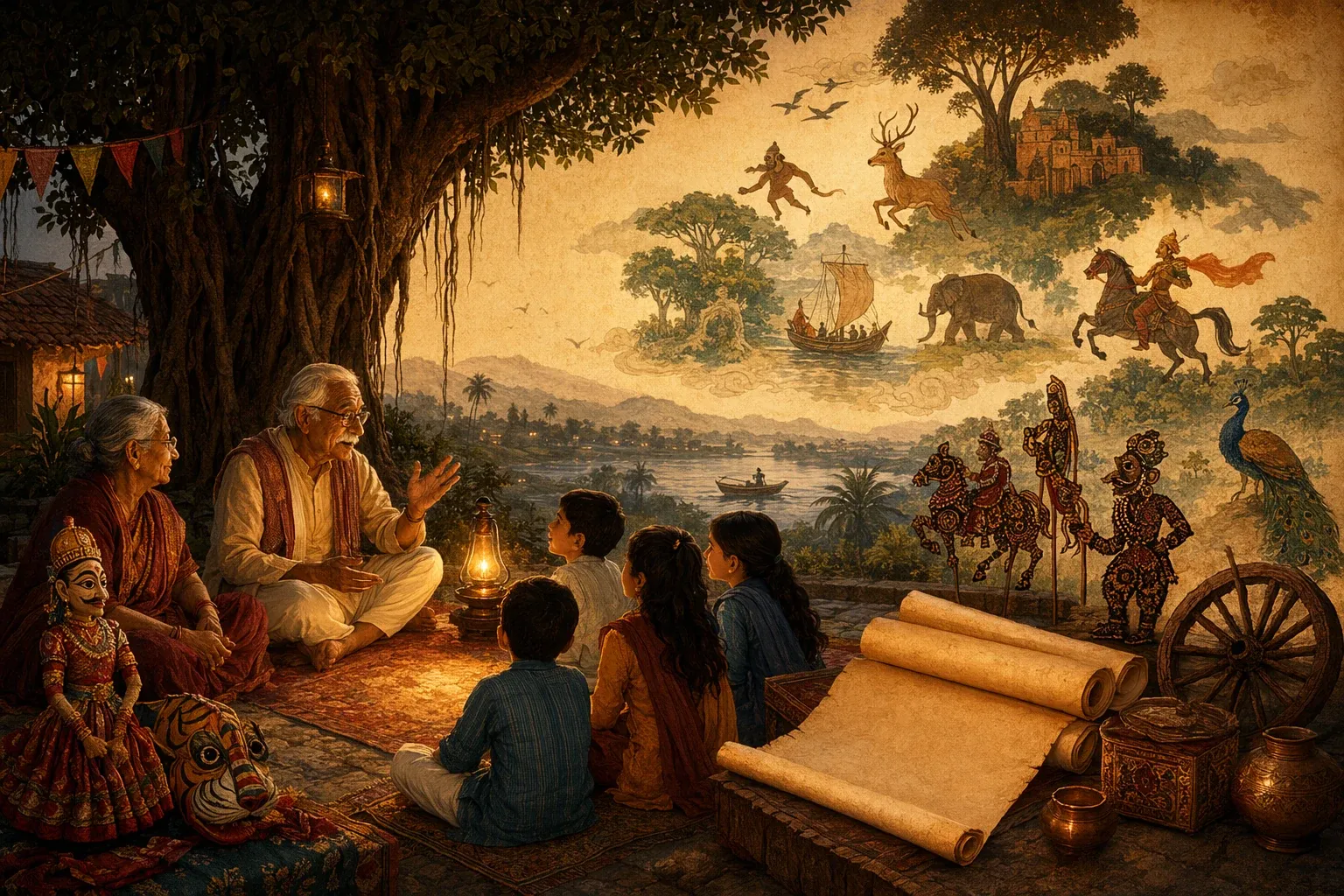
Indian folklore stories are not one shelf in one library. They are a huge family of tales told in homes, village gatherings, performances, songs, manuscripts, children’s books, temple spaces, seasonal festivals, and now online videos. Some are funny. Some are scary. Some are devotional. Some explain a place. Some teach caution through animals. Some keep the memory of a hero, saint, queen, craftsperson, community, river, hill, tree, or shrine alive.
For beginners, the easiest map is to separate three words: folktale, legend, and story. A folktale is usually a tale passed through community retelling, often with flexible versions. A legend is often tied to a person, place, shrine, battle, saint, or community memory, and listeners may treat it as closer to history even when details are layered. “Story” is the broad word that can include both.
Animal tales that teach judgement
Animal tales are among the most approachable Indian story types. The Panchatantra, Hitopadesha, and many Jataka stories use animals to explore human choices: friendship, betrayal, greed, caution, foolishness, loyalty, and quick thinking. The animals are not just cute characters. They create distance. A child can discuss a greedy crocodile, a proud lion, or a clever rabbit without feeling personally accused.
The Panchatantra is often remembered as practical wisdom taught through stories. That does not mean every tale is soft or innocent. Some are sharp, political, and even uncomfortable. A careful reader asks what the story is teaching and whether cleverness is being used to protect life, expose pride, or simply win. This is where dharmic reflection matters: intelligence without compassion can become manipulation.
Clever people, kings, and court humour
Many popular Indian tales celebrate wit. Akbar-Birbal stories, Tenali Rama tales, Gopal Bhar stories from Bengal, and similar regional traditions often show a clever person solving a problem through language, timing, observation, or humour. Historically, some of these characters connect with real courts or remembered personalities, but the stories themselves have often grown through popular retelling.
Their appeal is easy to understand. A witty answer can defeat arrogance without violence. A joke can reveal hypocrisy. A poor or ordinary person can outthink the powerful. These tales teach that intelligence is not only book learning. It includes listening carefully, reading people, seeing hidden motives, and speaking at the right moment.
Hero legends and community memory
Hero legends are different from simple joke tales. They are often connected with place, identity, and emotion. A region may sing about a warrior, a pastoral hero, a saint, a queen, or a protector figure. The story may be performed during festivals, remembered through ballads, or linked with shrines and community rituals. Rajasthan’s Pabuji traditions, North Indian Alha-Udal ballads, and many local goddess or guardian stories show how folklore can preserve collective pride and grief.
A beginner should treat such legends respectfully. They may contain historical echoes, but they are also shaped by devotion, performance, memory, and community need. The right question is not only “Did every detail happen exactly like this?” but also “Why has this story mattered to people for so long?”
Place stories, origin stories, and sacred landscapes
Many Indian folk stories explain why a place matters. A lake may be linked with a serpent being. A grove may be protected by a local deity. A hill may have a story of a saint’s tapasya. A temple may carry a legend about discovery, healing, vow, or divine protection. These stories turn geography into memory. They help people feel that land is not empty space; it is layered with responsibility.
Origin stories also appear in communities, crafts, festivals, and families. A weaving pattern, a marriage song, a ritual food, or a seasonal vow may carry a story explaining how it began. Even if the details vary, the story gives people a way to remember who they are and why an action has meaning.
Why one tale has many versions
Multiple versions are normal in folklore. A story changes when it enters another language, caste or tribal community, religious setting, performance form, or historical moment. A storyteller may shorten a tale for children, expand it for a night performance, add local place names, change an animal, or adjust the ending for the audience. This does not make the tradition weak. It makes it flexible.
UNESCO’s explanation of oral traditions notes that spoken forms often combine reproduction, improvisation, and creation. That is a helpful idea for Indian folklore. A teller does not always repeat like a recording. The teller remembers a pattern and gives it life again. In that moment, the story belongs to the past and the present together.
The boundary between folklore and literature
Some Indian story collections are written texts, not purely oral folklore. Panchatantra, Hitopadesha, Kathasaritsagara, and Jataka collections have textual histories, translations, and scholarly discussion; manuscript traditions also matter, as seen in Indian illuminated manuscripts. Yet their stories also circulate orally and popularly. So it is better to say they are adjacent worlds: literature, teaching tradition, and folk retelling often meet.
This matters because beginners sometimes think folklore means “no text” and literature means “no people”. Indian reality is more interesting. A story may move from oral performance into manuscript, from manuscript into print, from print into school narration, from school narration into animation, and from animation back into family storytelling. Each movement changes emphasis.
Safe starting points for beginners
Start with a small group of stories rather than trying to “finish” Indian folklore. Read a few animal tales from Panchatantra or Jataka collections. Listen to regional stories from your own family language if possible. Explore one local legend connected with a temple, river, hill, festival, or craft. Watch a performance tradition with context, not just a short clip; Indian puppetry is one good example of storytelling that needs cultural setting. If you use online sources, prefer libraries, museums, cultural archives, trusted publishers, and clearly legal editions.
- Keep a notebook of story names, regions, and languages.
- Ask elders for versions, but do not force them into textbook style.
- Compare two versions and notice what changes.
- Avoid piracy links and random files that remove context.
Questions beginners ask
What are Indian folklore stories?
They are community-retold stories from Indian cultural life, including animal tales, clever-person tales, hero legends, ghost stories, place legends, ritual stories, songs, proverbs, and performance narratives.
What is the difference between folktales and legends?
Folktales are usually flexible community tales that may focus on entertainment and teaching. Legends are often attached to a remembered person, place, shrine, community, or event and may be treated as closer to memory or history.
Where should beginners start with Indian folklore?
Begin with well-known animal tales, one regional story tradition from your own language or state, and one local place legend. Then compare versions instead of looking for one final version.
A good story leaves a question behind
The best Indian folklore stories do not end when the plot ends. They leave a question behind: what is cleverness for, how should power behave, why do places matter, what do communities remember, and what kind of person should I become? That is why these tales still work. They entertain first, then slowly teach us how to notice life.