
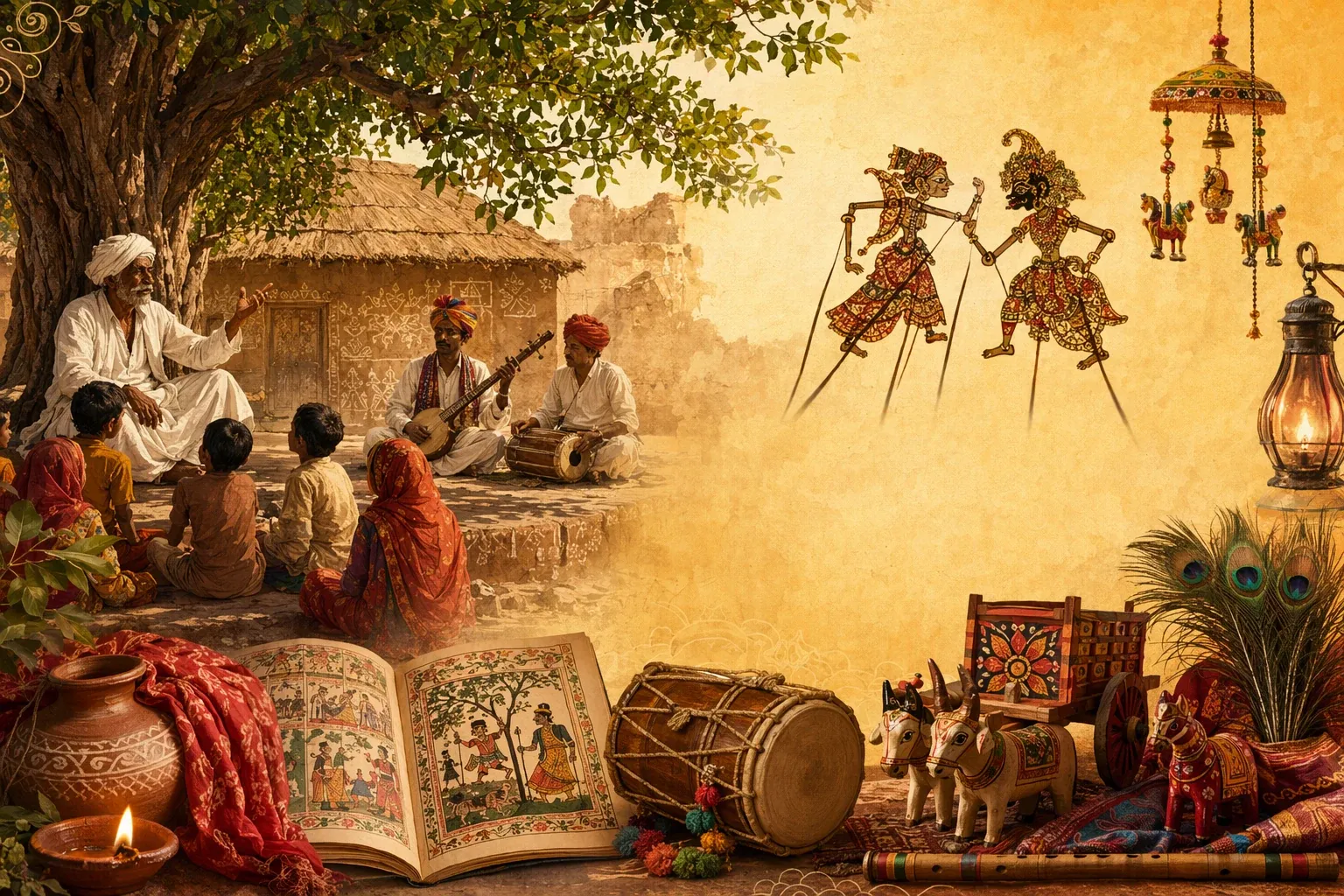
Indian folklore is the living memory of people: stories told at night, proverbs used by grandparents, local legends about a pond or hill, festival songs, riddles, healing sayings, village deities, clever animal tales, and warnings that help a community explain life. It is not one single book and it is not only “old stories”. It is a way knowledge travels when ordinary people remember, perform, adjust, and pass it on.
A useful beginner meaning is this: folklore is culture carried through shared expression. In India, that expression may be spoken, sung, danced, painted, enacted, or woven into ritual. UNESCO describes oral traditions as forms such as tales, legends, proverbs, songs, chants, and performances that pass knowledge, values, and collective memory. That description fits India beautifully, because many Indian stories have lived in kitchens, courtyards, temples, fields, markets, and travelling performances as much as in printed books.
Folklore lives where people keep retelling
The most important feature of folklore is retelling. A printed story usually has a fixed author and a fixed version. A folk story often has many tellers and many versions. A grandmother in Odisha may tell a snake story differently from a storyteller in Rajasthan. A village legend may change when it moves from Bhojpuri into Hindi, from Tamil into English, or from a courtyard performance into a school textbook. That change does not automatically make it fake. It shows that folklore is alive.
This is why Indian folklore cannot be reduced to “mythology” or “fairy tales”. Mythology usually points to sacred or cosmic stories connected with deities, creation, dharma, and the universe. Folklore is wider and more everyday. It includes a mother telling a child not to waste grain, a community song sung during harvest, a local story about a temple tank, a proverb about greed, and a comic tale about a clever villager. Some folklore touches religion, but not all folklore is scripture.
Everyday forms you may already know
Indian folklore appears in many forms. Animal tales teach judgement through monkeys, crocodiles, jackals, crows, lions, turtles, and snakes. Trickster stories use sharp wit to expose pride or foolishness. Hero legends remember warriors, saints, queens, shepherds, local guardians, and community protectors. Ghost stories warn children about unsafe places, late nights, greed, or disrespect. Proverbs compress experience into one sentence. Songs preserve emotion during marriage, childbirth, farming, worship, and seasonal change.
Folk arts are part of the same world. A Madhubani painting, a Warli scene, a scroll painting performance, a puppetry show, a mask dance, or a devotional village song may carry stories that people understand without needing a formal classroom. The art is not just decoration. It can be a memory device, a social gathering, a teaching method, and a way of keeping identity visible.
Concrete examples from Indian story worlds
The Panchatantra is a famous Sanskrit story tradition often linked with animal fables and practical wisdom. It is a textual tradition, but many of its stories also feel close to folklore because they travel easily through retelling. The Monkey and the Crocodile teaches presence of mind when trust breaks. The Lion and the Rabbit shows how intelligence can defeat raw force. The Jataka tales, Hitopadesha stories, Akbar-Birbal jokes, Tenali Rama tales, and Vikram-Betal stories are also widely retold, though each has its own history and setting.
There are regional examples too. Rajasthan remembers heroic and devotional figures through songs and performance. Kerala has ritual performance traditions in which local memory, deity stories, costume, music, and community participation meet. Northeast India has rich oral traditions connected with origin stories, landscapes, clan memory, animals, and nature. A respectful learner should not treat these as “content” detached from communities. Many stories belong to living people, languages, and places.
Why stories change by region
A story changes because each telling has a situation. The teller may be teaching children, entertaining guests, explaining a ritual, warning someone, praising a local hero, or making listeners laugh. The audience matters. The language matters. The season matters. A farming community may remember rain, snakes, cattle, crops, and forests differently from an urban reader. A coastal community may use sea images, boats, storms, fish, and goddess shrines in ways that inland listeners may not.
This regional movement is one reason Indian folklore is so rich. India has hundreds of languages and dialects, many ecological zones, and long histories of migration, trade, pilgrimage, royal patronage, devotional movements, and community exchange. When a story travels, it often keeps a recognizable core but changes its clothing. That is why two versions can disagree in detail and still belong to the same family of memory.
What folklore teaches without becoming a lecture
Folklore teaches softly. It may not say, “Here is the lesson.” Instead, it shows a greedy character losing peace, a foolish king learning humility, a weak animal surviving with intelligence, or a village protecting a sacred grove. Children remember the story before they understand the moral. Adults return to the same story and notice deeper ideas: how power works, why speech matters, how fear spreads, what hospitality means, and why community rules exist.
A dharmic reading of folklore does not mean every old custom must be copied exactly. It means we ask what the story is trying to protect. Is it protecting truth, compassion, caution, ecological respect, family responsibility, generosity, or courage? Sometimes a story may also reflect older social attitudes that deserve careful discussion today. Respect and honesty can stand together.
How folklore differs from history and scripture
History asks what can be supported by evidence: inscriptions, texts, dates, archaeology, records, and careful comparison. Scripture belongs to sacred tradition and theological interpretation. Folklore often belongs to community memory and performance. These categories can overlap, but mixing them carelessly creates confusion. A local legend about a temple may contain devotion, historical hints, and symbolic teaching; it should not be forced into only one box.
For young readers, this distinction is freeing. You do not have to prove every folk tale like a science experiment to value it. You also do not have to accept every dramatic claim as literal history. The mature approach is to ask: who tells this story, where is it told, what does it teach, and how has it changed over time?
Questions beginners ask
What is Indian folklore?
Indian folklore is the shared cultural expression of Indian communities: stories, songs, sayings, rituals, legends, art forms, performances, and local beliefs passed across generations, often through oral or community practice.
What are examples of Indian folklore?
Examples include Panchatantra-style animal tales, Vikram-Betal stories, Akbar-Birbal and Tenali Rama tales, local hero legends, harvest songs, village deity stories, proverbs, riddles, puppetry traditions, mask performances, and regional ghost stories.
How is folklore connected with Indian culture?
Folklore connects culture with daily life. It keeps languages alive, preserves memory, teaches values, explains places, entertains communities, and gives people a sense of belonging to a family, region, profession, or tradition.
A simple way to remember it
Think of Indian folklore as a river, not a stone. A stone stays fixed; a river moves while remaining connected to its source. Folklore moves through voices, songs, images, jokes, warnings, and performances. It changes, but it carries memory. That is why it matters: it helps us see Indian culture not only in monuments and famous texts, but also in the everyday imagination of people.