
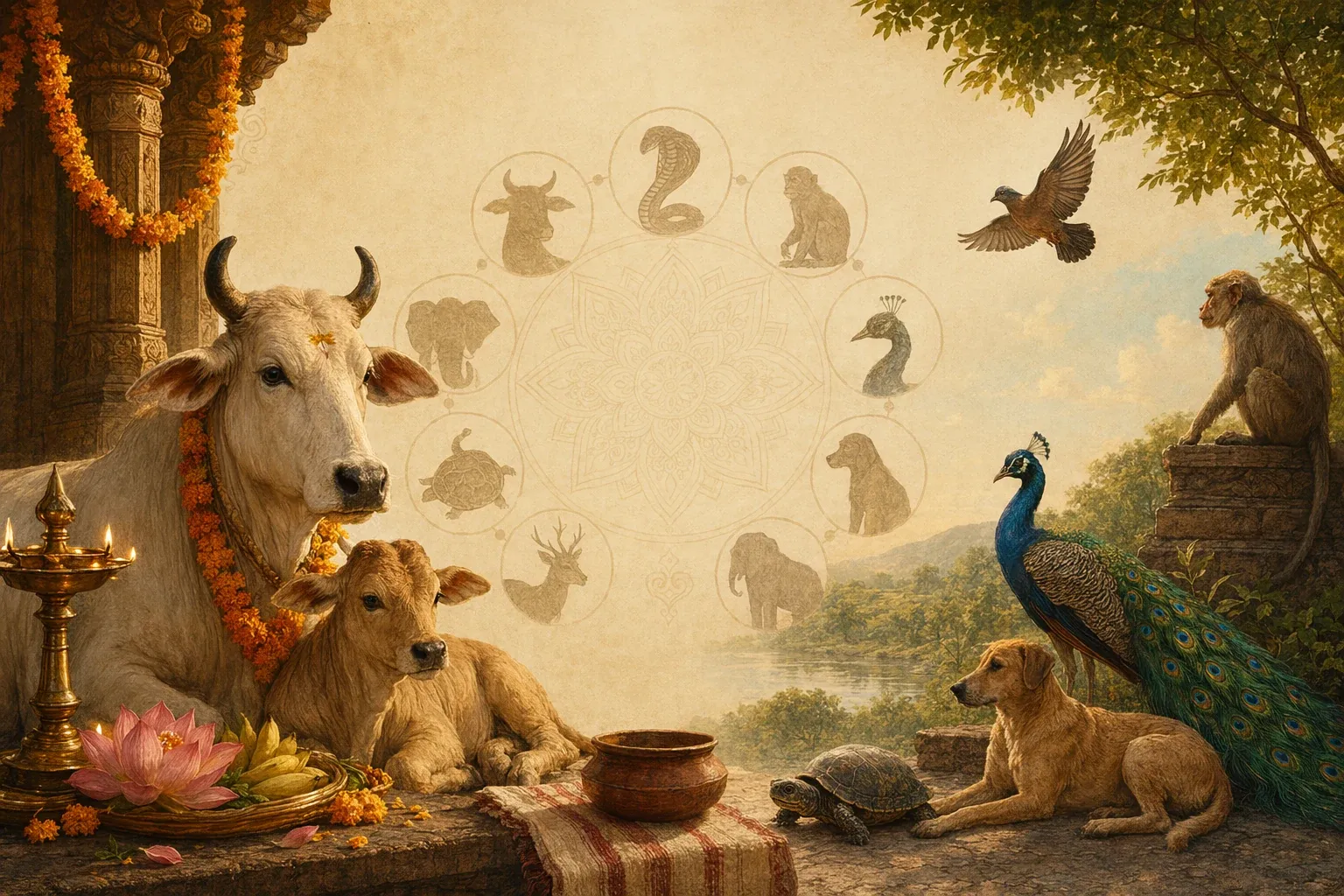
No, all animals are not sacred in India in the exact same way. A cow, snake, monkey, elephant, bull, peacock, Garuda, mouse, or hamsa may carry special meaning in particular traditions, but that does not mean every animal receives the same ritual status everywhere. India’s view is more layered: some animals are worshipped or honoured directly, some are linked with deities, some appear in stories, and many are respected through the wider ethic of non-harm.
This distinction matters because outsiders often hear “animals are sacred in India” and imagine one simple rule. Indian culture rarely works like that. It is a collection of regions, languages, communities, scriptures, temple practices, village customs, and family habits. A snake shrine in one village, a Nandi sculpture in a Shiva temple, a cow shelter near a town, and a peacock in a Kartikeya story all show sacredness, but each shows it differently.
Some animals are ritually honoured
Cows are the clearest example of an animal ritually honoured by many Hindu families. They are connected with nourishment, motherhood, agrarian life, Krishna devotion, and ahimsa. During certain festivals or household observances, people may feed cows, decorate cattle, or treat them as symbols of prosperity and gratitude. This does not make every Indian practice identical, but it does show a strong and visible form of reverence.
Snakes are another example. Nagas are remembered in shrines, stories, and festivals such as Nag Panchami. A snake can represent danger, fertility, water, hidden energy, and protection. In Shiva imagery, the serpent around the neck suggests mastery over fear and time. In Vaishnava imagery, Vishnu resting on Shesha carries cosmic meaning. Here the snake is not just an animal; it becomes a sign of nature’s power.
Some animals teach through deity associations
Many animals become sacred because of their connection with a deity. Nandi, the bull of Shiva, is one of the most familiar examples. Almost every Shiva temple has Nandi facing the main shrine. Devotees do not usually see him as ordinary decoration. He is a guardian, a devotee, and a symbol of strength held in stillness.
Ganesha’s mouse teaches a different lesson. The mouse is small, quick, and able to enter hidden places. Beside Ganesha, it can suggest that restless desire and clever movement must be guided by wisdom. Garuda, linked with Vishnu, suggests speed, courage, protection, and devotion. The peacock of Kartikeya or Murugan can suggest beauty, victory, and disciplined energy. The hamsa linked with Saraswati often suggests learning, grace, and the ability to separate truth from confusion.
Some animals are honoured through story, not daily worship
Hanuman shows how the line between animal, divine being, and story-symbol can be complex. He is not simply “a monkey” in the ordinary sense. He is a vanara hero, a devotee of Rama, and a sacred figure in his own right. Through him, monkeys become connected with strength, courage, humility, and service. Yet that does not mean every monkey in a city should be treated as a pet or fed without thought. Cultural reverence and ecological responsibility have to go together.
The same applies to elephants. Ganesha’s elephant head gives the elephant strong sacred recognition. Elephants also appear in royal, temple, and festival settings in parts of India. But a living elephant is not a festival prop. Modern care must include animal welfare, habitat, and safety. If sacredness ignores suffering, it has missed its own point.
Ahimsa is wider than one animal
The larger Indian idea behind many forms of animal respect is ahimsa, non-harm. Jain traditions place very strong emphasis on non-violence toward living beings. Buddhist traditions also developed deep compassion for sentient life. Hindu traditions include many expressions of ahimsa, vegetarian practice, and reverence for creatures connected with divine stories. These traditions differ, but they share the thought that humans should not act as if only human life matters.
Ahimsa does not automatically mean every animal is worshipped. It means restraint matters. A person can avoid cruelty toward a dog, a bird, a cow, a snake, or an insect without performing the same ritual for each. In that sense, respect for animals is broader than ritual sacredness. It is a moral habit.
Indian practice is diverse and sometimes contradictory
India’s animal traditions are not always neat. Some temples and communities historically included animal sacrifice, while others strongly rejected harm. Some families are vegetarian; others are not. Some regions are famous for cow reverence; others have different food histories. Some communities treat particular animals as clan symbols, local guardians, or taboo beings. A serious reader should not flatten this diversity.
This is why the question “Are all animals sacred in India?” needs a careful answer. If sacred means “equally worshipped by everyone,” then no. If sacred means “many animals can become carriers of spiritual meaning,” then yes, many can. If sacred means “life deserves care,” then the idea reaches even wider.
National symbols are different from sacred symbols
Modern India also has official national symbols, such as the tiger as national animal and the peacock as national bird. These are important cultural symbols, but they are not the same as ritual sacredness. The tiger can represent power, wildness, and conservation. The peacock can be both a national symbol and a religious-cultural image connected with Kartikeya, Krishna’s peacock feather in popular devotion, and monsoon beauty.
Understanding the difference helps avoid confusion. A national symbol is chosen by a modern state. A sacred symbol grows through stories, rituals, local memory, and devotional use over long periods. Sometimes the same animal belongs to both worlds, but the meanings are not identical.
A useful answer for beginners
The best beginner answer is this: India does not treat all animals as equally sacred, but Indian traditions often teach that animals are not meaningless. Some are sacred through deity links, some through festivals, some through agriculture, some through ancestors, some through folklore, and some through ethical teachings about non-harm. The result is a culture where animals regularly appear in temples, songs, stories, calendars, village customs, and moral lessons.
So if you see a cow being fed, Nandi facing Shiva, a serpent stone under a tree, a Ganesha image with a mouse, or Hanuman worship on a Tuesday or Saturday, do not reduce it to “animal worship.” Look for the relationship behind it. What is the animal teaching? What human quality is being trained? What fear, gratitude, duty, or hope is being expressed?
That approach gives a more respectful answer than a simple yes or no. All animals are not sacred in one equal category. But many Indian traditions invite humans to see animals as fellow beings, symbols, helpers, and reminders that dharma is not only about what we believe. It is also about how carefully we live.