
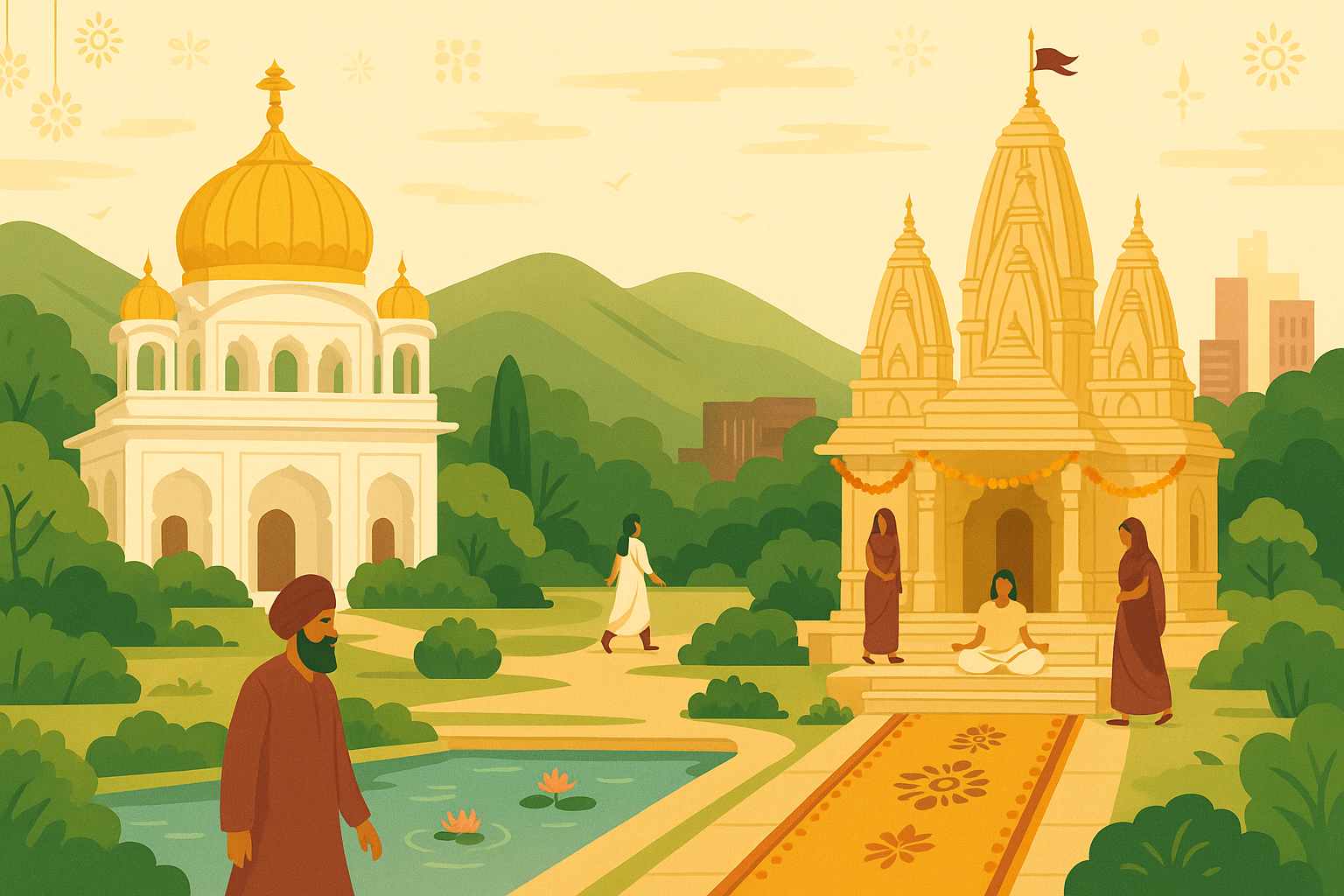
Chandigarh’s sacred places include temples, gurdwaras, churches and mosques distributed through the city’s sector plan. Some predate or were incorporated into the planned capital; others were designed as part of its neighbourhoods. Nearby Panchkula and Mohali add important pilgrimage sites, but they are separate cities and jurisdictions.
A responsible guide should give accurate locations, avoid ranking one tradition above another and distinguish documented history from devotional belief. Opening hours, services, food distribution, photography and festival arrangements are controlled by each institution and can change.
Sacred places in Chandigarh’s plan
The Chandigarh Master Plan 2031 chapter on social infrastructure maps temples, gurdwaras, churches and mosques across the sector grid. It notes that older sites, including a Hanuman temple in Sector 32 and a Kali temple in Sector 19, were integrated into the developing city.
The plan also identifies religious buildings valued for their architecture. A church in Sector 18, a mosque in Sector 20, a gurdwara in Sector 22 and a mandir in Sector 23 were recommended for heritage status. That planning recommendation is more specific than calling every place “ancient” or treating worship buildings as generic tourist attractions.
Chandigarh and the wider Tricity
The Chandigarh Tricity commonly refers to Chandigarh, Panchkula in Haryana and Sahibzada Ajit Singh Nagar (Mohali) in Punjab. They function as one urban region, but administrative boundaries still matter for transport, official information and accurate descriptions.
Mata Mansa Devi Temple and Gurdwara Sri Nada Sahib are in Panchkula. Chandi Mandir is also on the Panchkula side of the urban region. They can be part of a Chandigarh-based trip, but should not be presented as sites within the Union Territory.
Temples within Chandigarh
ISKCON Chandigarh, Sector 36-B
ISKCON Chandigarh identifies its Hare Krishna Dham in Sector 36-B. The current duplicate articles alternately place it in Sectors 34 and 36; Sector 36-B is the location given by the institution’s own site.
The temple follows the Gaudiya Vaishnava tradition and centres worship on Krishna. Programmes may include darshan, arati, kirtan and discourse, but schedules and food distribution should be checked directly. Do not promise a particular form of prasad or assume that every programme is open at every hour.
Historic and planned-sector temples
The master plan specifically notes the older Hanuman temple in Sector 32 and Kali temple in Sector 19. It also identifies a Sector 23 mandir among religious buildings recommended for heritage recognition and notes other purpose-designed religious buildings within the Chandigarh architectural context.
These planning references document the sites’ place in the city. They do not establish every local origin legend, miracle account or ritual schedule. On-site information and the managing trust remain the best sources for current worship arrangements.
Shirdi Sai Baba and other neighbourhood temples
Chandigarh has numerous neighbourhood temples, including a Sai Baba temple commonly associated with Sector 29. A broad city article should not invent architectural details, universal Thursday programmes or guaranteed food service without a current statement from the responsible body. Confirm the exact institution and schedule before travelling.
Gurdwaras in Chandigarh
Gurdwaras are places of Sikh worship centred on the Guru Granth Sahib. Visitors of any background are generally welcomed when they follow the institution’s discipline: cover the head, remove shoes, wash hands, avoid tobacco or intoxicants and sit respectfully in the congregation.
The Chandigarh Master Plan notes gurdwaras in Sectors 8 and 34 as having historical associations and identifies a Sector 22 gurdwara for heritage consideration. These statements should not be expanded into precise visit narratives without a gurdwara or SGPC record that documents them.
Seva and langar
Seva means selfless service, while langar is the community kitchen and shared meal associated with Sikh practice. Visitors should participate with humility: follow local seating and serving arrangements, take only what they can eat and do not turn service into a staged photograph.
Langar timing and capacity vary. A gurdwara is not a free restaurant, and a travel guide should not promise a meal at a particular hour.
Church and mosque heritage
The master plan’s heritage inventory includes the church along a V4 road in Sector 18 and the mosque in Sector 20. Their importance is both religious and architectural, reflecting how different communities established worship within the planned city.
Visitors should avoid entering during a service merely to sightsee. Dress appropriately, silence phones, ask before photography and respect areas reserved for prayer. For churches, confirm service and visitor hours with the congregation; for mosques, avoid disrupting congregational prayer and follow local guidance on dress and ablution areas.
Mata Mansa Devi Temple, Panchkula
The Shri Mata Mansa Devi Shrine Board places the temple at Bilaspur in Panchkula district, Haryana. It says Maharaja Gopal Singh of Manimajra built the present main temple between 1811 and 1815; the nearby Patiala temple was built in 1840.
The board presents sacred narratives linking the shrine to Sati and Shakti worship. Those are properly described as traditions or beliefs, not archaeological proof. The official site does not need the blog’s unsupported claim that this is categorically a Shakti Peeth.
The board publishes seasonal opening and arati times, facilities and official online services. Because schedules change during Navratri and for crowd management, consult the board immediately before visiting and use only its authorised booking channels.
Gurdwara Sri Nada Sahib, Panchkula
The Shiromani Gurdwara Parbandhak Committee lists Gurdwara Sri Nadha Sahib Patshahi Dasvi in Panchkula, associating it with the Tenth Guru, Guru Gobind Singh. It is a major regional gurdwara but is not within Chandigarh’s Union Territory boundary.
Use the gurdwara or SGPC for current programme and access information. Follow Sikh etiquette, cover the head, remove shoes and refrain from treating the congregation or langar hall as a photo opportunity.
Chandi Mandir and the city’s name
Chandigarh’s name is commonly explained as “the fort of Chandi” and associated with Chandi Mandir near the city. This naming relationship should not be inflated into a claim that the temple is an officially recognised Shakti Peeth without a supporting authoritative record.
The temple lies near a major military cantonment in Panchkula district. Routes, security restrictions and photography rules may be stricter than at an ordinary neighbourhood temple. Follow signs and do not photograph defence installations.
Planning a respectful multi-faith visit
- Group sites by city and sector; allow extra travel time for Panchkula or Mohali.
- Verify current opening hours and services with the managing institution.
- Wear modest clothing and carry a clean head covering when visiting gurdwaras.
- Remove shoes wherever required and use designated storage.
- Do not photograph worshippers, rituals, sacred objects or security areas without permission.
- Give priority to congregations during worship and festivals.
- Use official donation channels and be cautious of unofficial agents.
- Describe sacred narratives as living beliefs when they are not independently documented history.
Frequently asked questions
Are Mata Mansa Devi and Nada Sahib in Chandigarh?
No. Both are in neighbouring Panchkula, Haryana, though they are often included in wider Chandigarh itineraries.
Which sector is ISKCON Chandigarh in?
The institution identifies Hare Krishna Dham in Sector 36-B, Chandigarh.
Did Chandi Mandir give Chandigarh its name?
The city’s name is commonly associated with Chandi Mandir and understood as “the fort of Chandi.” The temple is near Chandigarh in Panchkula district.
Can non-Sikhs visit a gurdwara and eat langar?
Gurdwaras generally welcome visitors of all backgrounds who follow the local discipline. Langar is a shared practice of equality and service; follow the directions of sevadars and do not waste food.
Are all the listed buildings official tourist attractions?
No. They are active places of worship. Heritage or planning recognition does not imply unrestricted sightseeing access.