
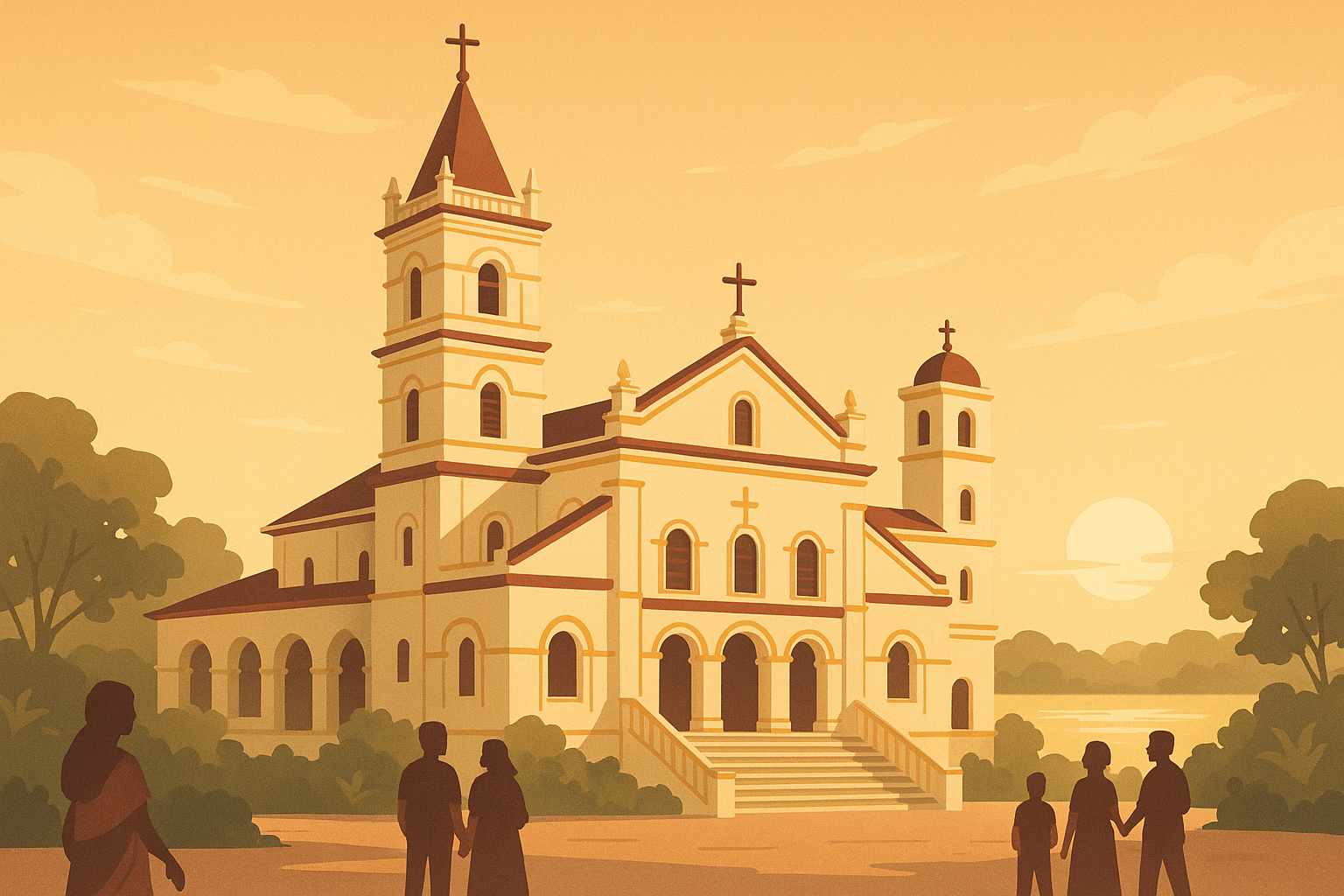
Bandel is a historic settlement and transport hub in Hooghly district, West Bengal, best known for the Basilica of the Holy Rosary—popularly called Bandel Church. Its story is connected with the Hooghly River, Portuguese maritime activity, Mughal–Portuguese conflict, Christian pilgrimage, railways and the wider multicultural heritage of Hooghly-Chinsurah.
A responsible visit should distinguish Bandel itself from nearby Chinsurah, Hooghly, Bansberia, Chandannagar and Serampore. They can form one heritage itinerary, but they are not all neighbourhoods or monuments within Bandel.
First understand Bandel's geography
Bandel lies on the western side of the Hooghly River, north of Kolkata. The district administration describes the name as connected with bandar, meaning a port or wharf, and identifies Bandel with the historical port of Hooghly.
Modern place names overlap in everyday use: Bandel is closely tied to Hooghly-Chinsurah urban life and Bandel Junction serves a much wider area. Historical sources may use “Hooghly,” “Hugli” and “Bandel” differently depending on period. Before assigning a monument to Bandel, check its present address and historical context.
Bandel Basilica and the Portuguese settlement
The Basilica of the Holy Rosary is Bandel's principal heritage and pilgrimage site. Official district and church sources connect the establishment of the mission with Portuguese Augustinians in 1599. The earlier complex was affected by the Mughal capture of Hooghly in 1632, and the church was rebuilt and altered across later periods.
This layered history makes one precise “construction year” misleading. A foundation tradition, dated stone, rebuilt church, monastery, later additions and modern basilica status can all be true without describing one unchanged building.
Our Lady of Happy Voyage
The shrine venerates Our Lady of the Rosary, also associated locally with Our Lady of Happy Voyage. A ship's mast displayed at the complex is linked by church and tourism accounts to a captain's thanksgiving after danger at sea. Present this as the shrine's recorded devotional tradition, not as independently proven evidence for every detail of the voyage.
Minor basilica status
The church received the title of minor basilica in 1988. “Basilica” here is a Catholic ecclesiastical title; it does not mean that the current building is a Roman imperial basilica or that every visible architectural element dates to the sixteenth century.
A living place of worship
Bandel Basilica is not an abandoned monument. It is a parish, shrine and pilgrimage destination with Masses, festivals, prayer and community activity. Visitors should check the official church site for current worship times and notices, dress respectfully, silence phones and avoid photographing people at prayer without permission.
The Portuguese presence in Hooghly
Portuguese merchants and missionaries were active around the Hooghly river port from the late sixteenth century. Their settlement became involved in regional trade, imperial politics and conflict. Mughal forces captured Hooghly in 1632, ending Portuguese political and military dominance there, but a Christian community and religious institutions continued.
The story should not be romanticised as only a peaceful trading encounter or reduced to one battle. Maritime commerce, mission activity, local communities, enslavement and coercion, imperial competition, adaptation and cultural exchange belong to the wider historical context and require careful sources.
What to notice at Bandel Church
- The church and monastery complex: a living site shaped by rebuilding and alteration rather than a frozen sixteenth-century structure.
- Our Lady of Happy Voyage: central to the shrine's devotional identity.
- The ship's mast: displayed as a maritime thanksgiving object in local tradition.
- Altars, memorials and tombstones: read labels carefully and do not touch or climb on them.
- The river-port setting: useful for understanding why Bandel emerged where it did.
Architecture claims should be modest. Repeated repair, earthquake damage and later expansion mean that a visible feature cannot be dated from appearance alone.
What is nearby but not in Bandel
Hooghly Imambara
Hooghly Imambara is a major Islamic religious and architectural site in the wider Hooghly-Chinsurah area. It is commonly paired with Bandel Church in day itineraries, but it is a separate institution and location. Verify current entry and prayer-time arrangements and behave as at an active religious site.
Chinsurah's Dutch heritage
Chinsurah preserves traces of Dutch colonial history, including cemetery and memorial contexts. Calling these “Bandel's Dutch monuments” erases an important geographic and historical distinction. Use a local heritage map and respect cemetery rules.
Hanseswari Temple at Bansberia
Hanseswari Temple and the adjoining Ananta Basudeb Temple are at Bansberia, north of Bandel. They can be combined with Bandel in a route, but their patronage, architecture and religious traditions deserve separate treatment.
Chandannagar and Serampore
Chandannagar is especially associated with French colonial history, while Serampore is linked with Danish settlement and later educational and printing history. They demonstrate the Hooghly River's wider network of European and Bengali settlements; neither should be labelled part of Bandel.
Bandel Junction and modern connectivity
Bandel Junction is a major railway interchange connected with the Howrah–Bardhaman main line and routes toward Naihati and Katwa. The district tourism page places the basilica roughly two kilometres from the station and lists local road transport.
Services, platforms and local transport can change. Use current railway information rather than copying old train numbers or claiming a fixed journey time from Kolkata. At busy stations, protect valuables, use official crossings and never walk on tracks for photographs.
Bandel cheese is a separate food-history story
Bandel cheese is a small smoked or unsmoked cheese associated with Bengal's Portuguese culinary legacy. It is not a monument and its present production and sale extend beyond Bandel itself. A separate guide can address its history, storage and food safety without turning the town's entire heritage into a food-origin claim.
Read the separate Bandel cheese guide.
A realistic one-day heritage plan
Option 1: Bandel and Hooghly-Chinsurah
Begin at Bandel Basilica, allowing time for worship schedules and quiet observation. Continue to a nearby Hooghly-Chinsurah site such as the Imambara or a documented heritage stop. Two or three places are more realistic than a rushed list across the district.
Option 2: Bandel and Bansberia
Combine the basilica with Hanseswari and Ananta Basudeb temples if transport and opening conditions work. Remember that this moves between towns and between active Christian and Hindu sacred sites; adapt dress and behaviour accordingly.
Option 3: a wider river-heritage trip
Chinsurah, Chandannagar or Serampore can be included on a longer itinerary, but road and rail time grows quickly. Treat each settlement as a distinct chapter rather than collecting “European colony” photo stops without context.
Respectful and safe visiting
- Check current church, mosque/imambara, temple and cemetery rules before arrival.
- Do not photograph worshippers, services, funerals or private ceremonies without explicit consent.
- Keep voices low and phones silent inside active sacred spaces.
- Do not touch tombstones, altars, old plaster, paintings or memorial objects.
- Use authorised river crossings and local transport; follow monsoon and cyclone advisories.
- Do not climb riverbanks, railway structures or heritage masonry for photographs.
- Avoid single-use plastic and do not leave food or devotional waste.
- Ask before using a tripod, drone or commercial camera; local and aviation restrictions may apply.
Frequently asked questions
What is Bandel famous for?
It is best known for Bandel Church, officially the Basilica of the Holy Rosary, and for its connections with the historic Hooghly river port, Portuguese settlement and Bandel Junction.
Is Bandel Church from 1599?
The mission and original church foundation are associated with 1599. The complex was rebuilt and altered after conflict and across later centuries, so the current structure should not be described as wholly unchanged since that date.
Is Hooghly Imambara in Bandel?
It is in the neighbouring Hooghly-Chinsurah area and is often combined with Bandel in tourism routes. It is not the same site or institution as Bandel Basilica.
Can Bandel, Chandannagar and Serampore be visited together?
They can form a wider Hooghly River heritage itinerary, but each is a distinct settlement with different histories. A single day may become rushed depending on transport and opening times.
Is Bandel cheese still made in Bandel?
The food is historically associated with Bandel and Portuguese influence in Bengal, but modern production and retail may occur elsewhere. Check provenance, refrigeration and food safety rather than relying on a product name alone.