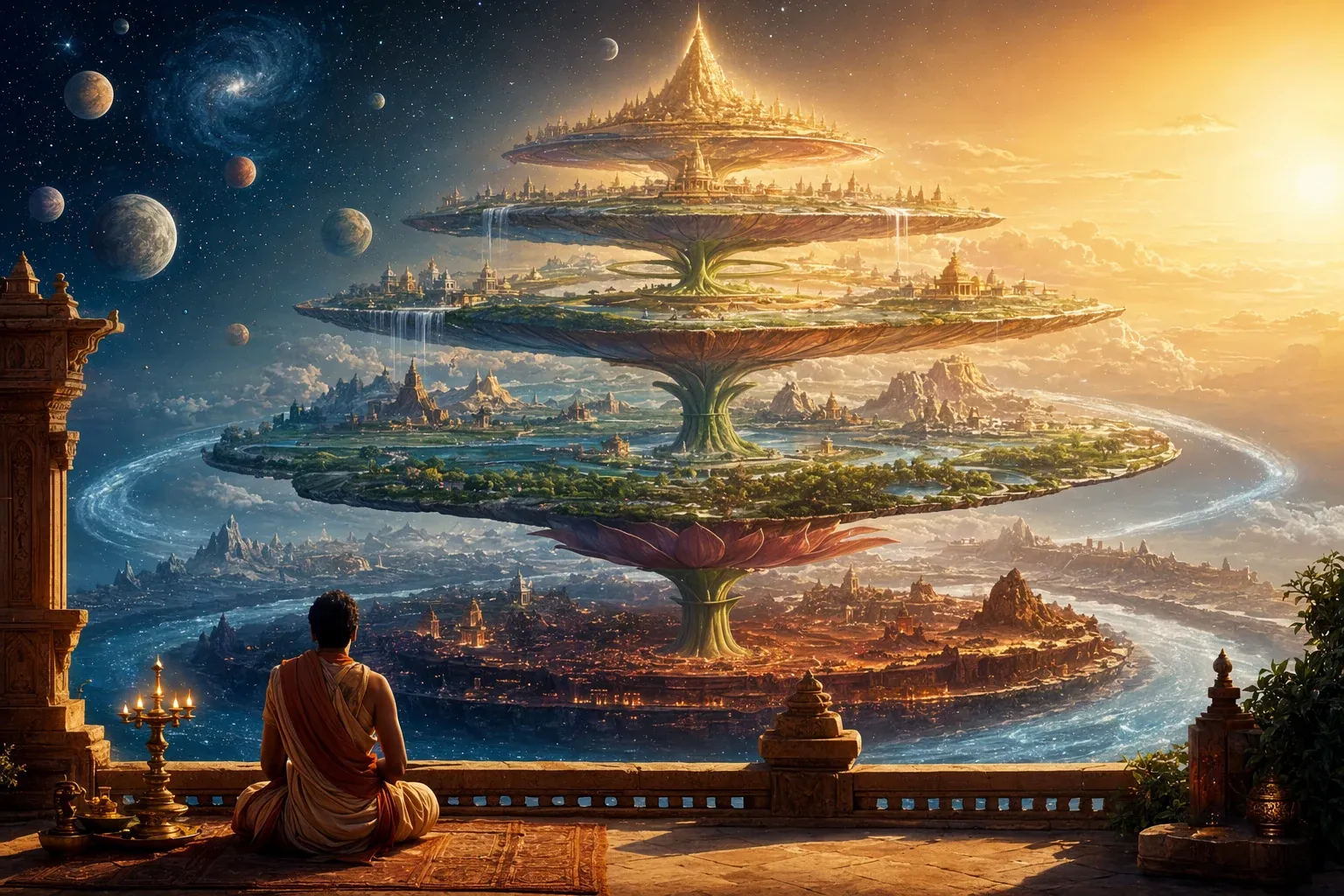
Search for a Hindu cosmology map and you will quickly see colourful charts: fourteen lokas, Mount Meru in the centre, heavenly worlds above, lower worlds below, oceans, continents, gods, sages, nagas, and sometimes the cosmic egg known as Brahmanda. These maps are fascinating, but they can also mislead beginners if we treat them like a modern school atlas. A Hindu cosmology map is usually a teaching diagram. It compresses many textual traditions into one visual form so the mind can begin to understand a layered universe.
The first thing to remember is that Hindu cosmology is not one single drawing. Vedic hymns, Puranas, epics, temple architecture, jyotisha traditions, philosophical schools, and devotional communities can emphasise different images. A chart may be useful, but it is never the whole ocean. It is more like a doorway: it helps us enter the imagination of a cosmos where physical space, moral order, spiritual states, divine beings, and time cycles are linked.
The Loka Idea at the Centre of Many Charts
The most common map-style entry point is the idea of lokas. A loka can mean a world, realm, sphere, or plane of existence. In many popular explanations, seven higher lokas are named: Bhuloka, Bhuvarloka, Svarloka, Maharloka, Janaloka, Tapoloka, and Satyaloka or Brahmaloka. Seven lower lokas are often listed as Atala, Vitala, Sutala, Talatala, Mahatala, Rasatala, and Patala. Together, they produce the familiar fourteen-world structure.
Bhuloka is the earthly realm, the world of human experience. Svarloka is often associated with heaven or the realm of the devas. Maharloka, Janaloka, Tapoloka, and Satyaloka are usually imagined as higher spiritual realms connected with sages, tapas, purity, and Brahma. The lower lokas are not always simple “hells” in the modern sense. Some Puranic descriptions present them as rich, strange, powerful realms associated with nagas, asuras, and subterranean splendour. Patala, for instance, is often more complex than a place of punishment.
This matters because many beginners read “lower” as automatically evil and “higher” as automatically good. Hindu cosmology is subtler. Direction often suggests spiritual refinement, but each realm carries its own story-world, inhabitants, and symbolic meaning.
Mount Meru as a Sacred Axis
Many Hindu cosmology diagrams place Mount Meru at the centre. Meru is not just a mountain in the ordinary geographical sense. It is a sacred axis, a cosmic centre around which worlds, directions, gods, and celestial movements may be imagined. In Puranic geography, Meru connects the map of the universe with sacred kingship, divine order, and the arrangement of continents and oceans.
Temple architecture sometimes echoes this idea. A temple shikhara rising above the sanctum can feel like a symbolic mountain. The devotee moves from the outer world toward the garbhagriha, the womb-like inner chamber, as if travelling from ordinary space toward sacred centre. This does not mean every temple is a literal map of Meru, but the cultural imagination is connected: height, centre, axis, and sanctity belong together.
In Southeast Asian Hindu-Buddhist architecture, such as Angkor Wat in Cambodia, the Meru idea became visually grand. In India too, many temple forms invite us to think vertically: earth below, divine presence above, and the human body moving between them through darshan, mantra, and ritual.
Brahmanda and the Cosmic Egg
Another image often seen in Hindu cosmology is Brahmanda, the cosmic egg. The Sanskrit word joins Brahma or the vast sacred principle with anda, egg. The image suggests a contained universe, a world unfolding from a hidden seed. It is powerful because an egg is both closed and alive. From outside, it looks still. Inside, formation is happening.
Some Puranic accounts describe layers around the cosmos, each larger and subtler than the previous one. Beginners do not need to memorise every layer immediately. The important idea is that the universe is not imagined as a random empty box. It is structured, held, covered, generated, dissolved, and generated again. The map is therefore both spatial and spiritual.
Why Online Diagrams Differ So Much
If two Hindu cosmology maps look different, that does not automatically mean one is fake. They may be based on different texts, different traditions, or different design choices. One chart may focus on the fourteen lokas. Another may show Jambudvipa, oceans, and continents. Another may use Vaishnava devotional cosmology. Another may simplify the topic for children. Some modern graphics mix Sanskrit terms from different sources without explaining the context, so caution is needed.
A good map should tell you what it is based on. Is it presenting a Puranic structure? A temple symbolism model? A philosophical explanation of elements? A devotional universe? If it does not say, use it as a starting point, not as proof. Sacred diagrams can teach beautifully, but they can also flatten a living tradition into one rigid poster.
Reading Upward and Downward Without Losing Balance
The vertical structure of lokas is easy to visualise: higher realms above, earthly realm in the middle, lower realms below. But the deeper teaching is not only about up and down. It is about quality of experience. A human life can be pulled downward by ignorance, greed, anger, and attachment. It can be lifted upward by dharma, knowledge, devotion, tapas, compassion, and self-control. The map outside becomes a mirror inside.
This is why Hindu cosmology often sits close to karma. The universe is not morally empty. Actions have consequences. Beings move through states of experience shaped by conduct, desire, knowledge, and grace. A map of lokas therefore also becomes a map of possibility: where consciousness can get trapped, where it can be refined, and why liberation matters.
Historical and Traditional Context
Historically, the fully developed loka charts most beginners encounter are strongly associated with Puranic imagination, though older Vedic and epic material also contributes to Hindu cosmic thinking. The Puranas are not modern scientific manuals. They are religious-cultural texts carrying myth, genealogy, pilgrimage geography, ritual memory, ethics, and cosmology. They organise the world in ways that make sacred meaning visible.
Traditional readers may accept these realms as real in a sacred sense. Philosophical readers may interpret them as planes of experience. Historians may study how these ideas developed across texts and communities. A respectful beginner can hold these approaches separately instead of forcing a fight between them.
A Practical Way to Use a Hindu Cosmology Map
When you look at a chart, first identify the main purpose. Is it showing lokas, time cycles, creation stages, or sacred geography? Second, check whether the chart names its source. Third, learn a few core terms rather than memorising everything at once. Bhuloka, Svarloka, Patala, Meru, Brahmanda, yuga, kalpa, karma, and dharma are enough for a first pass. Fourth, remember that the visual is a simplification.
The best map is not the one with the most labels. It is the one that helps you ask better questions. What does Hindu thought say about human life? How does it connect ethics with the universe? Why do time, place, gods, ancestors, animals, and unseen beings all matter? Once those questions open, the diagram has done its work.
Questions People Usually Have
Are the fourteen lokas accepted by every Hindu tradition in exactly the same way?
No. The fourteen-loka model is common in Puranic and popular teaching, but Hindu traditions vary in emphasis and interpretation. Some read the lokas literally, some symbolically, and some philosophically.
Is Patala the same as hell?
Not exactly. Patala and the lower lokas are often subterranean or lower realms, but Puranic descriptions can make them wealthy, powerful, and inhabited by nagas or asuras. Hell-like realms are a related but separate topic in many discussions.
Can one diagram show the full Hindu universe?
No single diagram can do that. A chart can teach one model clearly, but Hindu cosmology is a wide tradition with multiple texts, images, and interpretations.