
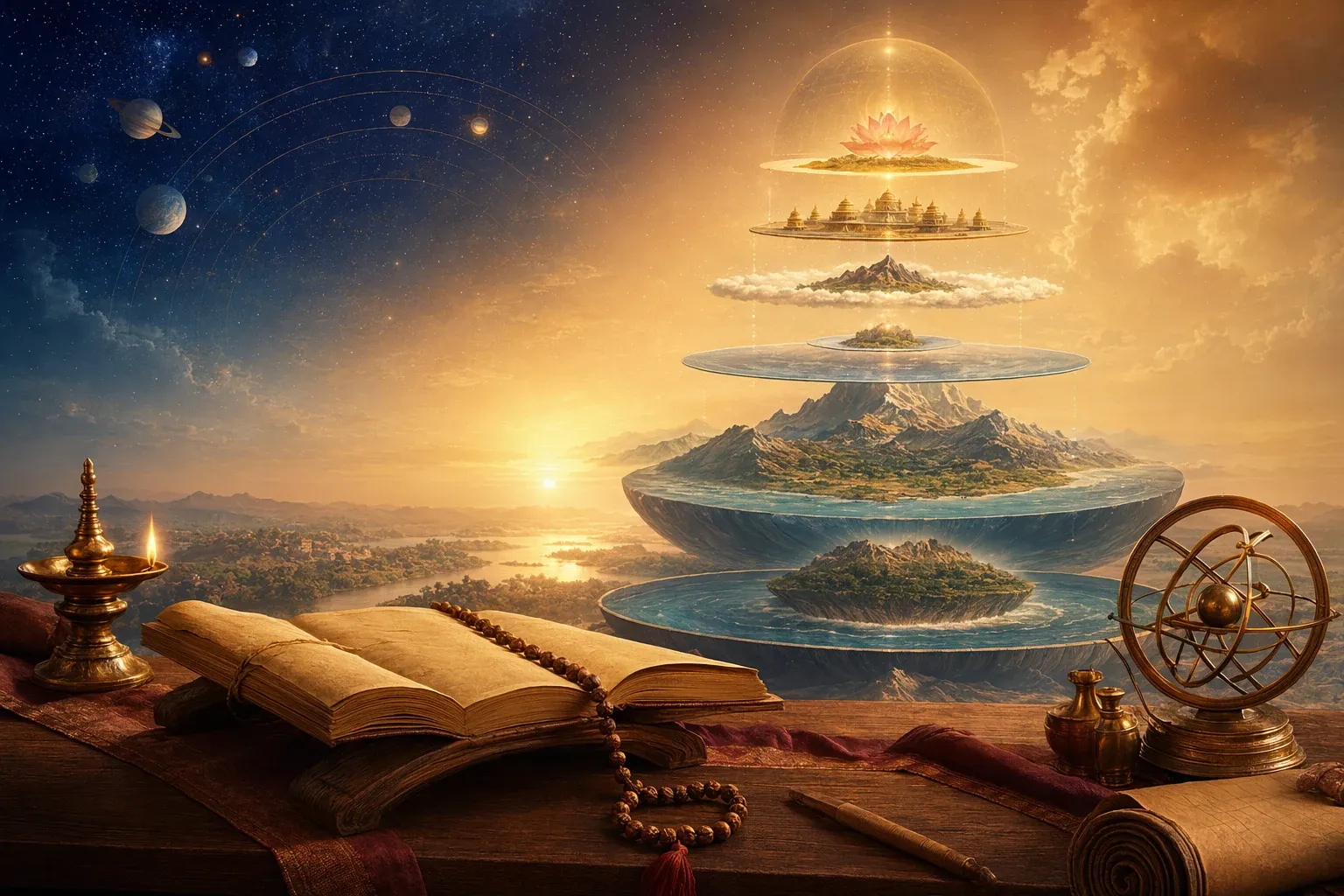
When people say “Hindu Vedic cosmology,” they often imagine one ancient map of the universe: seven worlds, many lokas, huge time cycles and a sacred mountain at the centre. That picture is not entirely wrong, but it is too small. Hindu cosmology is better understood as a layered tradition. It begins with Vedic hymns that ask deep questions about existence, grows through Upanishadic reflections on Brahman and the Self, and becomes more visual in Puranic stories of worlds, oceans, mountains, devas, asuras and repeated creation.
So the simple answer is this: Hindu Vedic cosmology is the Hindu way of thinking about the universe as a meaningful, ordered reality. It is not only about astronomy. It also asks why there is a cosmos, what keeps it ordered, how time moves, and how human action fits into the larger rhythm of dharma and karma.
Why “Vedic” can mean different things
The word “Vedic” can be used in a strict or loose way. Strictly, it refers to the Vedas: the Rig Veda, Sama Veda, Yajur Veda and Atharva Veda, along with connected layers such as Brahmanas, Aranyakas and Upanishads. In Hindu tradition, these are Shruti, “that which is heard,” preserved through careful oral transmission long before print culture. Historically, scholars usually place much of the Vedic period roughly between the second and first millennia BCE, while accepting that the oral tradition is complex and not reducible to one simple date.
In popular speech, however, “Vedic cosmology” often includes later Hindu ideas too. Many familiar cosmic images come from Puranic literature, epic imagination and later temple culture, not directly from a single Vedic hymn. This matters because a beginner should not force every Hindu cosmic idea into one textbook-like chart. Hindu thought preserved many voices: ritual, poetic, philosophical, devotional and mythic.
The Vedic mood: wonder before certainty
One of the most beautiful things about early Vedic cosmology is its sense of wonder. The famous creation hymn of the Rig Veda, often called the Nasadiya Sukta, does not sound like a loud announcement that humans know everything. It asks what existed before existence as we know it. It wonders whether even the highest overseer knows how creation began. That questioning mood is important. It shows that Vedic thought could be devotional and humble at the same time.
Another Vedic idea is rta, cosmic order. Rta is the sense that the universe is not random chaos: sunrise, seasons, sacrifice, truth and right action are connected. Later, the language of dharma develops in many directions, but the old intuition remains powerful: human life should align with a larger order. In Bhaktilipi language, this is where cosmology becomes practical. The universe is not just “out there.” It is also a moral space in which our actions matter.
Upanishadic depth: Brahman, Atman and reality
The Upanishads shift the focus from ritual order to inner understanding. They ask what the deepest reality is and how the self is related to it. Terms like Brahman and Atman become central in many Vedantic traditions. Brahman can be understood as ultimate reality, while Atman points to the deepest Self. Different schools interpret their relationship differently, so it is safer to say “many Vedantic readings” rather than pretend all Hindus explain it in one way.
For cosmology, this creates a major difference from a purely physical map. The universe is not only a collection of objects. It can be seen as an expression, appearance, body or dependent reality in relation to the divine or ultimate truth, depending on the school. Advaita Vedanta, Vishishtadvaita and Dvaita do not explain the cosmos in exactly the same way. That diversity is not a weakness. It is part of Hindu intellectual life.
Puranic imagination: lokas, mountains and cycles
When beginners hear about Bhu-loka, Svarga-loka, Patala, Meru, kalpas and yugas, they are usually entering the Puranic world. Puranas are rich narrative texts, full of genealogy, pilgrimage geography, temple-linked imagination, sacred stories and cosmic scale. They describe multiple realms, vast durations of time and cycles of creation and dissolution. These descriptions are not meant to be read in only one flat way.
For example, Mount Meru appears as a cosmic centre in many Hindu, Buddhist and Jain traditions. A temple tower can echo a mountain form. A mandala can turn cosmic space into sacred geometry. A pilgrim walking around a shrine may be performing a small human version of moving through a meaningful cosmos. In this way, cosmology becomes art, architecture and practice.
Time is cyclical, not only linear
One of the most striking Hindu ideas is cyclical time. Instead of one creation followed by one ending, many Hindu texts speak of repeated creation, preservation and dissolution. Yugas describe moral and cosmic ages; kalpas describe enormous cosmic days; pralaya describes dissolution. Exact numbers vary by text and interpretation, but the broader message is clear: the universe is vast, time is deep, and human pride should become smaller before that scale.
This does not mean every Hindu text gives a modern scientific model. It means Hindu traditions developed a powerful religious imagination of time. The point is not to turn every number into a laboratory claim. The point is to notice the spiritual feeling produced by deep time: humility, patience and awareness that dharma must be practised even inside changing ages.
What beginners should avoid
The first mistake is saying, “Hinduism has one exact cosmology.” It does not. There are Vedic hymns, Upanishadic teachings, Puranic descriptions, philosophical schools and regional devotional traditions. They overlap, but they are not identical.
The second mistake is claiming that ancient texts “proved” every modern scientific discovery. Respect does not need exaggeration. It is more honest to say that Hindu texts contain profound reflections on order, time, consciousness and cosmic scale, while modern astronomy uses mathematics, observation and instruments for a different kind of knowledge.
The third mistake is dismissing symbolic language as “fake.” A sacred story can carry meaning without being a modern physics paper. When a text speaks of worlds above and below, it may be shaping ritual imagination, ethical life and devotion, not simply drawing a school atlas.
A simple way to remember it
Think of Hindu Vedic cosmology as four layers. The Vedic layer asks about origin and order. The Upanishadic layer asks about ultimate reality and the Self. The Puranic layer gives rich pictures of worlds, cycles and divine activity. The lived layer appears in temples, festivals, pilgrimage, art and everyday language of karma and dharma.
For a young reader, that is enough to begin respectfully. Hindu cosmology is not just “ancient space science” and not just “myth.” It is a civilisational conversation about where we are, what kind of universe we live in, and how our life should become more aligned with truth, responsibility and devotion.