
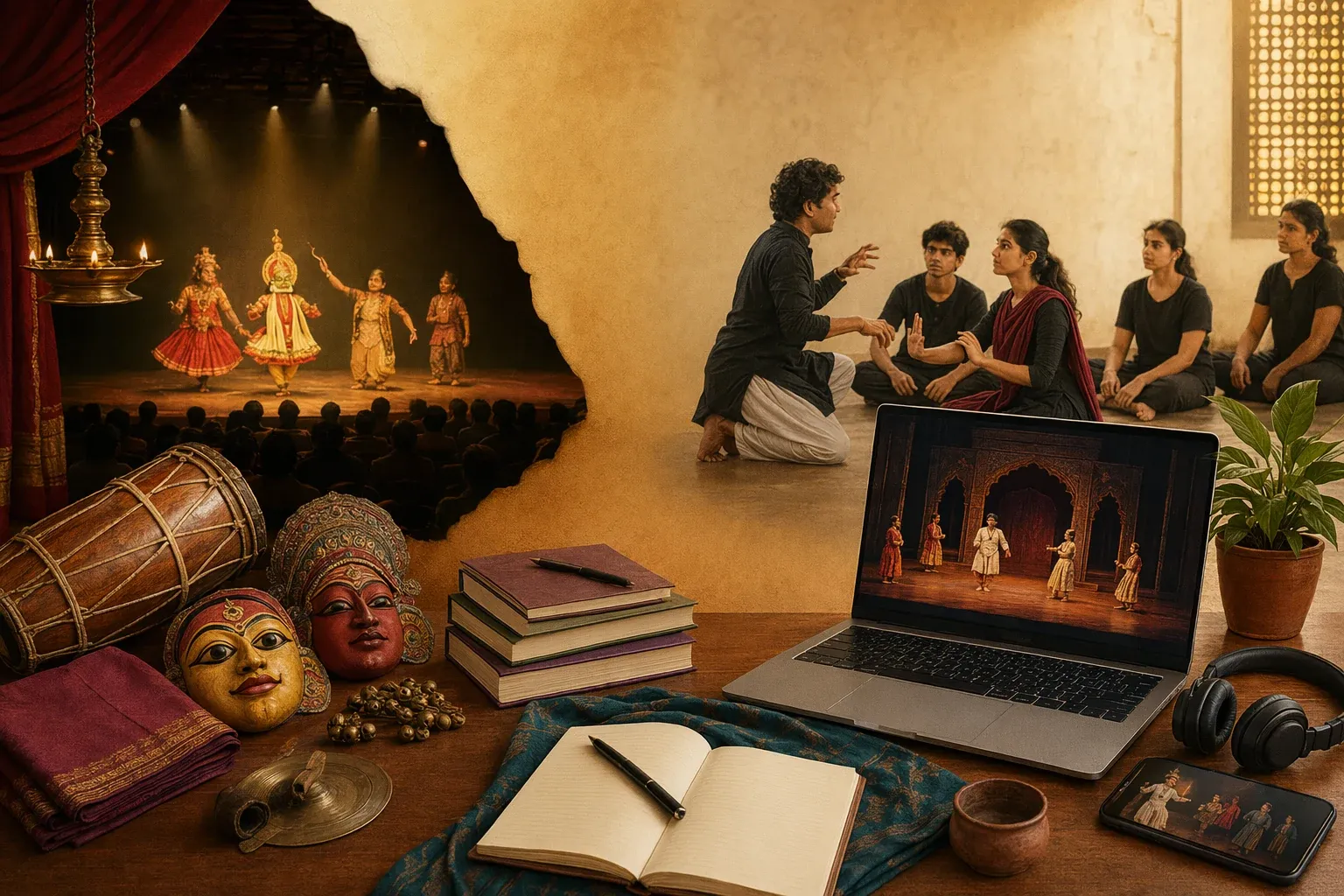
Indian theatre can feel difficult to enter if you are not already part of a drama club or arts circle. Films are easy to find. Songs are everywhere. But plays often happen in specific spaces, on specific dates, with small posters, WhatsApp forwards, college notices, Instagram pages, or ticketing links that disappear after the show. The good news is that Indian theatre is not hidden. You just need to know where to look and how to begin.
This guide is for students, young professionals, parents, and curious culture lovers who want to watch plays, attend local events, join workshops, or learn theatre online without feeling lost. It is not about one city only. India’s theatre life is spread across Mumbai, Delhi, Bengaluru, Kolkata, Chennai, Pune, Kochi, Guwahati, Bhopal, Hyderabad, Ahmedabad, and many smaller towns where local groups keep performing with remarkable dedication.
If you want background before booking a show, first understand the main types of Indian theatre. Festival theatre is also a friendly entry point, so a practical Ramlila watching guide can show how local venues, dates, language, crowd rhythm and community participation shape the experience.
Live performances near you are the best beginning
The best way to understand theatre is to sit in a room with performers and an audience. Live theatre teaches things that recorded clips cannot: silence, timing, breath, stage presence, lighting, mistakes, laughter, and the strange energy that moves between actor and viewer. Begin by checking known venues in your city or state. Mumbai has spaces such as Prithvi Theatre and the National Centre for the Performing Arts. Bengaluru has Ranga Shankara. Delhi has the National School of Drama campus and many independent venues. Kolkata, Pune, Chennai, and Kerala’s cultural centres also have strong theatre circuits.
If you are outside a big city, do not assume nothing is happening. Search for local auditoriums, college theatre festivals, language associations, cultural sabhas, district arts councils, and community halls. Many powerful performances happen in modest spaces, not only in famous theatres.
Ticketing sites and theatre pages work best together
Ticketing platforms are useful for finding professional and semi-professional shows. They can show dates, language, venue, cast, age guidance, and ticket prices. But not every play is listed there. Some groups announce shows mainly through Instagram, Facebook, Telegram, mailing lists, college circles, or venue newsletters. If you enjoy one play, follow the theatre group, director, actors, and venue. That single habit will open many more doors than random searching.
Look carefully at language and duration. Indian theatre may be in Hindi, English, Marathi, Bengali, Kannada, Malayalam, Tamil, Telugu, Assamese, Gujarati, Urdu, or a mix. A language you do not fully know can still be enjoyable if the performance is physical, musical, or visually strong, but it is better to check beforehand.
Watch online with patience and respect
Online theatre is useful, especially when you cannot travel. Some institutions, festivals, and groups share recordings, conversations, lectures, rehearsed readings, or archival clips. YouTube can help, but quality varies a lot. Search using specific words: “Indian theatre performance”, “NSD theatre lecture”, “Marathi natak”, “Kannada theatre”, “Yakshagana performance”, “Kutiyattam”, “IPTA songs”, or the name of a playwright such as Vijay Tendulkar, Girish Karnad, Badal Sircar, Mohan Rakesh, Habib Tanvir, Mahesh Elkunchwar, or Safdar Hashmi.
Be careful with unauthorised uploads. A play recording is not just content; it is someone’s rehearsal time, writing, music, design, labour, and rights. Prefer official channels, festival pages, institution archives, and uploads shared by artists or venues. If a group sells access to a recording, paying for it is a small but meaningful way to support theatre.
Learn through workshops before chasing fame
Theatre workshops are not only for people who want to become actors. They can help with voice, confidence, listening, body awareness, teamwork, storytelling, and language. A good beginner workshop may include warm-ups, theatre games, improvisation, reading scenes, basic movement, voice exercises, and group reflection. It should feel challenging but safe.
Before joining, check who is teaching, how long the workshop is, what age group it is meant for, and whether there will be a final performance. A serious workshop does not need to promise instant stardom. In fact, beware of any class that sells theatre mainly as a shortcut to film fame. Theatre is valuable even when it remains theatre.
Colleges and schools are powerful entry points
For many Indians, the first real theatre experience comes through school annual days, college dramatics societies, street-play teams, youth festivals, or inter-college competitions. These spaces matter. They teach teamwork and discipline at low cost. They also introduce students to writing, direction, stage management, costumes, music, lights, and backstage work.
If you are a student, join even if you are shy. Theatre needs more than lead actors. It needs people who can research, handle props, design posters, manage sound cues, translate scripts, keep rehearsal notes, and help with audience seating. Backstage work often teaches more humility and responsibility than being centre stage.
Explore Indian forms beyond urban stage plays
Indian theatre is much wider than auditorium drama. Try to watch at least a few traditional and regional forms: Yakshagana from Karnataka, Jatra from Bengal and Odisha regions, Tamasha from Maharashtra, Nautanki from North India, Bhavai from Gujarat, Therukoothu from Tamil Nadu, Kutiyattam from Kerala, and Ankiya Naat linked with Assam’s Vaishnav tradition. These forms mix story, music, costume, satire, devotion, dance, and community memory in different ways.
When watching them, avoid treating them as “old-fashioned”. Many forms have changed over time and still speak to local audiences. Ask: What story is being told? How does the performer use voice and costume? What does the audience already know? How is humour used? Which parts feel devotional, social, political, or playful?
Build a simple learning routine
A beginner can follow a three-part routine. First, watch one live or recorded performance every month. Second, read one play or scene every month. Third, attend one discussion, lecture, or workshop whenever possible. Keep a small theatre diary: title, language, venue, playwright, director, what you noticed, and one question you still have.
Over six months, this habit changes your eye. You start noticing blocking, pauses, costume choices, lighting, music, and audience response. You also become a better viewer, which is a real contribution. Indian theatre survives not only because actors perform, but because audiences show up with attention.
Where can I find live Indian theatre performances?
Check local theatre venues, cultural centres, college festivals, official venue calendars, ticketing platforms, and social media pages of theatre groups in your city or language community.
Can I learn Indian theatre online?
Yes, you can begin online through official recordings, lectures, play readings, interviews, and beginner classes. For acting and stagecraft, however, live practice with a group is still extremely valuable.