
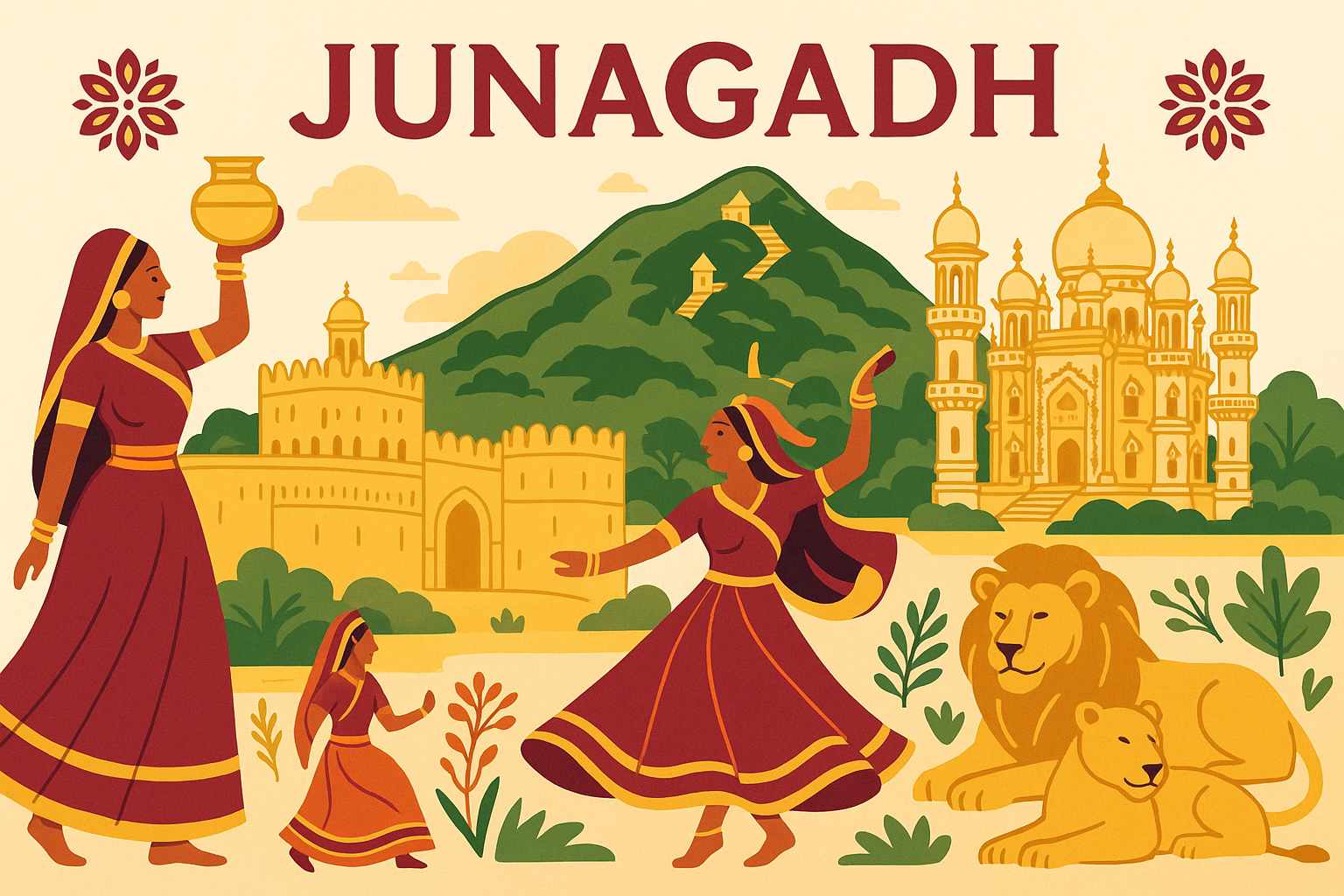
Junagadh, at the foot of the Girnar range in Gujarat’s Saurashtra region, brings together archaeology, Nawabi architecture, living Hindu and Jain pilgrimage and access routes toward Gir’s protected forests. Those subjects are connected, but they are not one attraction and should not be collapsed into a hurried checklist.
A careful visit distinguishes Junagadh city, the physically demanding Girnar pilgrimage and the separately permitted wildlife experiences at Gir, Devalia or Girnar Nature Safari. It also distinguishes recorded history from foundation legends and sacred belief.
Three connected but distinct journeys
- Junagadh city includes Uparkot, rock-cut caves, stepwells, the Ashokan inscription site, Nawabi mausoleums and historic urban quarters.
- Girnar is a mountain pilgrimage landscape with Hindu, Jain and other religious associations, approached by steps and, for part of the ascent, a ropeway.
- Gir wildlife visits use controlled forest zones and official permits. Sasan Gir is outside central Junagadh and requires its own transport and schedule.
Allowing separate time for each produces a more accurate and respectful experience than promising that every site can be covered in one day.
Reading Uparkot’s layered history
Uparkot is Junagadh’s historic citadel. The Junagadh district culture and heritage page connects its origin to Chandragupta Maurya and 319 BCE, while Gujarat Tourism describes a roughly 2,300-year historical span. That early attribution is part of the official local narrative; the surviving fort contains structures and alterations from many later periods.
It is therefore misleading to describe every wall, gate or passage as Mauryan. The site’s value comes from its layers: fortifications, water systems, religious remains and buildings shaped under successive political regimes.
Adi Kadi Vav and Navghan Kuvo
Within the Uparkot complex, Adi Kadi Vav and Navghan Kuvo demonstrate different rock-cut approaches to water access. The district tourism listing dates Adi Kadi Vav to the fifteenth century and describes its long stairway; it associates Navghan Kuvo with the early eleventh century.
Popular legends explain the names and construction of these places, but legend should not replace the physical and documentary record. Steps can be steep, uneven or slippery. Barriers and closed sections must be respected.
Buddhist rock-cut heritage
Junagadh’s protected monuments include the Uparkot caves and the Baba Pyare and Khapra Kodia groups. The Archaeological Survey of India lists the Ashokan rock edict, Buddhistic Cave and Baba Pyare–Khapra Kodia caves among centrally protected sites in Junagadh.
“Buddhist caves” here generally refers to rock-cut monastic or ritual spaces, not natural caves. Their chronology and surviving fabric differ by group. Visitors should not touch carvings, scratch surfaces or enter closed areas.
Ashoka’s edicts—and later inscriptions
On the route toward Girnar, a boulder bears Ashoka’s Major Rock Edicts from the third century BCE. Gujarat Tourism and the district administration describe fourteen edicts in Brahmi script addressing ethical government, restraint and conduct.
The same inscription site is historically broader than Ashoka alone: later rulers also added important inscriptions to the rock. A short tourism paraphrase of “peace and compassion” cannot substitute for scholarly translation, and the language should not be simplistically called modern Pali without attention to Prakrit, script and epigraphic context.
The Archaeological Survey of India controls the protected monument. Current hours and tickets should be checked through ASI or on site rather than copied permanently from an old article.
Mahabat Maqbara and Nawabi Junagadh
Junagadh became a state ruled by Babi Nawabs in the eighteenth century. Gujarat Tourism’s heritage material describes the city’s nineteenth-century maqbara complex as mausoleums of the Nawabs and minister Baha-ud-din, with richly embellished façades, domes and an eclectic architectural vocabulary.
The frequently photographed spiral staircases belong to the minarets of the neighbouring Bahauddin Maqbara complex. Naming the whole scene simply “Mahabat Maqbara Palace” can blur separate buildings and their funerary purpose.
This is memorial architecture, not a fantasy palace or unrestricted photography set. Follow current access rules and avoid climbing or entering closed spaces.
The historic city beyond headline monuments
Gujarat Tourism’s Junagadh Heritage Walk traces the city’s expansion beyond Uparkot and documents Babi-period urban spaces such as Limda Chowk, Diwan Chowk, Circle Chowk and Mandvi Chowk. It also points to Jain temples, mosques, havelis and civic buildings.
The walk is useful evidence that Junagadh’s heritage is not limited to isolated monuments. Markets and neighbourhoods are living spaces: do not block commerce, photograph residents without consent or assume that every historic building is publicly accessible.
Girnar as a shared sacred landscape
The district administration’s Girnar page describes a mountain group sacred to Hindu and Jain communities. Jain temple groups, especially the Neminath tradition, stand alongside Hindu pilgrimage destinations associated with Ambaji, Gorakhnath, Dattatreya and other traditions.
Different destinations lie at different elevations and may require long climbs beyond the ropeway’s upper station. “Approximately 10,000 steps” is often used for the journey toward the highest pilgrimage points, but routes and counts vary. The ropeway does not eliminate every climb.
Girnar also has Nath, sadhu and festival traditions. Visitors should not treat religious specialists, pilgrims or rituals as spectacle. Ask before photography and yield space to those undertaking vows or worship.
Preparing for the Girnar climb
- Check weather, ropeway operation, festival crowds and local advisories on the day.
- Begin with realistic knowledge of fitness, heat and the return journey.
- Carry water where permitted, but do not leave plastic or food waste.
- Wear footwear suited to steps; remove it only where a shrine requires.
- Do not feed monkeys or other animals.
- Respect separate temple rules, dress expectations and photography restrictions.
- Seek medical advice before a strenuous ascent if health conditions make exertion risky.
Gir wildlife: not a city attraction
The Gir protected landscape is the last wild stronghold of the Asiatic lion, but a wildlife permit is never a promise of a lion sighting. The official system distinguishes Gir Jungle Safari at Sasan, Devalia Safari Park, Ambardi Safari Park and Girnar Nature Safari.
These products have different entrances, routes, closures and purposes. Girnar Nature Safari near Junagadh is not the same as the Sasan Gir Jungle Trail, and Devalia is not an unrestricted substitute for the national park.
Use only the official Gir online permit system. Its terms require original identification, state that guide and vehicle charges may be separate, and allow authorities to change slots for weather or other circumstances. The official site also publishes annual monsoon closures and warns against fraudulent booking sites.
Ethical wildlife visits
- Accept that sightings are uncertain and never pressure a driver to chase wildlife.
- Remain in the authorised vehicle and follow the eco-guide.
- Keep voices low; do not feed, call or block animals.
- Do not use flash or publish sensitive locations.
- Book the correct site and report to its named reception centre.
- Recheck closure dates and permit terms shortly before travel.
Damodar Kund and foothill sites
Damodar Kund at Girnar’s foothills is sacred in Hindu practice and is used for rites including immersion of cremation remains. It should be approached as an active ritual place, not simply a scenic lake. Avoid photographing mourners or ceremonies, and follow local water and safety rules.
Other foothill temples and ashrams have their own traditions and access arrangements. A map label does not imply open entry or identical etiquette.
Planning time and transport
Junagadh is connected by rail and road within Gujarat. Airport routes, train services and road times change, so verify them through the current transport operator rather than relying on old distance tables.
A practical plan often gives one period to city monuments, another to Girnar and a separate booked day for Sasan Gir if desired. Monument restoration, festival crowds, forest closures and summer heat can all change what is feasible.
Frequently asked questions
Is Uparkot Fort really 2,300 years old?
Official local accounts connect its origins to the Mauryan period, but the surviving complex contains many later layers. Do not assign one date to every structure.
Are Ashoka’s edicts inside Uparkot?
No. The protected inscription boulder is on the route toward Girnar, separate from the main fort complex.
Can the Girnar ropeway reach every temple?
No. It assists with part of the ascent, but several destinations require further walking and substantial steps.
Is Gir National Park in Junagadh city?
No. Junagadh is an access point, but the main Sasan Gir safari reception requires a separate road journey and permit.
Will a Gir safari show visitors an Asiatic lion?
No sighting is guaranteed. The visit is to a managed wild habitat, not an animal display.