
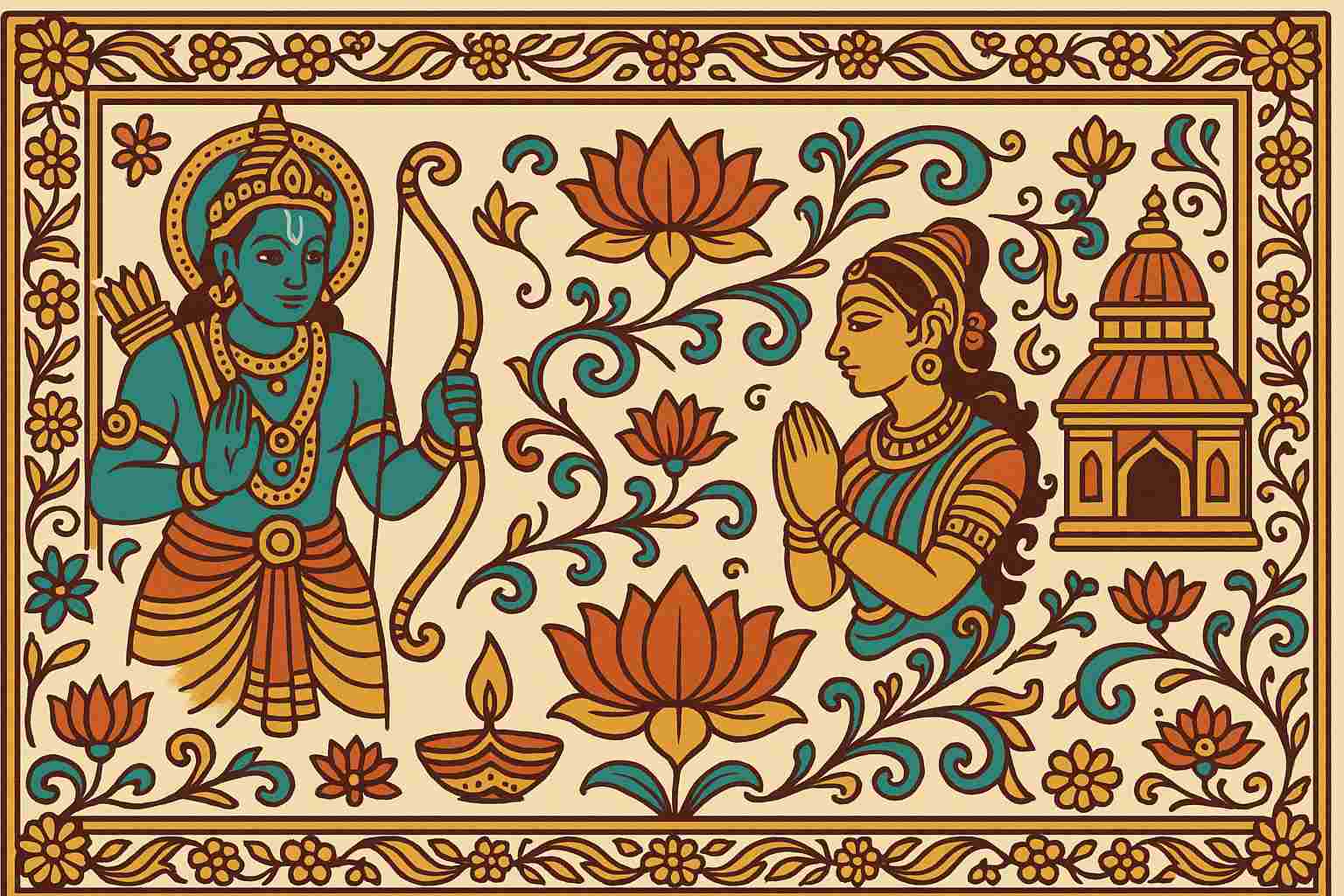
Pattachitra is a traditional painting practice closely associated with Odisha, especially the Jagannath tradition around Puri and communities of hereditary chitrakars. The name combines patta, a prepared cloth or surface, and chitra, picture or painting.
Odisha Pattachitra is not simply any colorful mythological image on fabric. Its prepared ground, line work, pigments, borders, themes and workshop knowledge belong to a specific craft tradition. It is also a living art: artisans make ritual paintings, narrative panels, palm-leaf work and contemporary objects for changing markets.
What Pattachitra means
“Pattachitra” and “Patachitra” are both common English spellings. In this guide, Pattachitra refers primarily to the GI-registered Odisha handicraft. India’s Development Commissioner (Handicrafts) describes it as cloth painting rooted in religious and mythological themes, with a strong connection to Jagannath temple traditions.
The literal meaning is useful but not a complete definition. A factory print on cloth is not automatically a traditional Pattachitra, and not every work by an Odisha artist must repeat an old composition unchanged.
History and the Jagannath connection
Official handicrafts material links the Odisha tradition to Puri, pilgrimage and the Chitrakara community. Paintings were made for ritual and storytelling and sold to pilgrims as portable sacred images. Jagannath, Balabhadra and Subhadra remain central subjects.
One important ritual context is the production of painted representations associated with the period when the temple deities are unavailable for ordinary public viewing after the bathing festival. Details should be learned from current temple and artisan sources rather than reduced to a tourist anecdote.
Raghurajpur near Puri is widely known for Pattachitra and other arts. Odisha Tourism presents it as a heritage crafts village where artisan households continue painting, palm-leaf engraving and related practices. The tradition is broader than one village, however, and individual artists should be credited rather than treated as anonymous representatives of “ancient India.”
How an Odisha Pattachitra is made
Methods vary by workshop and intended object, but the official handicrafts account describes a multi-stage process involving the whole artisan household.
1. Preparing the patta
Layers of cotton cloth are joined and coated with a mixture traditionally made from tamarind-seed adhesive and chalk or white mineral powder. After drying, the surface is polished with stones or similar tools to create a smooth, firm ground.
2. Planning and drawing
The artist establishes the composition and outlines figures, ornaments, architecture, animals and decorative borders. Strong controlled line is a defining visual feature. Repeated motifs are disciplined design, not evidence that the work was mechanically printed.
3. Preparing and applying color
Traditional palettes use pigments derived from materials such as conch shell for white, lamp soot for black, minerals or earths for other colors, combined with binders. Contemporary artists may also use prepared pigments. A seller should state materials honestly rather than calling every bright color “natural.”
4. Detailing and outlining
Colors are laid within the design, decorative patterns are added and final dark outlines strengthen the forms. Borders frame the narrative and often carry floral or geometric rhythm.
5. Finishing
The work may be polished or given a protective finish. Treatment depends on materials and market use; heavy varnish or artificial aging is not proof of tradition.
Visual characteristics to notice
- firm, flowing outlines and clearly organised figures;
- decorative borders that complete the composition;
- flat areas of color rather than illusionistic Western-style shading;
- repeated floral, architectural and textile-like pattern;
- narrative scenes arranged for legibility;
- expressive eyes, profile conventions and stylised posture;
- dense use of the surface without treating empty space as a defect.
These are tendencies, not a checklist for declaring a work authentic. Scale, subject, period, artist and intended use can change the result.
Common subjects and stories
Jagannath imagery, Krishna’s life, avatars of Vishnu, the Ramayana and Mahabharata are prominent themes in official craft descriptions. Artists also depict Ganesha, Devi traditions, regional festivals, animals, tree motifs and composite narrative scenes.
Meaning comes from more than identifying a deity. Gesture, attribute, vehicle, surrounding figures and episode determine the narrative. A blue figure is not automatically Krishna, and every circular composition should not be given one universal interpretation.
Palm-leaf work and other surfaces
Odisha artisan practice includes engraved and illustrated palm-leaf work, often called talapatra chitra, alongside cloth painting. Painting also appears on wood, masks, boxes, coconuts and contemporary decor objects.
These adaptations can support artisan livelihoods, but buyers should not assume that a painted bottle and a ritual cloth serve the same function. Material, technique and purpose should be described accurately.
Odisha Pattachitra and Bengal Patachitra are related, not identical
West Bengal has its own Patachitra or pat tradition. The Development Commissioner (Handicrafts) describes Bengal Patachitra as a scroll-painting and storytelling practice maintained by Patuas, who traditionally unroll painted scenes while singing narratives.
Odisha Pattachitra and Bengal Patachitra share Indic words connected with painted cloth or scrolls, and both are living narrative arts. They differ in regional history, communities, formats, performance contexts, iconography and craft systems. Calling one a copy or treating both as a single uniform style erases those distinctions.
GI status and what it means
Intellectual Property India lists Orissa Pattachitra as a registered geographical indication for handicrafts, and separately records the registered Orissa Pattachitra logo. GI status identifies a protected regional craft linked with defined producers and specifications.
A GI is not a personal quality score. It does not mean every piece has identical materials, complexity or artistic merit. Nor should a shop use the GI name to disguise a machine print as a hand-painted original.
How to buy responsibly
- Ask whether the work is hand-painted, printed, or a combination.
- Request the artist’s or workshop’s name and location.
- Ask about the ground, pigments and finish without demanding that every material be “ancient” or “all natural.”
- Look for consistent line work and signs of hand process, but do not bargain by devaluing the time involved.
- Use recognised artisan cooperatives, government emporia, credible craft organisations or direct artisan purchases where possible.
- For a claimed GI product, ask for traceable information rather than trusting a copied logo.
- Do not request unauthorised copying of a living artist’s composition.
A small work can be genuine and a large work can be printed. Price, age-looking varnish and religious subject alone do not prove authenticity.
Caring for a painting
- Keep it away from damp walls, leaks, strong heat and prolonged direct sunlight.
- Frame with suitable spacing so the painted surface does not stick to glass.
- Do not clean pigments with water, household spray or oil.
- Handle with clean dry hands and support the entire object when moving it.
- For flaking, mold or tears, consult a paper/painting conservator rather than applying glue.
Material-specific advice from the artist should override generic internet instructions.
Visiting Raghurajpur respectfully
Raghurajpur is a lived-in village and workplace, not an open-air stage. Ask before entering a home workshop or photographing residents. Pay fairly, avoid blocking work, and allow artists to explain their own methods and subjects. Odisha Tourism should be checked for current access and visitor programmes.
Frequently asked questions
Is Pattachitra only from Odisha?
The term is strongly associated with Odisha’s GI-registered craft, while Bengal has a distinct Patachitra tradition. Specify the region rather than claiming one uniform pan-Indian style.
Are all Pattachitra colors natural?
Traditional practice uses prepared mineral, earth, shell and soot-based pigments, but contemporary materials vary. Ask the artist or seller rather than assuming.
Is every Pattachitra painted on cloth?
Prepared cloth is central to the name and tradition, but associated artisan practices also use palm leaf, wood and contemporary objects. Those should be labelled by their actual material.
How can I tell a hand painting from a print?
Examine lines and repeated details closely, ask about the process and obtain artist/workshop information. Visual inspection alone may not be conclusive for a high-quality reproduction.
What makes Raghurajpur important?
It is a prominent Odisha craft village associated with Pattachitra, palm-leaf work and other living arts, but it is not the only community connected with the tradition.