
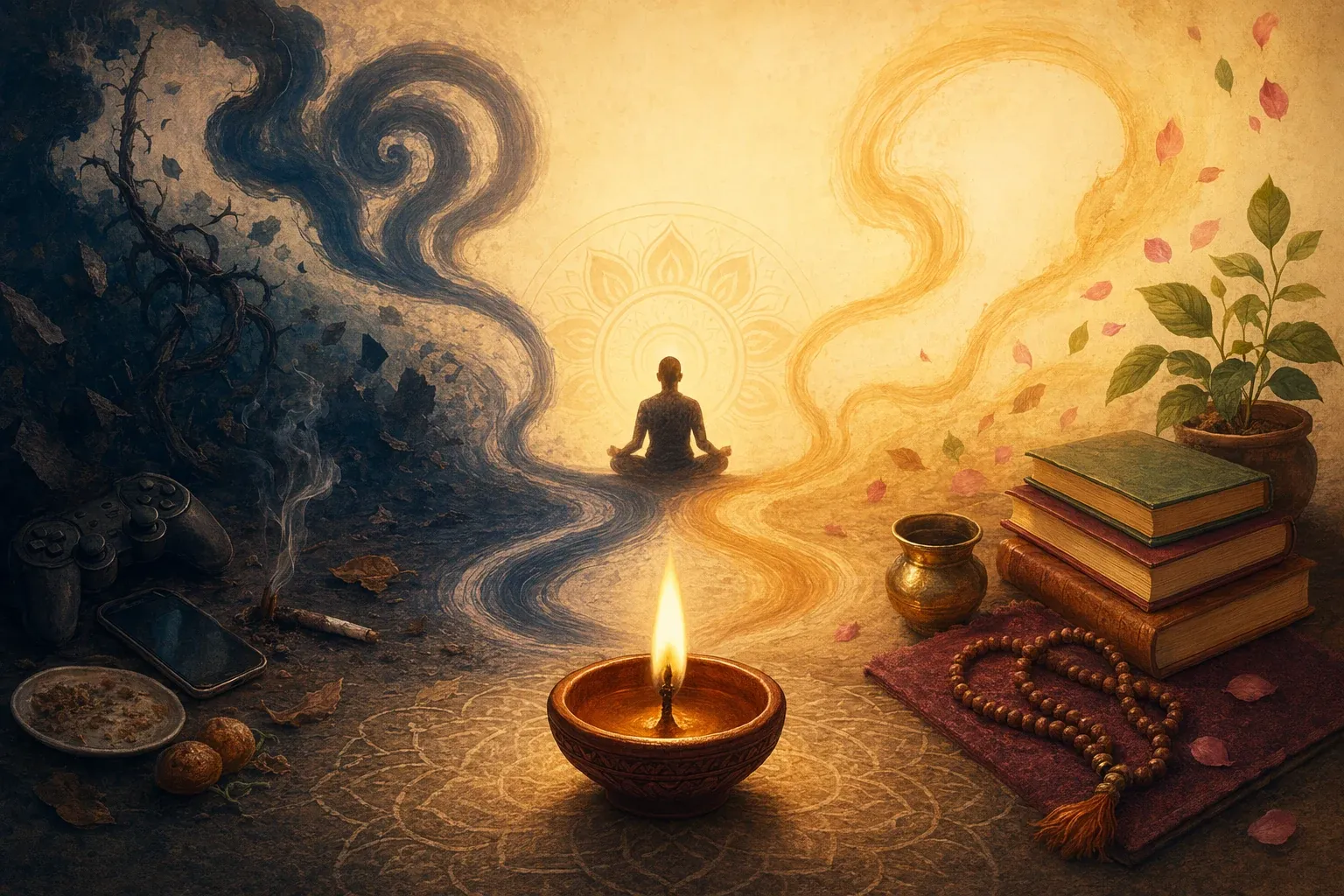
Samskara is one of those Sanskrit words that becomes easier when we stop treating it as a mystery word and look at ordinary life. A samskara is an impression left on the mind and character. It can come from repeated actions, repeated thoughts, family habits, education, rituals, language, fear, kindness, discipline, anger, and many small choices made again and again.
So, can samskaras be good or bad? Yes, in a practical sense they can be helpful or harmful. A helpful samskara makes the mind steadier, kinder, more truthful, and more capable of doing the right thing. A harmful samskara makes a person react in ways that create confusion, hurt, fear, laziness, pride, or repeated mistakes. The important point is that samskaras are not a permanent label on a person. They are patterns, and patterns can be strengthened, weakened, corrected, or replaced.
For the wider meaning of the word, read What Is Samskara? Meaning in Hinduism, Yoga, and Daily Life. For the inner-habit side of the same idea, see Samskara in Yoga: Mental Impressions, Habits, and Inner Patterns.
What a Positive Samskara Looks Like
A positive samskara is not only a big religious habit or a formal family tradition. It can be very small. A child who is taught to greet elders respectfully may gradually develop a natural sense of humility. A student who studies a little every evening may form the impression that learning is a normal part of life, not a punishment before exams. A family that speaks gently during disagreements teaches the mind that anger is not the only way to respond.
In Hindu thought, this is why action matters so much. Every action does not disappear after it is done. It leaves a trace. When a person repeats patience, patience becomes easier. When a person repeats honesty, truthfulness becomes less frightening. When a person repeats prayer, silence, reading, service, or gratitude, the mind begins to recognise those actions as familiar paths.
Everyday Examples of Helpful Samskaras
One useful example is the habit of pausing before speaking. A person may feel irritated, but if they have practised pausing, they do not immediately say the first harsh sentence that comes to mind. That pause is a samskara of self-control. It protects relationships.
Another example is respect for food. In many homes, children are taught not to waste food, to share first, or to remember the effort behind a meal. Over time this can build gratitude. It may also create sensitivity toward farmers, cooks, parents, and people who do not have enough.
A third example is regular study. The deeper samskara is not merely “I finished homework.” It is “I can return to a difficult task without running away.” That impression becomes valuable later in work, relationships, spiritual learning, and public life.
Kind speech is also a strong positive samskara. A person who has repeatedly seen elders apologise, thank others, and correct mistakes without humiliation learns that dignity and softness can exist together. Such a person may still become angry, but they have another road available inside the mind.
What a Negative Samskara Looks Like
A negative samskara is a repeated pattern that pulls a person away from clarity and goodness. It may begin with one action, but it becomes stronger through repetition. If someone lies once to escape trouble and it works, the mind may learn that lying is useful. If lying is repeated, honesty starts feeling risky and unnatural.
The same happens with anger. A person who shouts whenever they are challenged may start believing that force is the only way to be heard. After some time, even a small disagreement feels like an attack. The reaction becomes faster than thought. That is how a harmful impression gains strength.
Negative samskaras do not always look dramatic. Constant comparison is one. A student who always measures life by another person’s marks, clothes, phone, body, or popularity may develop the impression that their own life is never enough. Laziness can become another. If a person repeatedly postpones what matters, the mind becomes skilled at excuses.
Everyday Examples of Harmful Samskaras
Imagine a teenager who is mocked whenever they ask a question. Slowly they may stop asking, even when they are confused. The harmful samskara here is not stupidity; it is fear around learning. The person may need encouragement and safe teachers to replace that impression.
Another example is careless speech. If jokes are always made at someone else’s expense, the mind becomes trained to enjoy humiliation. Later, even when the person wants good friendships, their speech may keep hurting people.
A third example is the habit of blaming others for every problem. If this is repeated for years, self-reflection becomes uncomfortable. The person may protect their ego, but they lose the chance to grow.
Even spiritual life can be affected. A person may perform an outer practice while carrying pride, judgement, or mechanical behaviour. The outer action may be traditional, but the inner impression depends on attention, humility, and intention. This is why many teachers place so much value on bhava, the inner attitude.
Are Samskaras the Same as Destiny?
Samskaras influence us, but they are not the same as fixed destiny. They are more like grooves made by repeated movement. Water flows easily through an old channel, but a new channel can be made with effort. In the same way, the mind tends to follow familiar patterns, yet conscious practice can create new ones.
This is a hopeful idea. It means a person is responsible, but not trapped. Someone who has developed anger can practise patience. Someone who has developed fear can practise courage in small steps. Someone who has developed selfishness can practise generosity. Change is usually slow because old impressions are strong, but slow change is still real change.
How Positive Samskaras Are Built
Positive samskaras are built by repetition with awareness. One kind act is good; repeated kindness becomes character. One honest answer is good; repeated honesty becomes strength. One morning of study is good; repeated study becomes discipline.
Family, school, friends, books, rituals, festivals, stories, and community all matter because they give repeated impressions. A child who repeatedly hears stories of courage, compassion, sacrifice, and wisdom receives more than entertainment. They receive inner examples. This is one reason Indian traditions give importance to stories from the Ramayana, Mahabharata, Puranas, saint-poets, freedom movements, village memory, and family elders. The stories become mirrors for choice.
But repetition should not become blind copying. A positive samskara also needs understanding. Respect is healthier when it includes dignity for everyone, not fear. Discipline is healthier when it supports learning, not shame. Devotion is healthier when it opens the heart, not when it becomes pride over others.
How Harmful Samskaras Can Be Weakened
The first step is noticing the pattern. “I always interrupt.” “I become cruel when I am embarrassed.” “I avoid difficult work.” “I compare myself constantly.” Naming the pattern honestly reduces its hidden power.
The second step is replacing it with a small opposite action. A person who interrupts can practise listening until the other person finishes. A person who wastes time can keep one fixed study hour. A person who speaks harshly can pause, drink water, and choose a simpler sentence. A person who compares can practise gratitude for one real thing in their own life.
The third step is choosing good company and good inputs. If the mind is constantly fed anger, gossip, mockery, or greed, harmful impressions become stronger. If it is fed thoughtful conversation, good reading, service, music, silence, nature, and sincere friendship, better impressions have space to grow.
A Simple Way to Remember It
Samskaras are like seeds and pathways. Whatever we repeat, we water. Whatever we practise, we make easier to practise again. Good samskaras do not make a person perfect, and bad samskaras do not make a person hopeless. They simply show how deeply everyday life shapes the inner world.
For a young reader, the lesson is practical: choose one small habit that makes you clearer, kinder, braver, or more truthful, and repeat it. Also notice one habit that makes you smaller, harsher, or more confused, and gently interrupt it. Over time, these small choices become the impressions from which character is built.