
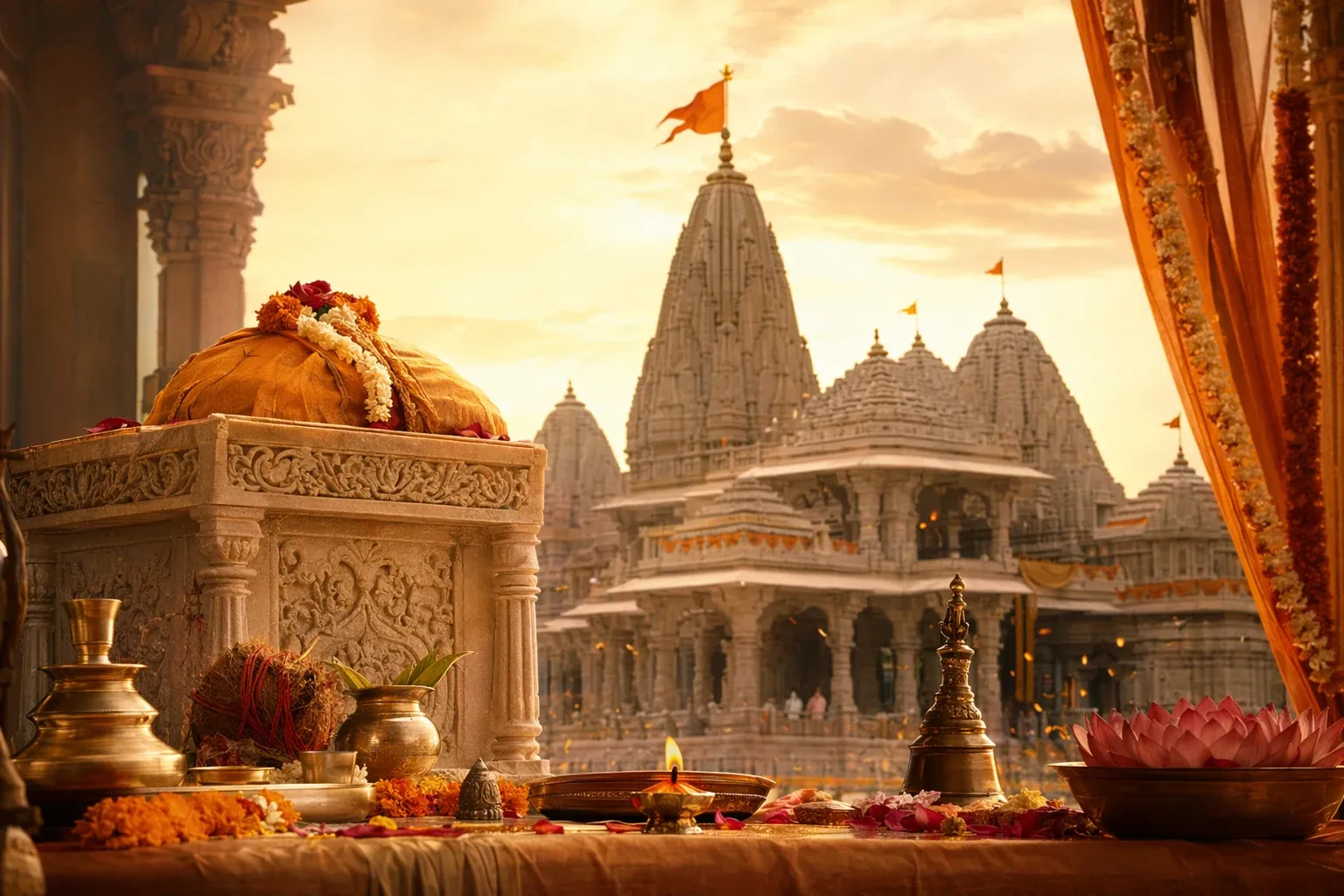
Why the Ram Mandir ceremony drew attention
The Prana Pratishtha at the Ram Mandir became important because it was not only a temple ritual seen by a small group of devotees. It was connected with devotion to Shri Rama, a long public memory, a major sacred site, and the emotional life of millions of people. For many, the ceremony marked the beginning of regular darshan of Ram Lalla in a newly established temple setting.
To understand why it mattered, one must first understand Prana Pratishtha itself. It is the consecration through which a deity's presence is ritually honored in a sacred form. The murti becomes the focus of worship, offerings, festivals, and community devotion. A simple introduction is available in What Is Prana Pratishtha?
Rama as a living devotional presence
Shri Rama is loved as Maryada Purushottama, the ideal king and embodiment of dharma, compassion, courage, restraint, and truth. Devotion to Rama is expressed through the Ramayana, Ramcharitmanas, bhajans, katha, temple worship, nama japa, festivals such as Rama Navami and Diwali, and family traditions across regions.
For devotees, Rama is not only a figure of the past. Rama is remembered, sung, invoked, and loved in daily life. The consecration of Ram Lalla therefore carried a deeply personal meaning for many people. It gave a visible, ritually established form for darshan and worship in a place associated with Rama's sacred story.
The meaning of Ram Lalla
The name Ram Lalla refers to Rama in child form. Worship of a child form of the divine has a tender devotional mood. Devotees may feel affection, care, protection, and closeness. This mood is different from approaching Rama only as king or warrior. It invites the heart to bow with love as well as reverence.
In such worship, offerings, clothing, ornaments, music, and daily care can carry the feeling of serving the divine child. After Prana Pratishtha, these forms of seva become part of temple rhythm.
Ritual importance and public emotion
A Prana Pratishtha ceremony often includes purification, sankalpa, mantras, offerings, fire rites, and the formal honoring of the deity's presence. In the Ram Mandir context, these ritual elements were joined with public emotion. Many people watched from afar, while others gathered in temples or homes, sang Rama's name, lit lamps, or offered prayers.
This does not mean everyone understood every ritual detail. Many experienced the event through devotion: folded hands, tears, songs, silence, or gratitude. Ritual and emotion met in a shared moment of darshan.
Why consecration is more than construction
A temple building can be architecturally impressive before consecration. It may have carved pillars, a sanctum, lamps, and carefully planned spaces. But in Hindu temple life, the building becomes fully centered when the deity is consecrated and daily worship begins.
This is why Prana Pratishtha is not simply the completion of construction. It marks the sacred beginning of worship. The temple's meaning is fulfilled through darshan, offerings, festivals, and ongoing service. For the ritual overview, see what happens during Prana Pratishtha.
A ceremony with many layers
The Ram Mandir ceremony carried ritual, devotional, cultural, historical, and emotional layers. Some people focused on theology: the deity's presence in the murti. Some focused on pilgrimage and temple worship. Some remembered family stories and songs of Rama. Some saw a civilizational moment. Others approached it primarily as a sacred occasion for prayer.
A respectful explanation can acknowledge these layers without reducing the ceremony to politics or spectacle. For devotees, the heart of the matter remained Ram Lalla's darshan and the beginning of worship in the temple.
What happens after such a ceremony?
After Prana Pratishtha, attention shifts to daily care. The deity is worshipped regularly. Devotees visit for darshan. Priests maintain temple routines. Festivals grow around the consecrated presence. The temple becomes part of pilgrimage routes, family vows, personal prayers, and shared memory.
This afterlife of the ceremony is crucial. A single day may draw cameras and attention, but the temple's sacred life continues through daily seva. See what happens after Prana Pratishtha for a general explanation.
How beginners can approach the subject
Beginners can approach the Ram Mandir Prana Pratishtha by learning three things. First, understand the meaning of consecration in Hindu worship. Second, understand Rama bhakti, especially the love for Ram Lalla. Third, recognize that large public ceremonies may carry many emotions at once.
It is possible to be curious without being dismissive, and devotional without making exaggerated claims. The respectful question is not only, What happened on that day? It is also, What relationship with the divine did the ceremony establish for devotees?
Frequently asked questions
Was the Ram Mandir ceremony a Prana Pratishtha?
Yes, it was widely described as the Prana Pratishtha of Ram Lalla, marking the consecration of the deity for worship and darshan.
Why did people watch from home?
Many devotees felt connected through Rama bhakti even if they could not be physically present. Watching, praying, singing, or lighting lamps became ways to participate emotionally.
Is Prana Pratishtha unique to Ram Mandir?
No. Prana Pratishtha is part of Hindu temple traditions more broadly. The Ram Mandir ceremony became especially prominent because of the deity, place, history, and public devotion.
What is the main spiritual meaning?
For devotees, the central meaning is the respectful establishment of Ram Lalla as the focus of worship, darshan, seva, and continuing devotion.