
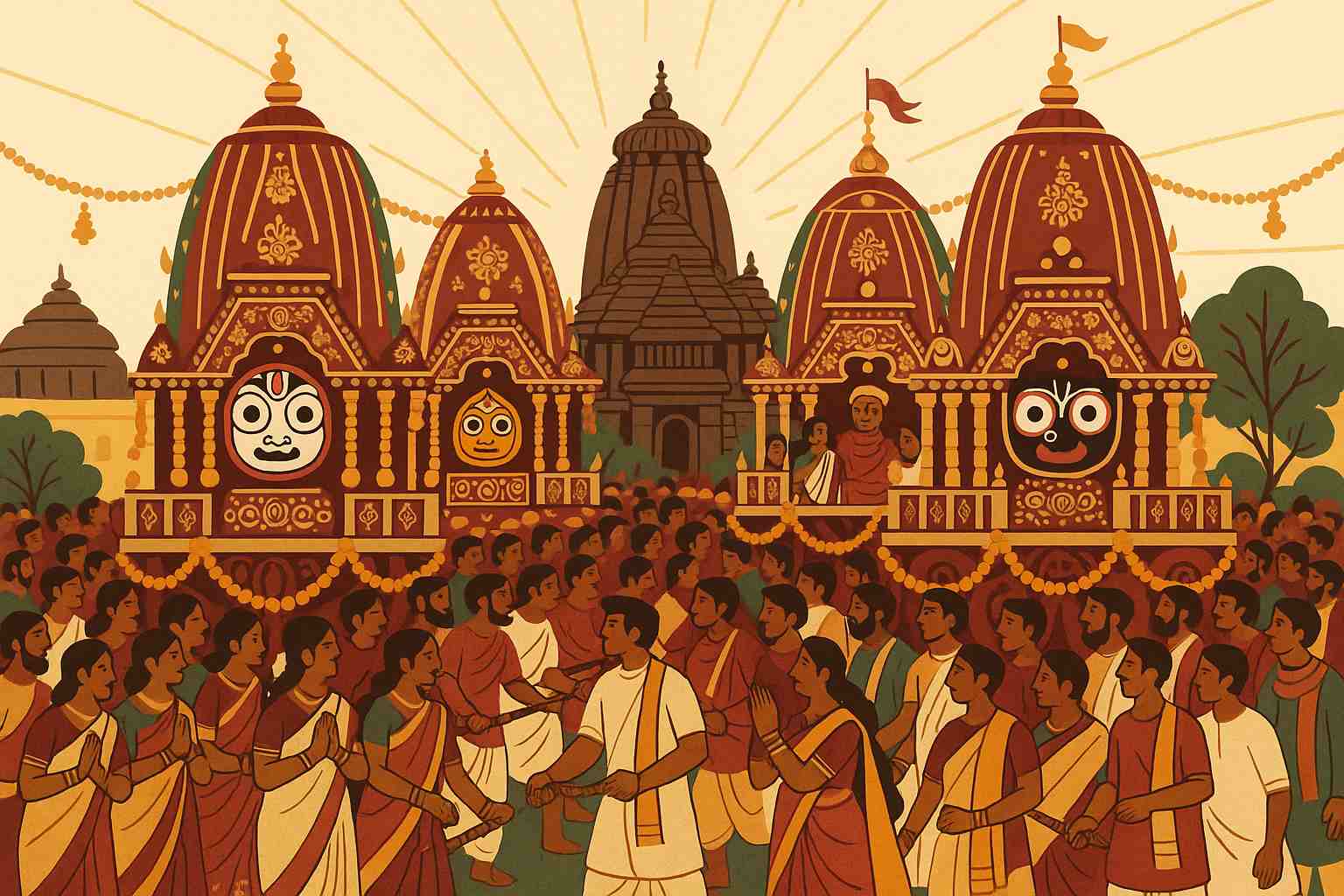
Ratha Yatra, also written Ratha Jatra or Rath Yatra, is the annual chariot festival of Lord Jagannath at Puri in Odisha. Jagannath, his elder brother Balabhadra and their sister Subhadra leave the Shree Jagannath Temple in a ceremonial procession, take their places on three wooden chariots and travel along the Bada Danda, or Grand Road, to Gundicha Temple.
The festival is not only the day when the chariots move. It belongs to a longer ritual cycle that includes the deities’ public appearance, their stay at Gundicha Temple, the return journey called Bahuda Yatra and the ceremonies that follow. Dates change each year according to the traditional calendar, so visitors should use the current official Odisha Tourism or temple schedule rather than an old dated guide.
The journey from Shree Mandir to Gundicha Temple
The main procession begins at the Shree Jagannath Temple, also called Shree Mandir. The deities are brought from the temple to their chariots through Pahandi, a rhythmic ceremonial movement performed by temple servitors amid music and chanting.
After the chariots are prepared and the deities are installed, the Gajapati Maharaja of Puri performs Chhera Pahanra, sweeping the chariot platforms with a golden broom. Official Odisha accounts interpret this service as an expression of humility and equality before the divine.
Devotees then pull the chariots along the Grand Road toward Gundicha Temple. Popular retellings call Gundicha the deities’ aunt’s home; this is a devotional explanation, while the ritual destination is the Gundicha temple complex at the other end of the ceremonial avenue.
Who travels in Ratha Yatra?
- Lord Jagannath travels on Nandighosha.
- Lord Balabhadra travels on Taladhwaja.
- Devi Subhadra travels on Darpadalana, also spelled Devadalana in some sources.
Sudarshana is also carried in the festival and travels with Subhadra. Names, colours, emblems, guardians and other details associated with each chariot form a highly developed temple tradition. A short visitor guide should not flatten those details into decorative trivia.
The three chariots
The chariots are newly constructed for the festival by hereditary and traditionally trained craftspeople using prescribed methods and materials. They are not permanent vehicles reused unchanged from year to year. Their making begins well before the procession and involves carpenters, painters, tailors and other temple-service communities.
Odisha Tourism identifies the three principal chariots as Nandighosha, Taladhwaja and Darpadalana. Each has a distinct form, colour scheme and ritual identity. Published dimensions can vary with rounding or year-specific documentation, so current temple information is preferable when exact measurements matter.
How the festival cycle unfolds
Snana Yatra and Anasara
The wider sequence begins before the chariot journey. At Snana Yatra the deities receive a ceremonial bath. They then remain out of ordinary public view during Anasara, a period devotionally described as recuperation after the bath. Netrotsava and Nava Yauvana Darshana are connected with their reappearance before Ratha Yatra.
Pahandi and Chhera Pahanra
Pahandi brings the deities to the chariots. The Gajapati’s sweeping service follows as one of the most recognisable rites before the journey. These are specific ritual services, not staged entertainment.
Gundicha Yatra and the stay
The outward journey is also called Gundicha Yatra. The deities remain at Gundicha Temple for several days, where worship continues. Hera Panchami, associated with Goddess Lakshmi and Jagannath, takes place during this period and is often narrated through a playful story of absence and displeasure.
Bahuda Yatra
The return journey to Shree Mandir is called Bahuda Yatra. The chariots again travel on the Grand Road, and the returning festival has its own sequence and viewing traditions.
Suna Besha, Adhara Pana and Niladri Bije
After Bahuda, the deities appear in golden adornment during Suna Besha while remaining on the chariots. Adhara Pana involves an offering in tall vessels. Niladri Bije marks the return into the temple and is popularly connected with Jagannath’s reconciliation with Lakshmi through an offering of rasagola.
Why the festival is culturally significant
Ratha Yatra brings the deities from the inner temple into public space. The event is therefore widely understood as a moment of accessibility: people who do not ordinarily enter the temple can see the deities on the Grand Road. The shared act of drawing the chariots is also central to the festival’s public devotional character.
Jagannath culture is deeply connected with Odia language, poetry, music, craft, food and forms of temple service. The chariots make that living network visible—from woodworking and textile work to ritual performance, crowd service and Mahaprasad traditions.
Claims that the festival has one simple symbolic meaning should be treated cautiously. Devotees, temple traditions and scholarly accounts may emphasise divine journey, public darshan, equality, community, longing, return or renewal. These readings can coexist without being reduced to a single slogan.
When is Ratha Yatra?
Ratha Yatra falls on the second day of the bright fortnight of the lunar month of Ashadha, so its Gregorian date changes annually. Odisha Tourism lists the Puri Ratha Jatra beginning on 16 July in 2026, followed by Bahuda and the concluding rites later that month. For another year, confirm the date through a current official festival calendar.
Do not rely on this article alone for transport controls, crowd routes, accommodation, darshan arrangements or emergency instructions. Those operational details can change close to the event.
Visiting Puri during Ratha Yatra
- Book accommodation and transport well in advance; festival demand is exceptionally high.
- Follow Odisha Police, district administration and temple-administration crowd instructions.
- Expect long periods outdoors, slow movement, heat or monsoon rain. Carry permitted water and essential medication.
- Agree on a meeting point with companions and ensure children and vulnerable visitors carry contact details.
- Do not push toward chariot ropes or restricted service zones.
- Ask before photographing individuals or ritual work, and obey photography restrictions.
- Use official channels for donations and beware of unsolicited claims of guaranteed access.
People with mobility, respiratory or cardiac concerns should assess crowd conditions carefully and consult appropriate medical guidance. Watching an authorised broadcast can be a more suitable form of participation than entering a dense procession.
Common questions
Are Ratha Yatra and Rath Yatra different festivals?
No. Ratha Yatra, Ratha Jatra and Rath Yatra are common transliterations for “chariot journey.” In Odisha, “Ratha Jatra” closely reflects Odia usage.
Does only Jagannath travel?
No. Balabhadra and Subhadra travel on their own chariots, and Sudarshana is part of the ceremonial journey.
Are the chariots reused every year?
The principal chariots are constructed anew for the annual Puri festival according to temple tradition.
What is the return journey called?
It is called Bahuda Yatra. It returns the deities from Gundicha Temple toward Shree Mandir and is followed by further rites before they re-enter the temple.
Can non-Hindus attend the procession?
The procession takes place in public space and draws people from many backgrounds. Entry rules for the Shree Jagannath Temple are separate from viewing the public festival and should be checked through current official guidance.