
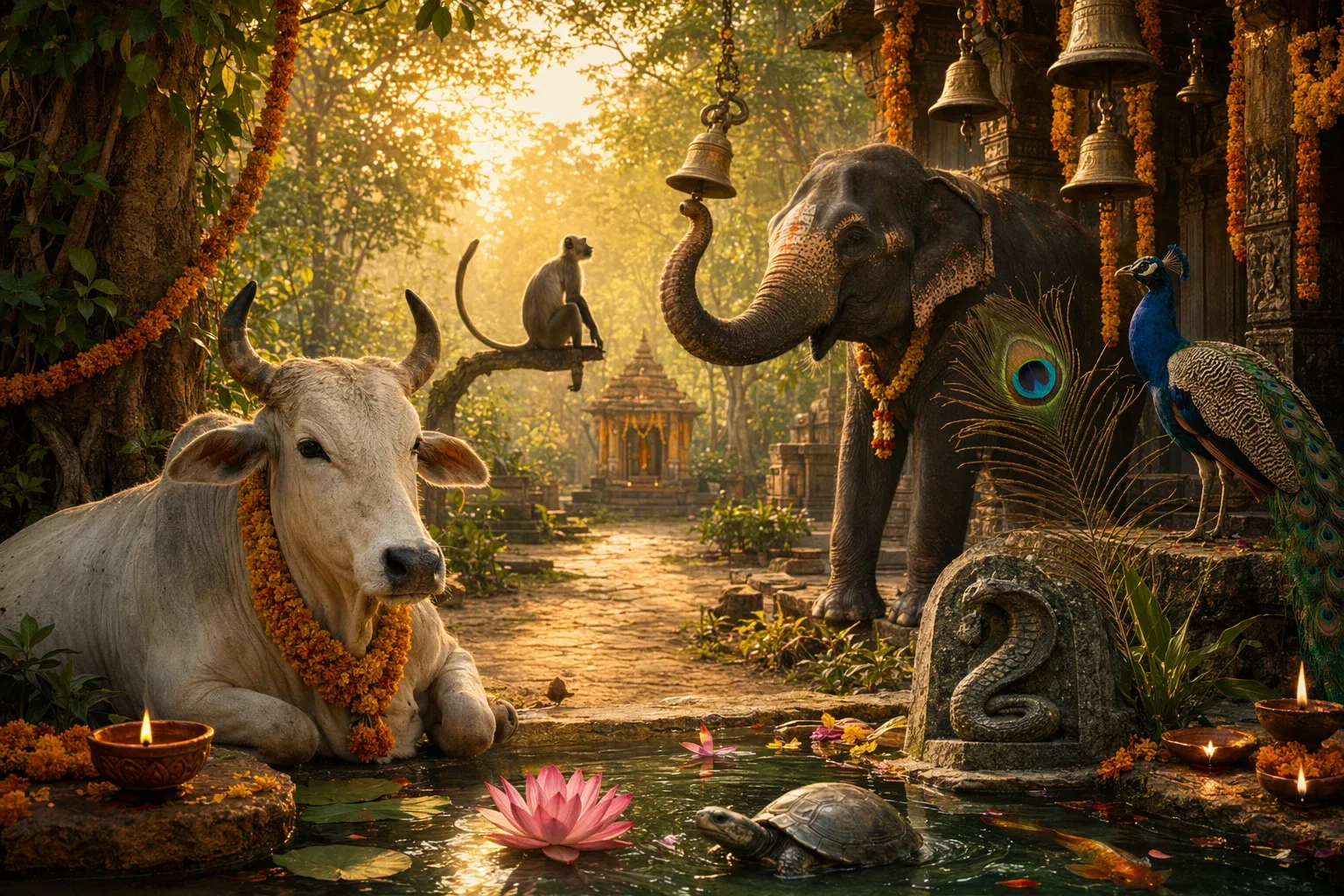
Hindu mythology does not use animals only as background characters. Animals become a language. A bull looking toward Shiva, a mouse near Ganesha, a lion under Durga, a peacock beside Kartikeya, and Garuda near Vishnu all help people read a sacred image even before they know long philosophical words. The animal gives the story a shape that the eye can remember.
This is why sacred animals in Hindu mythology are best understood through stories and symbols together; our overview of Hindu god and goddess symbols, vehicles, and weapons gives the wider visual-language context. A story tells us what happened in tradition. A symbol tells us what the story trains us to notice. Historical study then reminds us that these meanings developed across regions, texts, temple arts, folk practices, and centuries of retelling. All three levels matter.
Vahanas make divine qualities visible
One of the most important ideas is the vahana, the being or vehicle associated with a deity. In many cases it is an animal or bird. The vahana may appear under the deity, beside the deity, or facing the shrine. It can be a companion, a sign, a power under control, or a visual clue to the deity’s nature.
For example, the lion with Durga communicates royal courage and fierce protection. Nandi with Shiva communicates strength made calm through devotion. The mouse with Ganesha communicates quickness, desire, and the ability to enter small spaces. Garuda with Vishnu communicates speed, protection, and sky-like reach. These are not random mascots. They are part of Hindu iconography, the art of making ideas visible.
Ganesha’s elephant form and the meaning of beginnings
Ganesha is one of the clearest examples of animal symbolism becoming beloved across India. Tradition tells different versions of how he received the elephant head, but the popular story places him in the family of Shiva and Parvati. The result is not a strange accident to be laughed at. It becomes a teaching form. The elephant head suggests wisdom, memory, listening, and practical strength.
Ganesha is called at the beginning of work because beginnings need intelligence more than noise. Students pray before exams, artists before performances, families before a new house, and communities during Ganesh Chaturthi. The elephant symbol supports that feeling. An elephant can remove a branch blocking the road, yet it also moves with care. In this way, the animal form helps explain why Ganesha is remembered as remover of obstacles.
Nandi and the discipline of attention
Nandi, the bull associated with Shiva, is common in Shiva temples from the Himalayas to Tamil Nadu. In many shrines he sits in line with the sanctum, facing the Shiva linga. A visitor may whisper a prayer near Nandi or simply fold hands before moving forward. The image teaches without a lecture: look steadily, listen deeply, and keep your strength anchored.
The bull naturally suggests power, fertility, and agricultural labour. Hindu mythology does not reject that earthy meaning. It transforms it. Nandi becomes not wild force but devoted force. This is a subtle message for human life too. Energy is valuable, but energy without direction can become ego. Nandi’s body is strong; his posture is surrendered.
Hanuman’s monkey form and power used for service
Hanuman belongs to the Ramayana world, where his courage and devotion to Rama make him one of the most loved figures in Hindu practice. He leaps across the ocean to Lanka, finds Sita, faces danger, and returns with hope. Later, he carries the mountain connected with healing herbs when Lakshmana is wounded. Whether one reads these stories devotionally or as epic literature, Hanuman’s meaning is clear: strength becomes sacred when it serves a righteous purpose.
The monkey form is important because monkeys are quick, restless, clever, and physically agile. Hanuman takes those natural qualities and lifts them into bhakti. His restlessness becomes urgency for dharma. His leap becomes faith. His voice becomes courage. That is why Hanuman is worshipped by people seeking discipline, protection, bravery, and humility together.
Nagas and the sacredness of hidden power
Serpents, or nagas, appear throughout Indian religious imagination. They are linked with water, fertility, protection, the underground world, and dangerous energy. Shiva’s snake, Vishnu resting on Shesha, Krishna dancing over Kaliya in popular retellings, and Naga Panchami practices all show that the serpent is not treated as a simple villain.
The snake is sacred partly because it is feared. A culture that honours serpents is teaching people not to destroy every power they cannot control. In village contexts, snakes also belong to fields, water bodies, anthills, and monsoon landscapes. Mythology turns that ecological nearness into story. The result is respect, caution, and ritual memory.
Garuda, peacock, lion, and hamsa as symbolic companions
Garuda, the mighty bird linked with Vishnu, often stands for vigilance, protection, and speed. He is also known in stories as an enemy of serpents, which creates a dramatic contrast between sky power and underworld power. The peacock, linked with Kartikeya or Murugan, carries beauty, splendour, martial energy, and regional devotion, especially in South Indian and Tamil contexts. The lion with Durga expresses fearless protective strength.
The hamsa associated with Saraswati is gentler. Often translated as swan or goose, it becomes a symbol of wisdom and discrimination, the ability to separate what is true from what is mixed or confusing. These examples show that Hindu animal symbolism is not one mood. It can be fierce, playful, wise, protective, maternal, or ascetic depending on the deity and story.
A balanced way to read these stories
For a modern reader, the safest approach is to separate tradition, interpretation, and history. Tradition tells the stories as sacred memory. Interpretation asks what qualities the animal teaches. Historical context asks how temples, regional practices, literature, and art shaped these meanings over time. Mixing these levels carelessly creates confusion; holding them together creates respect.
Sacred animals in Hindu mythology are therefore not “animal worship” in a shallow sense. They are a rich symbolic language. They help children remember stories, help artists design temples and icons, and help devotees connect abstract values with visible forms. A bull, elephant, monkey, serpent, bird, lion, mouse, or hamsa becomes a doorway into thinking about courage, restraint, devotion, wisdom, protection, and the living world.