
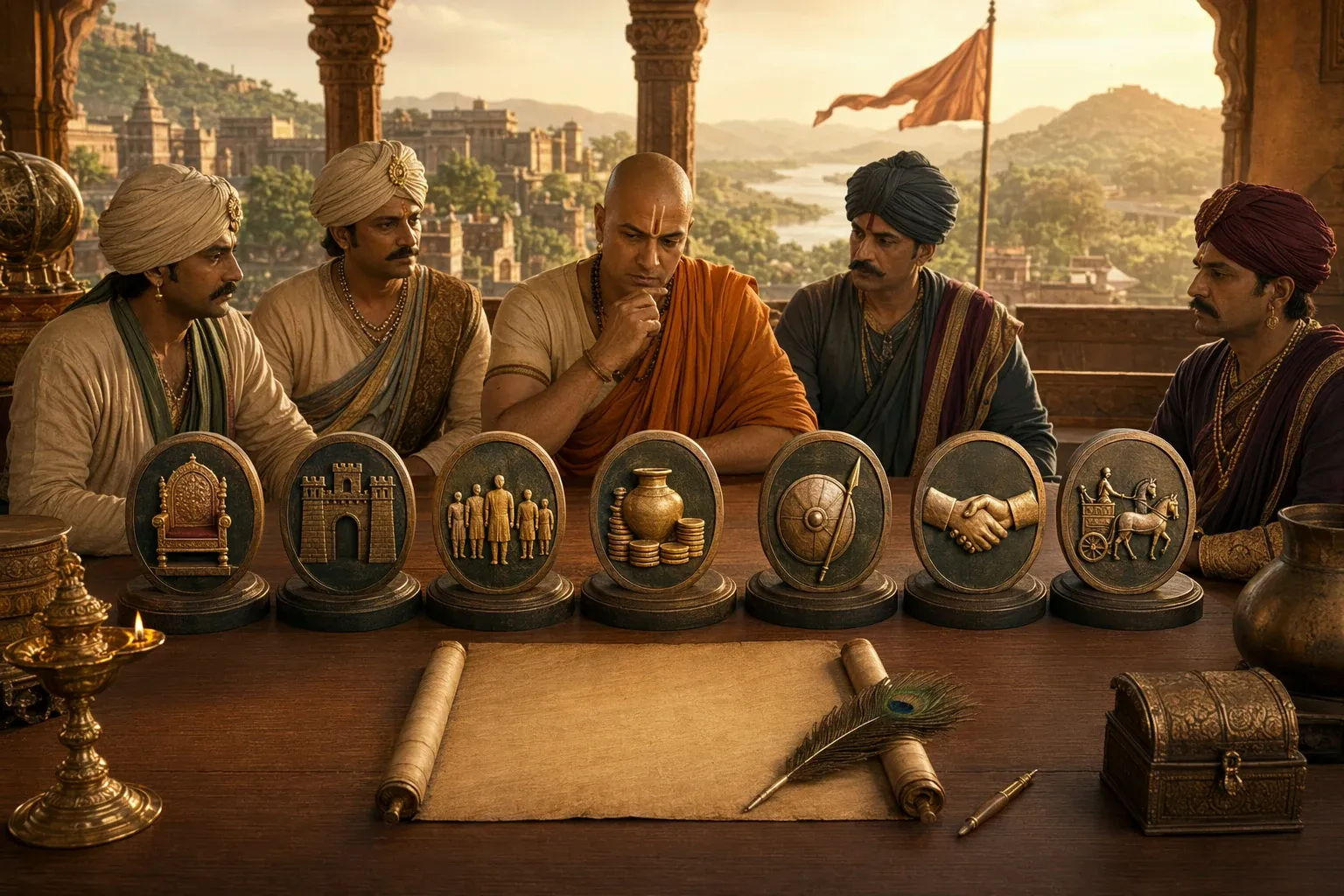
Saptanga theory is one of the most useful ways to understand Arthashastra’s view of the state. Sapta means seven, and anga means limb or part. The idea is that a state is not made of one thing alone. It has seven connected elements: the ruler, ministers, territory and people, fortified centre, treasury, army, and ally.
For beginners, this theory is helpful because it prevents a narrow view of power. A ruler without money is weak. Money without people is useless. An army without leadership can become dangerous. A fort without resources cannot hold. An ally without trust may fail at the crucial moment. The seven elements work together.
1. Swamin: the ruler
The ruler is the first element because decisions need direction. In Arthashastra, the ruler should be disciplined, trained, alert, and guided by counsel. The ruler’s personal habits matter because they affect public life. A careless ruler can damage every other limb of the state.
But Saptanga theory does not say the ruler alone is the state. That is the key point. The ruler is one limb among seven. If the other limbs are unhealthy, authority becomes unstable.
2. Amatya: ministers and officials
The second element is the group of ministers and officials. They advise, administer, supervise, and carry out decisions. Arthashastra is deeply aware that a ruler cannot manage everything personally. Competent officials turn intention into action.
This element also highlights the danger of corruption and poor selection. If officials are dishonest or incapable, orders fail on the ground. Good ministers are therefore not ornamental. They are part of the state’s basic strength.
3. Janapada: territory and people
Janapada refers to the inhabited territory: land, resources, settlements, and people. This is where the state’s life actually exists. Fertile land, productive communities, water, trade routes, and social stability all matter.
A beginner should notice that this element includes people, not only geography. A state cannot be strong if its population is constantly unsafe, hungry, overburdened, or disconnected from production. The ruler’s power depends on the health of the realm.
4. Durga: fort or protected centre
Durga means fort, fortified capital, or protected centre. In ancient political thought, a fort was not only a military structure. It was a place of storage, administration, refuge, and defence. It helped the state survive attack and disorder.
In modern terms, we might think of this element more broadly as protective infrastructure. The original idea still teaches a basic lesson: a state needs secure centres from which it can govern, store resources, and protect people in danger.
5. Kosha: treasury
Kosha is the treasury. Arthashastra takes money seriously because administration, defence, public works, salaries, relief, and diplomacy require resources. A ruler with an empty treasury may have good intentions but limited ability.
The treasury must be filled responsibly. If revenue collection destroys the productive base, the state harms itself. So the treasury is not just a box of wealth; it represents economic strength, careful management, and the ability to respond to crisis.
6. Danda or Bala: army and coercive power
The sixth element is the force that protects the state and enforces order. It is often discussed as army or coercive authority. Arthashastra sees this as necessary, but dangerous if undisciplined. Power must be trained, supplied, loyal, and properly directed.
This element reminds us that law without enforcement may fail, but enforcement without wisdom can become oppression. Balance is essential. Strength must serve stability rather than personal anger.
7. Mitra: ally
The seventh element is the ally. No state exists alone. Neighbours, friendly powers, treaty partners, and supportive relationships influence survival. An ally can provide confidence, help, warning, or strategic balance.
This is a sophisticated point. Arthashastra does not imagine that internal strength is enough in every situation. External relationships matter. A wise ruler studies not only enemies but also reliable friends.
Why the seven limbs must be balanced
Saptanga theory is powerful because it is systemic. It asks readers to look at the whole body of the state. If one limb is damaged, the others feel the effect. A strong army cannot compensate forever for a ruined treasury. A good ruler cannot succeed with corrupt officials. A wealthy state can still be vulnerable without allies or defence.
This approach connects well with Bhaktilipi’s guide to Kautilya on governance and corruption, because both show statecraft as a set of connected responsibilities.
The main takeaway
Saptanga theory explains the state as seven interdependent elements: ruler, ministers, territory and people, fort, treasury, army, and ally. It is not a simple glorification of kingship. It is a practical model of political health.
For a beginner, the best way to remember it is to picture a living body. A body cannot depend on one limb alone. In the same way, a state remains stable only when leadership, administration, people, resources, security, and relationships support one another.
A classroom example
Imagine a kingdom with a brave ruler and a strong army, but no money and dishonest officers. Saptanga theory would call that state unhealthy. Now imagine another kingdom with wealth but no allies, weak defence, and unhappy people. That state is also at risk. The model pushes readers to diagnose the whole structure rather than praise one impressive part.
This makes Saptanga useful beyond history. It teaches systems thinking: strength is shared across leadership, people, resources, protection, enforcement, and relationships.
Why the theory is memorable
The seven-limb image works because it is concrete. Instead of saying that a state needs many things, it names the parts and asks whether each one is healthy. That makes the theory easy to teach, revise, and apply. A student can test any political example by asking which limb is strong, which is weak, and how the weakness affects the rest.