
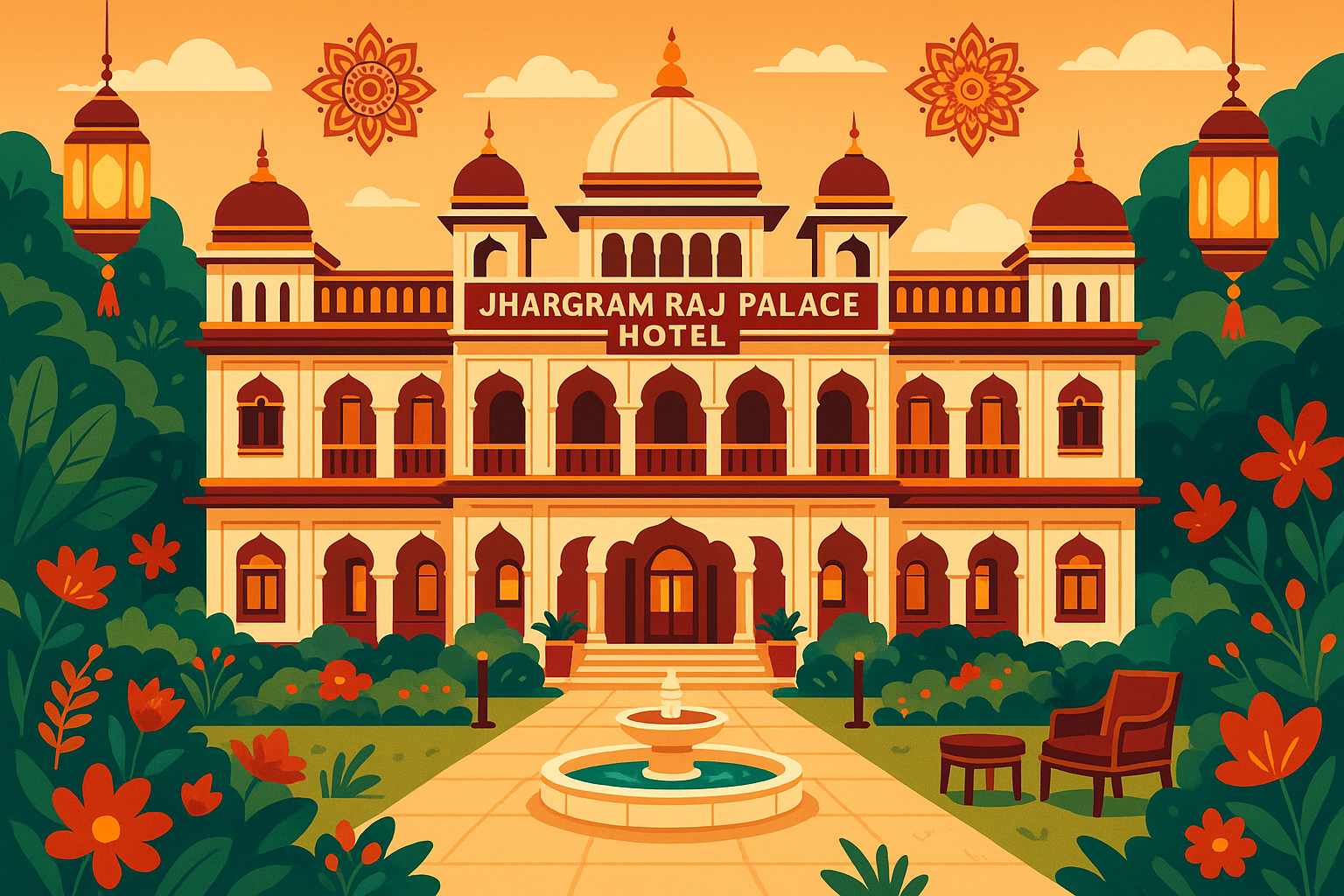
Jhargram Raj Palace, or Jhargram Rajbari, is a twentieth-century palace in Jhargram town, West Bengal. Its gardens, Indo-Saracenic design and relationship with the Malla Dev family make it an important local heritage landmark. It also sits within a wider district landscape of temples, forest routes, villages, lakes and community-run accommodation.
Online travel articles often blur three different things: visiting the palace, booking a privately operated palace-associated stay, and staying at the West Bengal Tourism Development Corporation’s Rajbari Tourist Complex. They should be checked and booked as distinct properties rather than treated as interchangeable.
Palace history and architecture
The Jhargram district administration’s palace page says work on the present palace began in 1922 during the reign of Raja Narasingha Malla Dev and that the building was commissioned in 1931. It credits the design to Kshitish Chandra Biswas, then Chief Valuer of the Calcutta Improvement Trust.
The district describes the building as Indo-Saracenic, set within gardens and lawns. That term generally refers to architecture combining Indian and Islamic-derived forms with elements of European colonial design. It is more accurate here than the duplicate articles’ unsupported formula of a simple “Italian and Islamic” fusion.
The current palace should not be confused with every earlier fortification or residence associated with Jhargram’s rulers. The district account mentions an older fortress behind the newer palatial residence, while the visible twentieth-century palace has its own construction history.
Dynasty, legend and evidence
The official district narrative links Jhargram’s ruling line to Sarveshwar Singh, the title Malla Dev and a campaign associated with Man Singh I in the late sixteenth century. The page itself describes this as part of the legend of Jhargram city.
That distinction matters. Dynastic memory is valuable historical evidence, but a tourism-page narrative is not a substitute for archival, inscriptional or peer-reviewed study. Visitors can appreciate the palace’s living family history without presenting every origin episode as independently established fact.
Palace, homestay or tourist complex?
The district’s current homestay directory lists a “Palace Homestay” in Old Jhargram along with numerous other commercial guesthouses and homestays across the district. The listing provides an owner and contact details, but it does not verify the room types, antique furnishings, restaurant menu, air conditioning or service promises repeated in older promotional copy.
West Bengal Tourism’s accommodation material separately identifies a Jhargram Rajbari Tourism Property operated by WBTDCL. A similar name does not prove that a room is inside the private residential palace. Before paying, confirm the exact property name, street address, operator, room location, cancellation terms and which spaces are accessible.
Availability, tariffs, amenities and management arrangements can change. Use the district directory or WBTDCL’s live booking channel rather than a copied phone number or price from an old blog post.
Choosing among Jhargram stays
The district lists homestays in Jhargram town and in areas such as Belpahari, Jamboni, Sankrail, Gopiballavpur and Nayagram. Location should match the itinerary: a town stay can suit the palace and urban sights, while a rural property may reduce travel to a particular forest, lake or village route.
“Homestay” does not guarantee the same degree of host interaction, meals or facilities at every property. Ask directly about licensing or registration, bathroom arrangements, accessibility, power backup, meals, transport, mobile coverage and check-in rules. Recent independent reviews may help, but official registration and direct confirmation are stronger evidence for basic identity.
Visiting Jhargram Raj Palace responsibly
The palace is associated with a living family and may contain private or restricted areas. Being listed as a tourist place does not imply unrestricted entry to gardens, interiors or residential rooms. Follow gates, signs and staff instructions, and ask before photographing people or private spaces.
Access hours, tickets and interior tours were not stated on the official district page checked for this update. Confirm current arrangements locally instead of relying on the old articles’ first-person descriptions of walking through corridors.
Kanak Durga Temple at Chilkigarh
Kanak Durga Temple at Chilkigarh is a separate religious and heritage destination in Jhargram district. The district administration maintains an official Kanak Durga Temple gallery, and West Bengal Tourism includes the temple and Chilkigarh Rajbari in suggested Jhargram itineraries.
The temple should not be presented merely as an atmospheric add-on to a palace hotel. It is an active sacred place. Dress and behave respectfully, avoid interrupting worship, observe photography restrictions and do not assume that every ritual or interior area is open to tourists.
Other places in a wider itinerary
West Bengal Tourism’s district itineraries include places such as Sabitri Mandir, Jungle Mahal Zoological Park, Gopiballavpur’s Radha Gobinda Jew Temple, Belpahari-area landscapes, Khandarani Lake and village craft stops. These sites are spread across the district; a brochure’s multi-stop list should not be read as proof that they are all close together or practical in one day.
Forest access, water levels, road conditions and opening arrangements can change seasonally. Build an itinerary from current district notices, daylight, realistic driving time and local guidance. Do not enter forest areas or approach wildlife outside authorised routes.
Reaching Jhargram
Jhargram is connected by rail and road to Kolkata and other regional centres. Train numbers, departure times and road durations change, so use Indian Railways and current navigation information rather than the exact schedules copied into older tourism brochures.
For destinations outside town, travellers may need a hired vehicle or locally arranged transport. Agree on route, waiting time and charges in advance, and avoid planning remote return journeys after dark without reliable arrangements.
A responsible booking checklist
- Verify whether the booking is for the palace-associated homestay, the WBTDCL tourist complex or another property.
- Confirm the current operator, exact address, total price, taxes and cancellation policy through an official or direct channel.
- Ask which palace spaces, if any, the booking permits guests to enter.
- Check accessibility, food, transport, power and connectivity rather than assuming “heritage” implies a standard amenity package.
- Use current district advice for temples, forests, roads and weather.
- Respect residential privacy, worship, local communities and waste rules.
Frequently asked questions
When was the present Jhargram Raj Palace built?
The district administration says construction began in 1922 and the building was commissioned in 1931.
What style is the palace?
The official district page describes it as Indo-Saracenic architecture.
Can travellers stay inside Jhargram Raj Palace?
The district lists a Palace Homestay in Old Jhargram, while WBTDCL lists a Rajbari Tourism Property. Because names and locations can be confused, confirm with the operator exactly where the room is and what access it includes.
Is the whole palace open to visitors?
Do not assume so. It is associated with a living family and may include private areas. Check current access locally and follow on-site instructions.
Is Kanak Durga Temple at the palace?
No. It is a separate sacred site at Chilkigarh and should be planned as its own visit.