
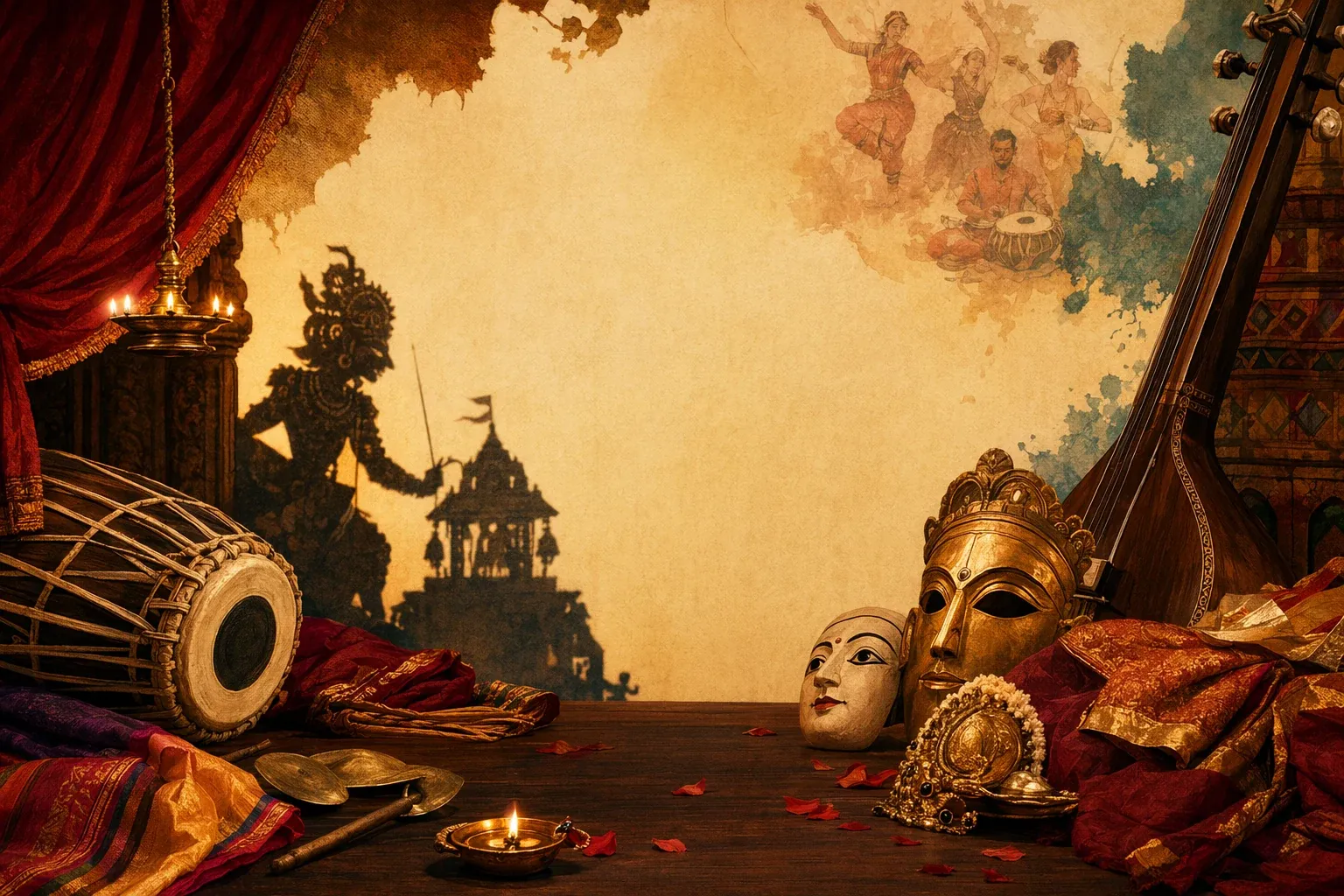
Indian theatre is live storytelling performed before people. That sounds simple, but in India it usually carries many arts together: spoken dialogue, song, rhythm, dance, gesture, costume, make-up, masks, poetry, humour, ritual, and audience participation. A performance may happen inside a formal auditorium, in a temple theatre, on a village ground during a festival, in a school hall, on a street corner, or in a small experimental black-box space.
To place theatre inside the wider performance world, read it with Natya Shastra and Indian performing arts, Indian classical dance, Ramlila performance tradition, and Indian puppetry for deeper examples of theory, dance-drama, devotional staging and puppet storytelling.
So when someone asks, “What is Indian theatre?”, the best answer is not just “Indian drama.” Indian theatre is a family of performance traditions shaped by India’s languages, regions, religions, communities, courts, markets, reform movements, and modern cities. Some forms feel sacred and ancient. Some are sharply political. Some are comic, musical, and popular. Some are literary plays written for trained actors. Others live because families, local communities, or festival groups keep performing them year after year.
A living art, not only a written play
In school, theatre is often explained through scripts: a playwright writes lines, actors learn them, and an audience watches. Indian theatre includes that, but it is much wider. In many traditions, the script is only one part of the event. The performer’s body, voice, expression, costume, and relationship with the audience matter just as much as the words.
Take Kutiyattam from Kerala. UNESCO describes it as Sanskrit theatre and one of India’s oldest living theatrical traditions. A performer may spend years learning eye expression, hand gestures, breathing control, and tiny movements of the face. A single episode can be expanded with great detail, and a complete performance may last many days. That tells us something important: Indian theatre is not always fast entertainment. Sometimes it is slow, trained, symbolic, and meditative.
Now compare that with Ramlila in northern India. Ramlila presents scenes from the Ramayana, especially during Dussehra season. It includes song, narration, recital, and dialogue, and the community is not just a silent audience. People gather, sing, help with costumes, make-up, lights, effigies, and local arrangements. Here theatre becomes a shared cultural memory. It is storytelling, devotion, festival, and neighbourhood life together.
Classical roots and regional branches
Indian theatre has classical roots associated with Sanskrit drama, performance theory, and the Natya Shastra tradition. The Natya Shastra is connected with Bharata Muni in Indian tradition and is discussed as a major early text on drama, acting, music, dance, stage space, costume, emotion, and audience experience. It is important to treat this carefully: tradition remembers Bharata as a foundational figure, while historians discuss dates, authorship, and development with caution.
Sanskrit drama also reminds us that ancient performance was not only about religious teaching. Courtly love, heroic stories, comic figures, moral dilemmas, and poetic beauty all had a place. Names such as Bhasa, Kalidasa, Bhavabhuti, and Harsha are often connected with classical drama. Kalidasa’s Abhijnanasakuntalam, based on the Shakuntala story from the Mahabharata tradition, became famous far beyond India through later translations.
At the same time, India’s theatre cannot be reduced to Sanskrit plays. Regional languages and local forms gave theatre its everyday life. Tamil, Bengali, Marathi, Hindi, Kannada, Malayalam, Assamese, Odia, Gujarati, Punjabi, Telugu, Urdu, and many other languages have their own stage histories. Folk and devotional forms grew in villages, pilgrimage centres, seasonal fairs, and community festivals. That is why Indian theatre looks different in Kerala, Bengal, Maharashtra, Assam, Karnataka, Uttar Pradesh, Manipur, and Tamil Nadu.
Music, dance, costume, and gesture carry meaning
One special feature of Indian theatre is that meaning often travels through more than words. A character’s entrance, musical pattern, mask, colour, gait, facial expression, or hand gesture can tell the audience who they are and what kind of world they belong to. In Chhau from eastern India, for example, UNESCO notes performances connected with episodes from the Mahabharata and Ramayana, local folklore, masks in some styles, martial movement, and festival settings. Even when Chhau is often classified as dance, it shows how Indian performance blends movement and dramatic storytelling.
Costume also works like a language. A crown, turban, moustache, ankle bells, face paint, sari style, jewellery, or mask may signal a king, clown, demon, devotee, warrior, queen, messenger, or village elder. Music can create suspense, devotion, comedy, or celebration before a character even speaks. This is why watching Indian theatre is sometimes closer to reading a moving visual text than simply listening to dialogue.
Indian theatre can be sacred, social, and political
Many Indian theatre forms grew near temples, rituals, or epic storytelling. That does not mean every performance is the same as worship. A Ramlila performance may carry deep devotion for Rama, while a modern play may ask uncomfortable questions about caste, gender, poverty, migration, corruption, or memory. Folk theatre may use jokes to speak about serious problems. Street theatre may gather people around a public issue without expensive sets or tickets.
This range is one reason Indian theatre matters. It keeps stories alive, but it also helps society think aloud. A performance can preserve a language, teach a child an epic episode, give local artists work, bring neighbours together, or challenge a community to look at injustice. The same art form can entertain and educate without becoming a lecture.
The audience is part of the experience
In many Indian settings, the audience is not expected to behave like a completely silent wall. People may respond, laugh, sing along, recognise a scene before it arrives, or discuss the performance afterwards. In festival theatre, the audience may already know the story, but still come because the experience renews a shared bond. The question is not always “What will happen next?” Sometimes it is “How will this community perform what we already love?”
This is different from the idea that theatre must always surprise us with a new plot. Indian performance often values repetition with variation. The Ramayana can be retold many times, but each town, troupe, language, actor, costume, and musical style gives it a local flavour. That is how tradition stays alive without becoming frozen.
How Indian theatre is different from cinema
India loves cinema, and films have borrowed heavily from theatre: dramatic songs, strong dialogues, comic side characters, mythological storytelling, and public emotion. But theatre has one power cinema cannot copy fully: presence. The actor and audience share the same time and space. A mistake, a powerful pause, a sudden laugh, or a collective silence becomes part of that particular evening.
Theatre is also easier to adapt locally. A small group can perform with limited props. A village can turn an open ground into a stage. A college group can create a play about campus life. A street theatre team can perform in a market or near a protest. This flexibility has helped Indian theatre survive even when money, space, and attention move toward films and digital media.
Why Indian theatre still matters
Indian theatre matters because it trains us to listen with the whole body. It teaches that culture is not only something stored in books or museums; it is something people rehearse, argue about, remember, and perform. It carries old stories, but it also makes space for new voices. A Sanskrit theatre performer in Kerala, a Ramlila group in Ramnagar, a Chhau artist in Purulia or Mayurbhanj, a Marathi playwright in Mumbai, a Bengali group in Kolkata, or a student street play team in Delhi may all be part of the same wide theatre universe.
If you are new to Indian theatre, begin with this simple idea: it is live performance where story meets community. The form may be classical, folk, devotional, modern, or experimental, but the heart is the same. People gather. Someone performs. A story becomes visible. For a short time, the audience and performers create a world together.
FAQs
What do you mean by Indian theatre?
Indian theatre means the many live performance traditions of India, including classical drama, folk theatre, devotional performances, modern plays, street theatre, and regional stage forms. It often combines dialogue, music, dance, gesture, costume, and audience participation.
What is Indian theatre called?
There is no single name for all Indian theatre. In Sanskrit discussions, words connected with natya and drama are important. In everyday use, people may say theatre, natak, drama, rangmanch, or use the name of a specific form such as Kutiyattam, Ramlila, Jatra, Yakshagana, Tamasha, or Bhavai.