
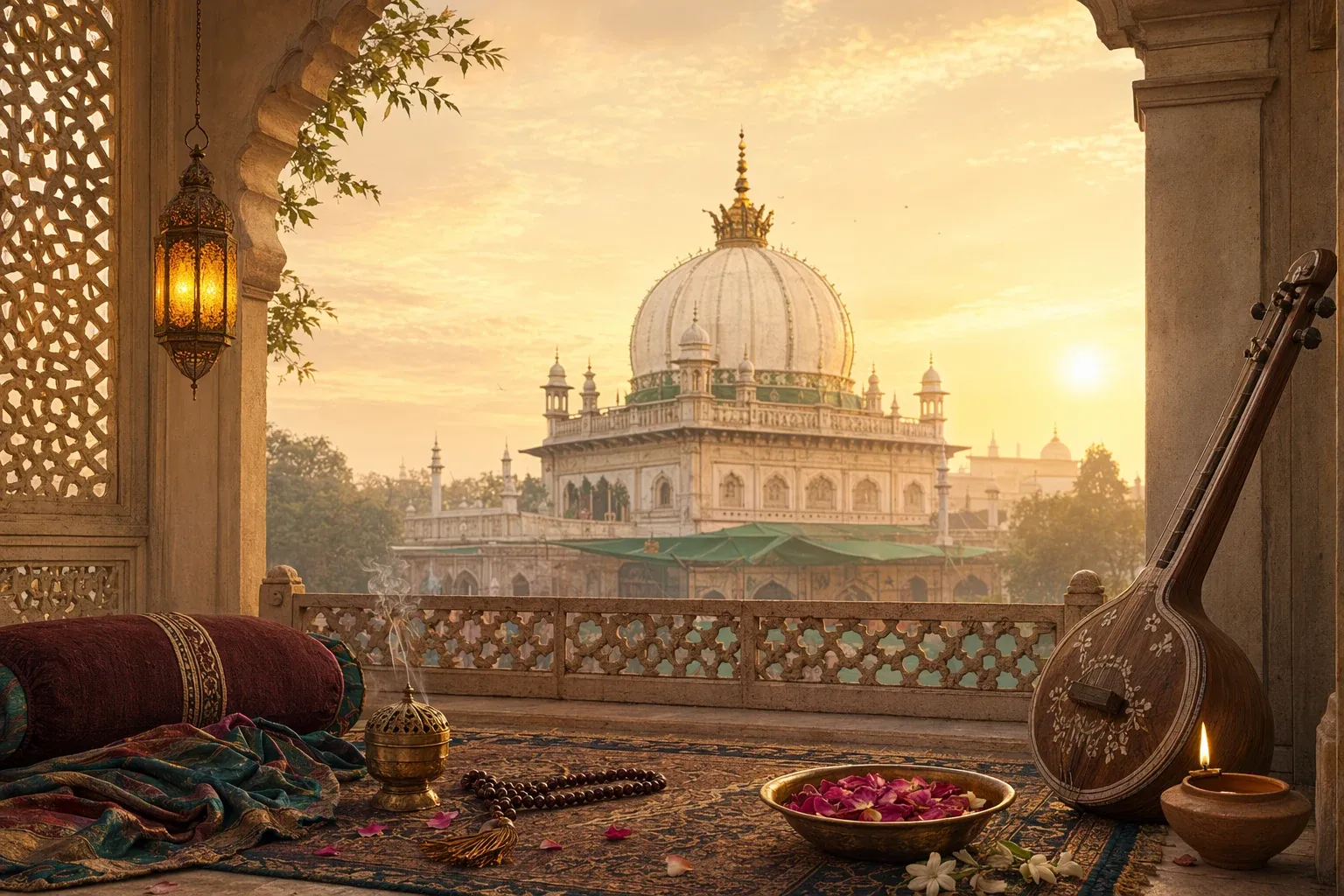
Sufism in India is best understood as a devotional and inner spiritual current within Islam, not as a separate religion. It speaks about polishing the heart, remembering God, learning from a guide, serving people, and letting love soften the ego. In India, this current became visible through saints, poetry, music, khanqahs, dargahs, and everyday acts of devotion that crossed social boundaries.
For many Indian readers, the word “Sufi” first brings to mind a qawwali at a shrine, the crowds at Ajmer, or lines of poetry about ishq, the love that pulls a seeker closer to God. Those images are not wrong, but they are only the outer doorway. Sufism is deeper than a musical mood. It is a disciplined way of religious life within Islam, shaped by prayer, remembrance, humility, companionship, and the guidance of a teacher.
The heart of the Sufi path
The Arabic word often used for a Sufi path is tariqa, meaning a way or path. A seeker may follow a lineage, called a silsila, in which teaching passes from master to disciple across generations. The goal is not entertainment or magic. The goal is closeness to Allah, purification of the self, and a life that reflects mercy, patience, truthfulness, and service.
One important Sufi practice is dhikr, the remembrance of God. This may be silent, spoken, rhythmic, or joined with devotional gathering depending on the order and community. Another important idea is suhbat, good company: staying near people whose character helps you become more sincere. In Indian Sufi settings, this often meant the khanqah, a hospice or spiritual centre where seekers, travellers, poor people, students, and visitors could gather.
Tradition describes many Sufi saints as people who lived simply and gave comfort to those around them. Historical details vary from saint to saint, and devotional stories often grow around beloved figures. A careful reader should keep both layers in mind: the spiritual memory preserved by devotees, and the historical record studied by scholars.
How Sufism became part of India’s landscape
Sufi traditions reached South Asia over many centuries through travel, trade, scholarship, migration, and the wider movement of Islam across Asia. By the period of the Delhi Sultanate, Sufi lineages were visible in north India and later in many other regions. Their influence was not limited to royal courts. In fact, the most loved Sufi spaces often became important because ordinary people felt welcomed there.
The Chishti lineage is especially famous in India. Mu‘in al-Din Chishti, remembered with deep respect at Ajmer, is associated with the spread of the Chishti tradition in the subcontinent. Later Chishti figures such as Qutbuddin Bakhtiyar Kaki, Baba Farid, and Nizamuddin Auliya became part of the spiritual memory of north India. Their names are attached not only to theology, but to food, music, poetry, charity, and the feeling that spiritual spaces should remain open to the suffering.
Other lineages also mattered. The Suhrawardi order had a strong presence in parts of India, especially through learned figures connected with urban and scholarly life. The Qadiri order, linked to Abdul Qadir Jilani of Baghdad, became respected across many Muslim societies, including South Asia. The Naqshbandi order became important in later Indo-Islamic history and is often associated with a more sober devotional style. These lineages were not identical, but they shared the idea that outer religious practice and inner transformation should go together.
Are there any Sufis in India today?
Yes. Sufi traditions remain present in India through shrines, lineages, devotional gatherings, poetry, music, and family practices. But it is important not to turn this into a simplistic label for all Indian Muslims. Some Muslims in India actively belong to Sufi orders. Some may not belong to any order but still visit dargahs, respect saints, or enjoy Sufi poetry. Others may avoid shrine practices because of their own religious understanding. Indian Islam is diverse, and Sufism is one influential strand within that diversity.
You can see this diversity at a place like the Nizamuddin area of Delhi, where the memory of Nizamuddin Auliya is tied to a living neighbourhood, qawwali gatherings, visitors from different backgrounds, and an old Chishti atmosphere. You can see it at Ajmer Sharif in Rajasthan, where pilgrims arrive with prayers, chadars, flowers, and offerings. You can also see quieter forms in homes where verses, zikr gatherings, or stories of saints shape daily devotion.
Where are Sufis mostly found?
In India, Sufi presence is spread across many regions rather than confined to one state. Rajasthan is strongly associated with Ajmer. Delhi has the shrine of Nizamuddin Auliya and other historic Sufi sites. Punjab remembers Baba Farid, whose verses also hold significance in Sikh tradition. Uttar Pradesh, Bihar, Bengal, Gujarat, Maharashtra, Karnataka, Telangana, and Kashmir all have important Sufi histories and local shrine cultures.
Globally, Sufi traditions are found across South Asia, Central Asia, Turkey, Iran, North Africa, West Africa, the Middle East, the Balkans, and diasporic communities. That wide spread matters because Indian Sufism is not isolated. It is part of a larger Islamic mystical world, while also carrying a strong Indian flavour through local languages, musical forms, festivals, architecture, and shared memory.
Dargahs, music and public devotion
A dargah is usually a shrine connected with the grave of a revered Sufi saint. For devotees, it is a place of prayer, gratitude, vows, remembrance, and community. People may offer flowers, light lamps where local custom allows, distribute food, listen to qawwali, or sit quietly. Not every Muslim community understands these practices in the same way, so a respectful guide should avoid declaring one single opinion as the opinion of all Muslims.
Qawwali is one of the best-known public faces of Indian Sufi culture. Its performance style is linked with sama, devotional listening, especially in Chishti spaces. The poetry may speak of the Prophet, saints, longing, separation, surrender, and divine love. A listener who only hears the romantic surface may miss the deeper movement: human love becomes a language for the soul’s longing for God.
What Sufism in India is not
Sufism is not a shortcut for “anything mystical.” It is not simply aesthetic clothing, a playlist, or a vague idea of peace. It is also not proof that all communities have always lived without conflict. Indian history includes exchange, friendship, debate, disagreement, politics, and tension. The value of Sufi history is not that it erases complexity, but that it shows how devotion, hospitality, and love of God created shared spaces in a complicated society.
It is also wrong to reduce Sufi saints to miracle stories. Devotional communities often tell wonders about beloved figures, but a careful reader can appreciate those stories as part of living tradition without treating every tale as historical certainty. The more grounded lesson is usually simpler: feed people, comfort the lonely, control the ego, remember God, and keep the heart soft.
A simple way to remember it
If you are new to the topic, remember three words: heart, path, and presence. The heart is the inner place that Sufism wants to purify. The path is the disciplined tariqa guided by teachers and practices. The presence is what Sufism created in India through shrines, poetry, service, music, and local memory.
That is why Sufism in India still attracts people who may not know technical terms. They recognise a mood of welcome. They hear poetry that speaks to longing. They visit a shrine because grief, gratitude, and hope need somewhere to sit. At its best, Indian Sufism reminds us that spirituality is not only about winning arguments. It is also about becoming kinder, more truthful, and more awake before God.
For a wider comparison with India’s devotional traditions, read Bhaktilipi’s guide to Bhakti Movement and Sufism.