
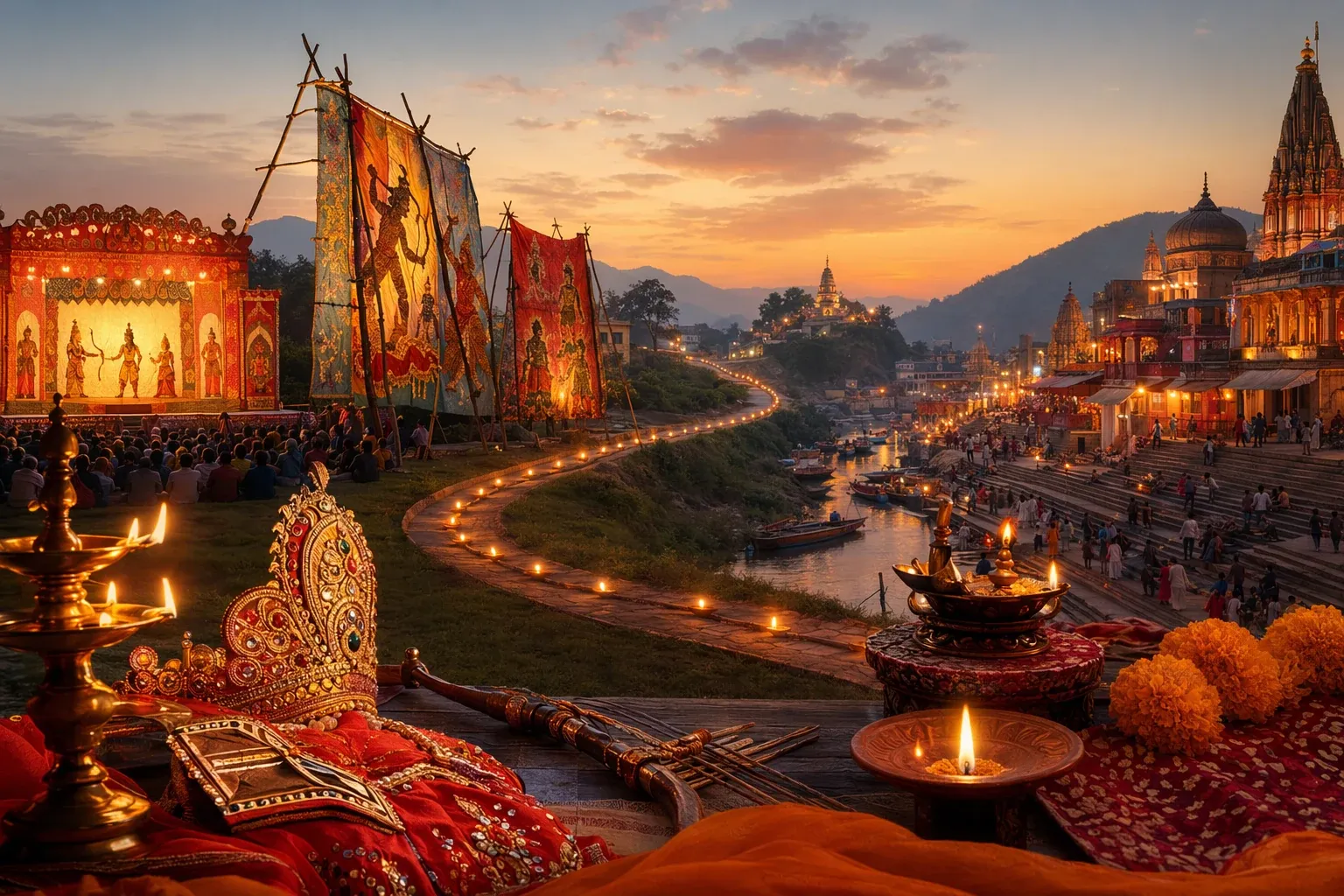
Ramlila is celebrated across northern India in cities, towns and villages, with performances in public grounds, temple-linked spaces, neighbourhood stages and sacred landscapes. Famous centres receive attention, but a small local production can be just as important to the community that sustains it.
UNESCO identifies representative Ramlila traditions in Ayodhya, Ramnagar and Benares, Vrindavan, Almora, Satna and Madhubani. Delhi also hosts many public and neighbourhood performances during the Dussehra season. This is not an exhaustive list: language, music, duration and staging change from place to place.
Where Ramlila is celebrated
Ramlila is especially associated with Uttar Pradesh, Delhi, Bihar, Madhya Pradesh, Rajasthan, Uttarakhand and other parts of northern India. Related Ramayana performance traditions also exist beyond this region, but they should not all be relabelled as one identical form.
UNESCO describes Ramlila as a series of Ramayana scenes using song, narration, recital and dialogue. It is commonly performed during the Dussehra season, often over ten to twelve days, although some traditions last longer.
Ramnagar near Varanasi
Ramnagar Ramlila is one of the best-known traditions. Instead of remaining on one conventional stage, the performance uses locations across Ramnagar as a changing sacred landscape and the audience moves with the action. IGNCA’s documentation describes a tradition lasting about a month and involving a very large moving audience.
Its scale and form should not be treated as a template for every Ramlila. Visitors should check current local arrangements, access and crowd guidance rather than relying on an old itinerary.
Ayodhya, Varanasi and other traditions
UNESCO’s representative list also names Ayodhya, Benares, Vrindavan, Almora, Satna and Madhubani. These examples show the range of languages, music, recitation and community practices within Ramlila.
A famous name does not make a tradition more authentic than a neighbourhood event. Local performances preserve relationships among performers, artisans, volunteers, families and audiences that may never appear in a national travel list.
Ramlila in Delhi
Ramlila takes place across Delhi during the Navratri–Dussehra period. Delhi Tourism describes shows throughout the city and highlights Ramlila Maidan, but venues, organisers, schedules, entry systems and transport arrangements can change every year.
Search by neighbourhood as well as by famous venue. A nearby production may be easier for children or older relatives and may offer a clearer view of local participation.
How to find a current Ramlila
- Check the current year’s organiser or venue page.
- Look for temple notices, local committee announcements and municipal updates.
- Use trusted local reporting for road closures, public transport and crowd controls.
- Confirm the date, start time, entry or pass rules and the scene scheduled that evening.
- Avoid treating an older event article as a current timetable.
Festival dates follow the ritual calendar and change in the Gregorian calendar. Weather, permissions and crowd management may also alter a performance.
What to expect
Expect a mixture of theatre, devotion, music and public gathering. Depending on the tradition, there may be live narration, dialogue, recorded or live music, processions, masks, crowns, painted sets or movement between locations. Audience participation may be part of the event.
Many viewers already know the story and attend for remembrance, devotion and community life as much as suspense. Observe how local people participate before assuming the etiquette is the same as an auditorium play.
Planning a safe visit
- Plan arrival and return transport, and expect diversions near large grounds.
- Choose a clear family meeting point and supervise children closely.
- Carry water where permitted and consider weather, footwear and elder accessibility.
- Stay behind barriers and follow police, fire-service and organiser instructions.
- Do not fly drones, enter backstage areas or photograph performers at close range without permission.
- For an effigy-burning finale, keep well outside the safety perimeter.
Frequently asked questions
Is Ramlila only celebrated in North India?
It is especially prominent across northern India. Other regions have their own Ramayana performance traditions, which may use different names and forms.
Which Ramlila is famous?
Ramnagar near Varanasi is among the best known. UNESCO also names representative traditions in Ayodhya, Benares, Vrindavan, Almora, Satna and Madhubani.
Where can I watch Ramlila in Delhi?
Delhi has city-scale and neighbourhood events during the season. Use current organiser, venue and local-authority information; do not rely on last year’s schedule.
Do I need tickets?
Rules differ. Some events are open, while others use passes, reserved seating or controlled entry. Confirm directly with the current organiser.
Is it suitable for children?
Often, but choose a manageable venue, explain the story beforehand and plan for crowds, noise, late hours and the fire-safety perimeter.