
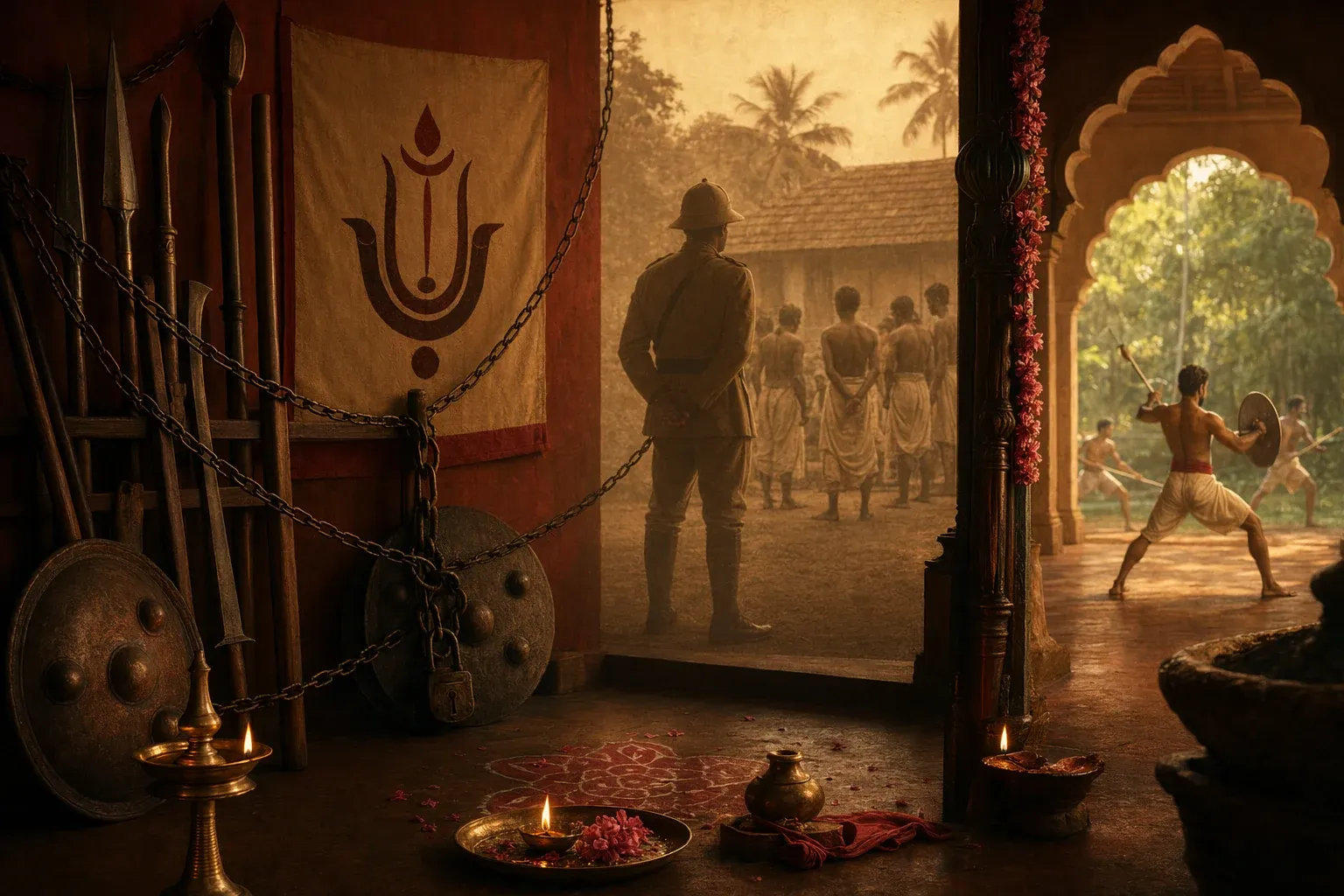
“Why was Kalaripayattu banned?” is a common question, but the honest answer needs nuance. It is safer to speak about colonial-era restrictions, policing, loss of patronage, changing social power, and decline in some regions rather than claiming one simple ban everywhere. Kalaripayattu’s story is regional, layered, and connected with Kerala’s martial, medical, ritual, and performance cultures.
This guide explains the issue in beginner-friendly language. The aim is not to create a dramatic slogan. The aim is to understand how a living tradition can weaken under political pressure and still survive through teachers, families, local memory, training spaces, and revival movements.
The short answer
Kalaripayattu was not “banned” in the same simple way everywhere at all times. In many discussions, people use the word ban to refer to restrictions and decline during colonial rule, especially when local martial training, weapons, and warrior groups came under suspicion or control. At the same time, changes in patronage, law, landholding, social order, and public training also affected practice.
What Kalaripayattu is
Kalaripayattu is a martial tradition strongly associated with Kerala. It includes body conditioning, movement, strikes, locks, weapons training in advanced contexts, discipline, respect for the teacher, and in some traditions links with healing knowledge and ritual practice. It is not just a fighting style in the narrow modern sense. It is part of a wider cultural world.
A kalari is a training space. The teacher, practice order, safety rules, and cultural etiquette matter. That is why serious explanations should avoid turning Kalaripayattu into only stunts, movie fights, or internet self-defence shortcuts.
Why restrictions happened
Colonial administrations were often suspicious of organised local martial training, weapons, and armed communities. In different places, authorities restricted weapons, changed policing systems, and weakened older structures of local military service. When courts, chiefs, temples, landlords, or warrior households lost power, the support systems around martial training also changed.
This is why the question cannot be answered with one line. A tradition can decline because of law, politics, economics, education, social change, and loss of public patronage together. Calling all of that a single ban may be easy, but it hides the real history.
How the tradition survived
Kalaripayattu survived because communities carried memory forward. Some teachers continued practice quietly. Some knowledge remained in families, ritual contexts, performance, theatre, and physical culture. Later, cultural revival, regional pride, cinema, tourism, and formal schools helped bring the art back into public view.
Survival does not mean nothing changed. Many traditions adapt as teaching spaces, uniforms, performance formats, safety expectations, and public audiences change. That adaptation should be studied respectfully instead of dismissed as fake.
Safety and cultural respect
Kalaripayattu should be learned from trained teachers, not copied from short videos. Weapons, locks, falls, kicks, and body conditioning can injure people when done carelessly. The safest public explanation is cultural and educational: understand the history, respect the discipline, and train only in appropriate settings.
Respect also means not using the tradition as a nationalist bragging point without knowing its regional roots. Kerala’s martial heritage deserves more than a meme. It deserves careful learning.
Related reading
For wider context, read Kalaripayattu Explained, South Indian Martial Arts, and Indian Martial Arts List. These links help readers place the ban question inside the broader martial-arts tradition.
What beginners should remember
The best answer is careful: Kalaripayattu faced restrictions, decline, and social disruption, especially in colonial-era contexts, but the story was not one simple all-India ban. It survived through teachers and communities, and it later revived in new forms.
That nuance matters. It helps us respect Kalaripayattu as living heritage instead of turning it into either a fantasy legend or a dry historical footnote.
What changed under colonial rule
Under colonial rule, older systems of armed service, local authority, and warrior training were gradually reshaped. Weapons laws, policing, revenue changes, and suspicion of organised martial groups all affected how martial knowledge could be practised in public. In some places, this meant direct restriction. In other places, the tradition weakened because the social world supporting it changed.
That distinction is important. If a palace, local chief, or community once supported training and that support disappeared, the art could decline even without a single dramatic order naming every kalari. History often works through many pressures at once.
Revival and modern practice
The modern revival of Kalaripayattu involved teachers, cultural activists, performers, researchers, and students who wanted the tradition to be visible again. Demonstrations, schools, cinema, tourism, and heritage conversations all played a role. Some revived forms emphasised performance and fitness; others worked to preserve older training methods and lineages.
Modern visibility is good when it brings respect and learning. It becomes shallow when the art is reduced to impossible claims or unsafe online imitation. A serious beginner should look for a teacher who explains warm-ups, discipline, safety, lineage, and cultural context.
How to answer the question carefully
If someone asks why Kalaripayattu was banned, a careful answer is: it faced colonial-era restrictions and decline, especially around weapons, martial training, and changing systems of local power, but the story was not one identical rule everywhere. This answer is less dramatic, but it is more responsible.
Responsible history protects the dignity of the tradition. It lets us admire Kalaripayattu’s survival without exaggerating the past. It also reminds us that cultural heritage needs teachers, students, spaces, and social support to stay alive.
For readers, this careful wording is useful because it respects both history and heritage. Kalaripayattu can be admired as a disciplined martial tradition while still being explained through evidence, regional context, and living teachers rather than through a single oversimplified claim.