Why these three words get confused
Yantra, mantra, and tantra are often mentioned together, but they are not the same thing. Confusion grows because all three appear in Hindu worship, meditation, and sacred practice, and because modern popular culture sometimes uses the words loosely. A simple distinction helps: a yantra is sacred form, a mantra is sacred sound, and tantra is a disciplined system or method that may use both.
This explanation is only a beginning. Each word has a long history and many traditional uses. Still, even a beginner can learn the difference respectfully and avoid treating them as interchangeable mystical labels.
Yantra: sacred form and visual support
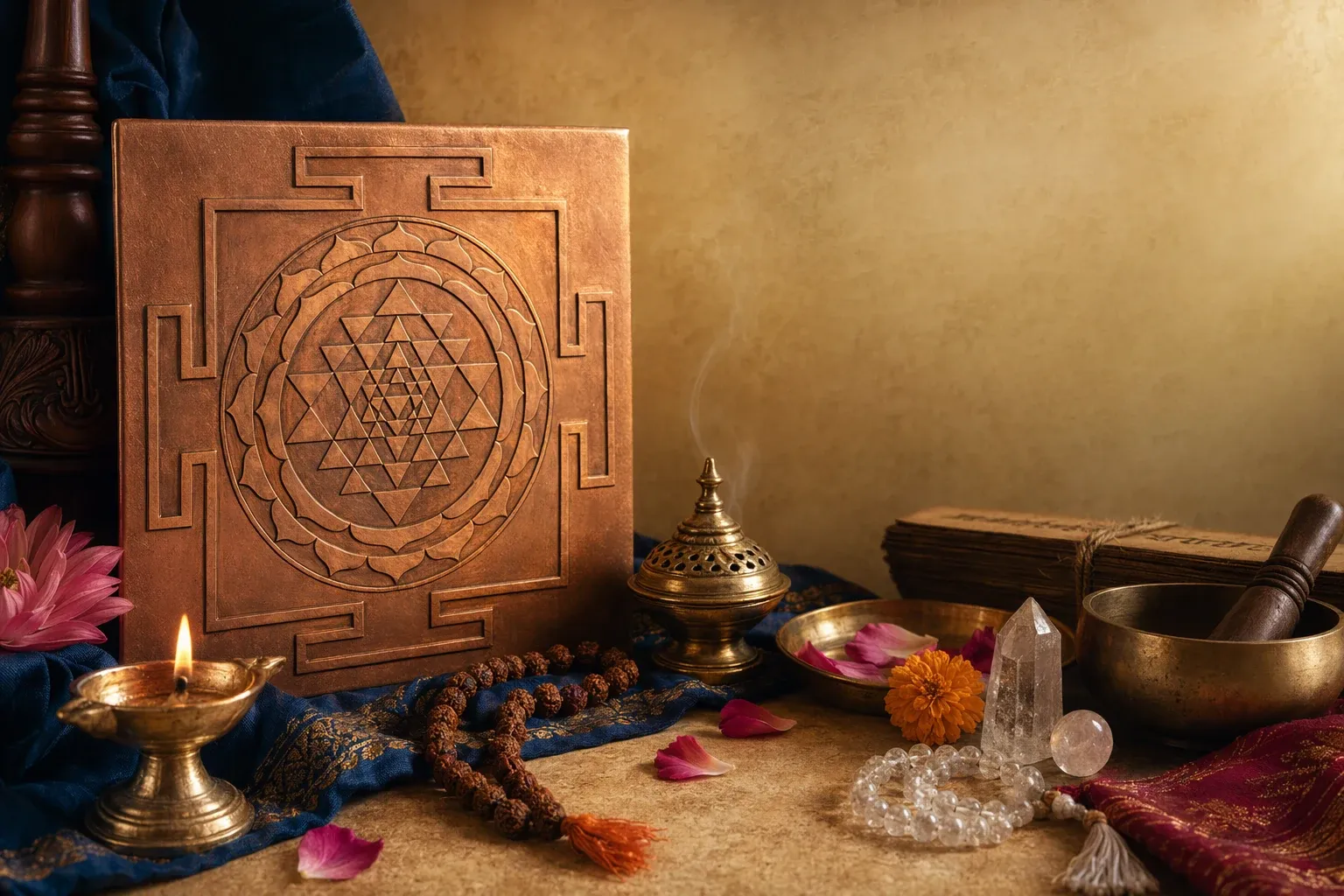
A yantra is a sacred diagram. It may include a bindu, triangles, circles, lotus petals, squares, and other geometric forms. In practice, it can serve as a focus for meditation, a support for worship, or a symbolic representation of a deity principle.
For example, a Ganesha Yantra may be used in devotion to Ganesha, while the Sri Yantra is associated with the Divine Mother in Sri Vidya traditions. The diagram is not merely decoration. It is a visual instrument that helps gather attention and express sacred meaning. The article `yantra-symbols-shapes-sacred-geometry-explained` explains the common shapes in more detail.
Mantra: sacred sound and remembrance
A mantra is a sacred sound, word, phrase, or verse used in repetition, worship, meditation, and remembrance. Some mantras are widely known, such as “Om Namah Shivaya” or “Om Namo Bhagavate Vasudevaya.” Others are specific to a deity, lineage, or initiation.
Mantra works through sound, rhythm, meaning, faith, and repetition. It may be spoken aloud, whispered, or repeated mentally. In many traditions, the mantra is not treated as ordinary language. It is honored as a living sacred presence.
Beginners should be careful with claims that any mantra can be casually used for any desired outcome. Many devotional names and prayers are open and common, while certain mantras are traditionally received from a teacher. Respect includes knowing the difference.
Tantra: method, teaching, and disciplined practice
Tantra is the most misunderstood of the three. In Hindu contexts, tantra refers to bodies of teachings, scriptures, ritual methods, and spiritual disciplines. It is not simply secrecy, magic, or sexuality, though sensational portrayals often reduce it that way.
Tantric traditions can include deity worship, mantra, yantra, visualization, ritual offerings, breath practices, temple procedures, and philosophical teachings. They may be Shakta, Shaiva, Vaishnava, or connected with other streams. Some practices are public; others require initiation and guidance.
A useful way to remember the relationship is this: tantra can provide the method; mantra gives sacred sound; yantra gives sacred form. But the exact relationship depends on the tradition.
An everyday analogy
Imagine a temple worship setting. The murti gives visible presence, the mantra gives sacred sound, and the ritual procedure gives ordered action. Similarly, in some practices, a yantra provides the visual seat or map, a mantra invokes or honors the deity, and tantric method gives the sequence and rules.
This analogy is imperfect because sacred practice is not a machine. But it helps beginners see why the three are related without being identical.
How they work together
In devotional practice, a person may place a yantra respectfully, light a lamp, repeat a mantra, and offer flowers or prayer. In more formal traditions, a practitioner may follow a specific sequence taught by a guru. The yantra is viewed, touched, worshipped, or meditated upon; the mantra is repeated; the method gives structure.
The combination can be powerful because it engages body, speech, and mind. The eyes rest on form, the voice or inner hearing follows sound, and the hands perform respectful action. This integration helps reduce scattered attention and deepen reverence.
What they are not
A yantra is not a magical sticker that guarantees results. A mantra is not a random password for forcing the universe. Tantra is not a shortcut around ethics, humility, or self-discipline. These misunderstandings are common, and they can lead to disappointment or disrespect.
Traditional practice usually emphasizes preparation, purity of intention, right conduct, devotion, and guidance. Even when practices are undertaken for worldly blessings, they are not meant to replace responsible action.
A beginner-friendly way to start
If you are new, begin with what is already familiar in your family or devotional background. If your household worships Ganesha, learn a simple Ganesha prayer and understand the symbolism of a Ganesha Yantra. If you are drawn to Shiva, learn the meaning of a widely known mantra such as “Om Namah Shivaya” from reliable sources.
For meditation, you can use a yantra as a quiet visual support without attempting complex ritual. Sit, breathe, gaze gently, and end with gratitude. The guide `yantra-for-meditation-beginner-guide` gives a simple approach.
Respecting lineage and limits
Some teachings are meant to be learned from a qualified teacher. This is not gatekeeping for its own sake; it protects the meaning of the practice and the wellbeing of the practitioner. When a source promises advanced powers without discipline, caution is wise.
Respect also means not mocking, commercializing, or mixing sacred forms carelessly. If you are not sure how to use a specific yantra or mantra, keep your practice simple and devotional until you can learn more.
FAQ
Can I use a yantra without a mantra?
For simple meditation, yes. You can gaze at the yantra quietly. In traditional worship, yantra and mantra are often connected, but beginners can start with respectful simplicity.
Is tantra always advanced?
Many tantric systems include advanced practices, but not everything related to tantra is inaccessible. Still, formal methods should be learned properly, especially when they involve specific mantras, initiations, or ritual details.
Which is more important: yantra or mantra?
It depends on the practice. Some paths emphasize mantra; others include yantra worship. In many settings, they support each other rather than compete.
Is the Sri Yantra tantric?
The Sri Yantra is deeply connected with Sri Vidya and Shakta tantric traditions. A general admirer can study it respectfully, while deeper ritual worship should follow proper guidance. See `sri-shree-yantra-meaning-structure-history`.