Why yantra symbols matter
A yantra is not just a pretty geometric drawing. In Hindu tradition, it is a sacred diagram used to hold attention, express a deity principle, and support worship or meditation. The word is often explained from roots connected with support, restraint, or instrument: a yantra can be understood as an instrument that steadies the mind and gives form to a subtle idea.
Because yantras use repeated shapes, people sometimes describe them as sacred geometry. That is useful, but incomplete. A yantra is not sacred only because the shapes are symmetrical. It becomes meaningful through a living religious setting: mantra, devotion, lineage, temple practice, household worship, and the intention of the practitioner. The same triangle or circle may look simple on paper, but in a yantra it participates in a larger symbolic language.
Bindu: the point at the center
The bindu is the central point of many yantras. It may be drawn as a dot or simply implied by the convergence of lines. Philosophically, the bindu can suggest the source from which manifestation unfolds and the point into which attention returns. In meditation, it gives the eyes and mind a place to rest.
The bindu is small, but it is not minor. In a busy design, it quietly says: come back to the center. This is why beginners using a yantra for focus often begin by looking gently at the middle, then expanding awareness to the surrounding shapes, and returning again to the center.
Triangles: ascent, descent, and union
Triangles are among the most recognizable yantra symbols. An upward triangle is often associated with fire, ascent, aspiration, or Shiva in certain interpretive traditions. A downward triangle is often connected with water, descent, manifestation, or Shakti. When triangles interlock, they can express the meeting of complementary principles rather than a simple opposition.
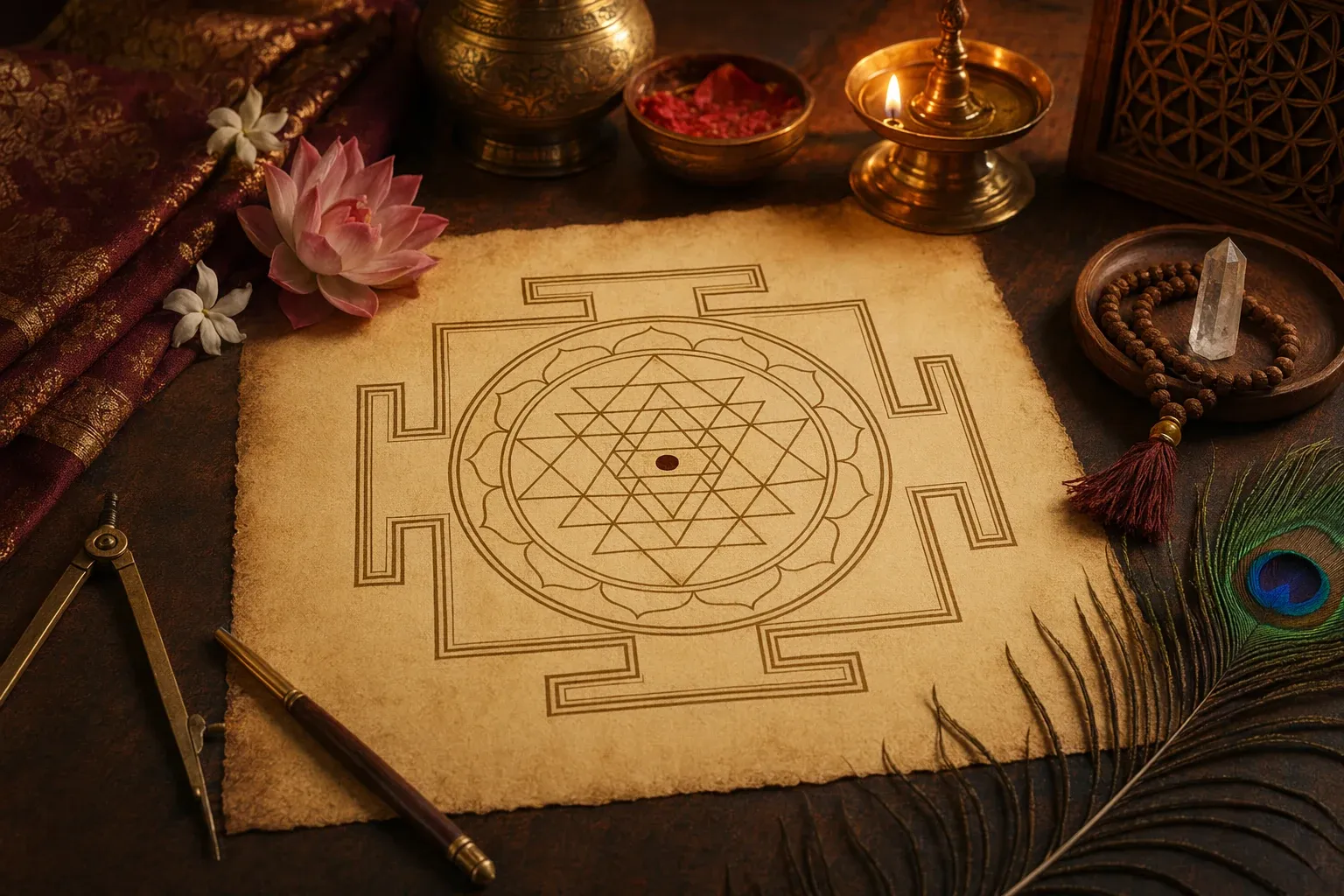
The Sri Yantra is the best-known example of this interlacing symbolism. Its nine main triangles form a complex pattern around the bindu, suggesting a cosmos ordered around the divine center. For a fuller explanation, see `sri-shree-yantra-meaning-structure-history`.
It is important not to flatten these meanings into one universal code. Traditions vary, and teachers may explain the same form in slightly different ways. A respectful reader should treat these symbols as doors into contemplation, not as a mechanical dictionary.
Circles: wholeness and containment
Circles in yantras often surround the inner diagram. They can suggest completeness, cycles, protection, or the subtle field within which the deity principle is contemplated. A circle has no corner and no obvious beginning or end, so it naturally evokes continuity.
In practice, the circular boundary also helps the eye move smoothly around the design before returning inward. This movement from outer ring to inner point mirrors many forms of meditation: the practitioner notices the wider field, gathers attention, and rests at the center.
Lotus petals: purity and unfolding
Lotus petals appear in many yantras, sometimes as rings of eight, sixteen, or more petals. The lotus is a beloved symbol across Hindu traditions. It grows from water and mud but opens cleanly to the light, making it a powerful image of purity, spiritual unfolding, and divine presence.
In a yantra, the lotus is not merely decorative. Petal rings create a transition between the outer boundary and inner geometry. They can suggest subtle centers, qualities, powers, or devotional offerings depending on the specific yantra and tradition. For someone meditating, the petals invite a softened attention: the eye can move petal by petal without strain.
Squares and gates: entering the sacred space
Many yantras have an outer square, often with openings on four sides. This form is sometimes called a bhupura, a ground plan or enclosure. It marks a sacred boundary. The four openings may be understood as gateways, suggesting that the practitioner symbolically enters the consecrated space of the diagram.
The square also gives stability. Compared with the flowing circle and delicate petals, it feels grounded and architectural. It says that sacred practice is not only mystical; it also needs structure, care, and discipline.
Lines, intersections, and symmetry
Yantra lines are usually precise. Intersections matter because they organize the diagram into a balanced field. The symmetry can calm the eyes and reduce wandering. Yet the purpose is not to admire mathematical cleverness alone. The geometry is meant to help attention become orderly.
This is where a yantra differs from ordinary ornament. Decoration may please the senses, while a yantra invites a devotional or contemplative relationship. The practitioner does not need to solve the diagram like a puzzle. Often, the more helpful approach is to look steadily, breathe naturally, and allow the design to gather the mind.
How to read a yantra respectfully
A simple way to approach a yantra is from outside to inside. Notice the square boundary, the gates, the circles, the lotus petals, the triangles, and finally the bindu. Then reverse the movement and observe how the central point seems to radiate outward into form.
If the yantra is associated with a deity, learn the basic story and qualities of that deity. A Lakshmi Yantra is not simply a wealth symbol; it is connected with Sri, grace, auspiciousness, generosity, and household harmony. A Ganesha Yantra is not just for removing obstacles; it belongs to the loving worship of Ganesha as the wise beginner of sacred undertakings. The article `common-hindu-yantras-lakshmi-ganesha-hanuman-shiva-kali` explores this further.
Common misunderstandings
One misunderstanding is that every shape has one fixed meaning everywhere. Hindu traditions are rich and varied, so meanings are often layered. Another misunderstanding is that the diagram itself automatically produces a result. Traditional use normally includes reverence, purity of intention, mantra, guidance, and regular practice.
A yantra can support focus, but it should not be treated as a vending machine for miracles. If a claim sounds like a guaranteed shortcut, it is wiser to be cautious.
FAQ
Is a yantra the same as sacred geometry?
A yantra uses sacred geometry, but it is more than geometry. It belongs to a devotional and ritual culture, often connected with deity, mantra, and traditional practice.
What is the most important part of a yantra?
Many practitioners would point to the bindu, the center. Still, the whole structure matters because the outer forms guide attention toward that center.
Can beginners study yantra symbols?
Yes. Beginners can learn the basic shapes respectfully without claiming mastery. Start with simple observation, reliable sources, and humility toward tradition.
Do yantra symbols work without belief?
The geometry may still help visual focus, but traditional yantra practice is deeply connected with faith, devotion, and intention. For practical meditation guidance, see `yantra-for-meditation-beginner-guide`.