
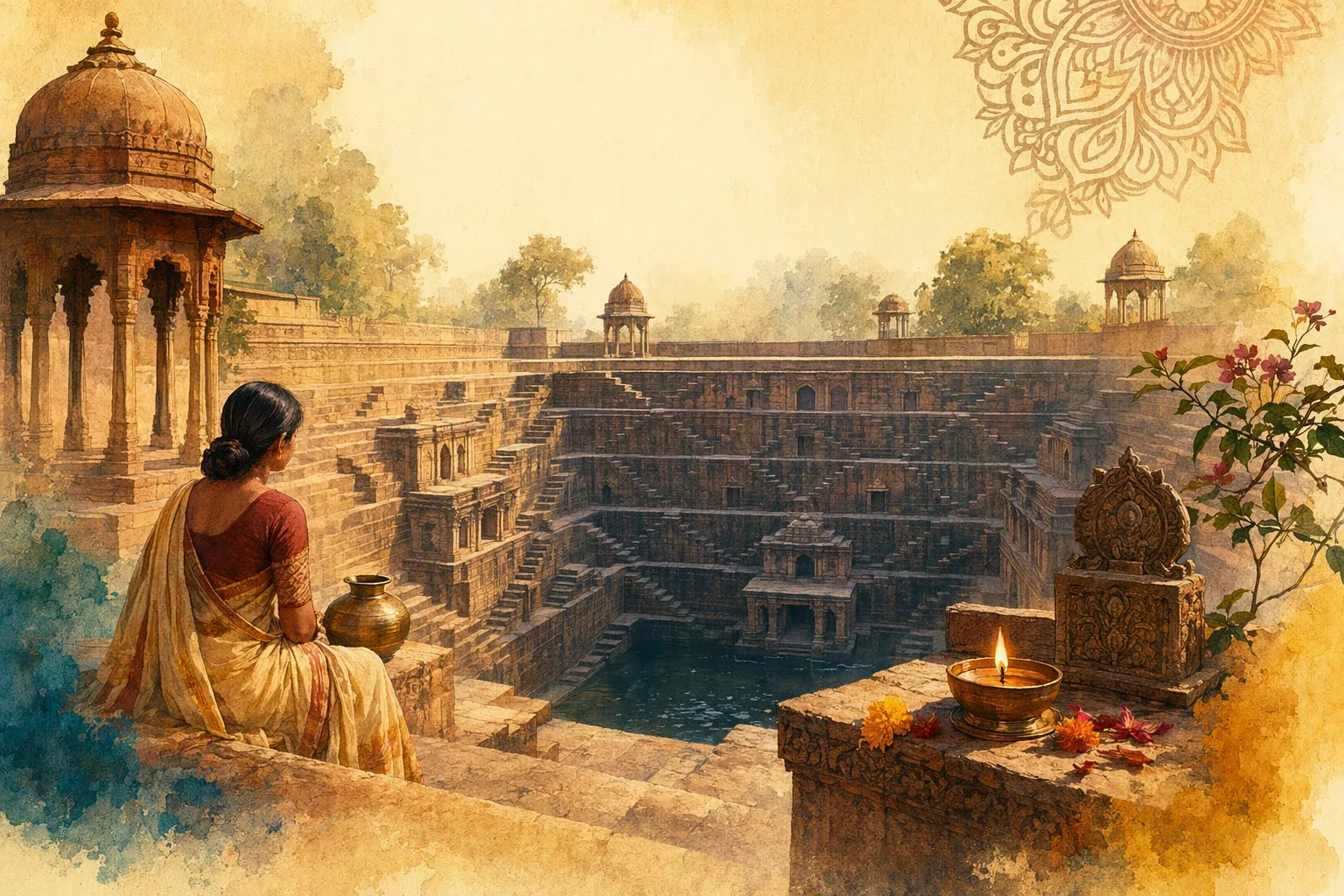
Some stepwells are still present in daily local memory, but most famous stepwells are not used today in the same way they were used in earlier centuries. Many are protected monuments, tourist sites, restored heritage spaces, or quiet neighbourhood landmarks. A few may still have water or limited local use, but it is safer to say that stepwells today survive mainly as heritage and learning spaces rather than as primary drinking-water systems.
This answer may feel less dramatic than “yes” or “no”, but it is more honest. India’s water systems have changed. Piped supply, borewells, municipal tanks, groundwater stress, urban expansion, pollution, and heritage protection rules have all changed how old stepwells are used. The stone structure may remain, but the social world around it is not the same.
Earlier use was practical and social
Historically, stepwells solved a real water problem. They allowed people to reach groundwater or stored water through steps, even as levels changed between monsoon and summer. They also created shade, rest, and a public meeting point. In dry regions of Gujarat, Rajasthan, Delhi, and parts of western or northern India, such spaces could support residents, travellers, traders, women collecting water, and ritual practices.
That older use depended on more than the monument itself. It needed a working catchment, safe water, regular cleaning, community discipline, and a water table that made the well useful. When those conditions changed, the stepwell’s role changed too.
Why many stepwells are not ordinary water sources now
Modern life has moved water into pipes, pumps, tanks, borewells, and municipal systems. In many cities, a stepwell sits inside a dense neighbourhood or protected zone, while the old drainage and recharge patterns around it are disturbed. Some stepwells became dry because water tables fell or because their channels were blocked. Some became unsafe because of silt, weak masonry, garbage, or polluted water.
Heritage protection can also limit everyday use. If a stepwell is a protected monument, authorities may restrict activities that could damage the structure. That is not an insult to its original purpose. It is a recognition that old stone, carvings, inscriptions, and underground masonry need careful conservation.
Rani ki Vav as a protected heritage site
Rani ki Vav at Patan shows how a stepwell can move from water structure to world heritage site. Sources describe it as a Chaulukya-period monument associated with Queen Udayamati and King Bhima I. It was silted over for a long period, rediscovered, restored by the Archaeological Survey of India, and listed as a UNESCO World Heritage Site in 2014.
Today, people visit Rani ki Vav to understand architecture, sculpture, water symbolism, and Gujarat’s heritage. They see multiple levels, carved pillars, Vishnu-related panels, and the inverted-temple idea. The visit is not mainly about drawing water. It is about learning how water was once honoured through engineering and sacred art.
Ahmedabad-area examples and changed water conditions
Bai Harir ni Vav in Ahmedabad is useful for understanding the present. Gujarat Tourism notes that its two small wells are now often dry, while the underground levels still feel cool. That one detail explains a lot. The cooling architecture remains. The carved columns remain. The memory of water remains. But the old hydrological condition may not survive in the same form.
Adalaj ni Vav, near Gandhinagar, is another example where tourism and heritage appreciation are strong. Visitors come for carved galleries, depth, stories, and architecture. Responsible learning should avoid turning these places into mere selfie backgrounds. A stepwell is not just an aesthetic backdrop; it is a former public water system.
Tourism can help or harm
Tourism brings attention, jobs, guides, local pride, and money for conservation. It can introduce students and families to water heritage. A guided visit can explain why stairs were needed, how the shaft worked, what the inscriptions say, and how stonework held the earth. That is valuable.
But tourism can also harm if visitors litter, climb unsafe surfaces, scratch names, make loud videos in sacred-feeling spaces, or treat a protected monument like a theme set. The right way to visit a stepwell is slow and respectful. Read the signs. Follow restrictions. Do not enter blocked areas. Do not throw coins, plastic, food, flowers, or ritual waste into the structure. If photography is allowed, take photos without damaging the place.
Living memory is still a kind of use
Even when water is no longer drawn, a stepwell can still be used as memory. Local people may know stories about who built it, which community cared for it, when it was cleaned, what festivals were associated with it, or how children were warned to stay safe around it. These stories are not the same as proof, but they are part of heritage.
There is also educational use. Architects study stepwells for passive cooling, structural planning, and movement through underground space. Water activists study them as reminders of local water thinking. Students learn how earlier societies responded to climate. Artists and writers use them as symbols of depth, memory, and descent.
Preservation is not only cleaning stone
Preserving a stepwell means protecting the structure, but it also means understanding water. If the surrounding area is polluted, if stormwater no longer reaches the system, if groundwater is overdrawn, or if the site becomes unsafe, the monument loses part of its meaning. Conservation must therefore include documentation, structural repair, visitor management, waste control, and local awareness.
In some cases, revival of traditional water bodies can help recharge groundwater or educate communities. But every site is different. Not every old stepwell should be reopened for active water use without scientific assessment. Safety, water quality, structural stability, and heritage law matter.
Questions people ask
Are stepwells still used today?
Some may have limited local or symbolic use, but many famous stepwells are now mainly heritage sites, protected monuments, tourist places, or educational spaces.
Where are the most famous stepwells located?
Many famous examples are in Gujarat and Rajasthan, such as Rani ki Vav at Patan, Adalaj ni Vav near Gandhinagar, and Chand Baori at Abhaneri. Delhi also has well-known baolis.
Can visitors take guided tours of stepwells?
At major heritage destinations, local guides or heritage walks may be available. Visitors should use reliable tourism information, follow site rules, and avoid unsupported claims.
The honest answer
Stepwells are still used today, but not always as wells. They are used as heritage, as memory, as classrooms, as architectural lessons, and as reminders of public water duty. Some still hold water; some are dry; some are restored; some need urgent care. Their present condition varies from place to place.
The best way to respect them is to see both the old function and the present responsibility. A stepwell once helped people live with seasonal water. Today it can help us remember that water is never just a utility. It is culture, community, and care.