
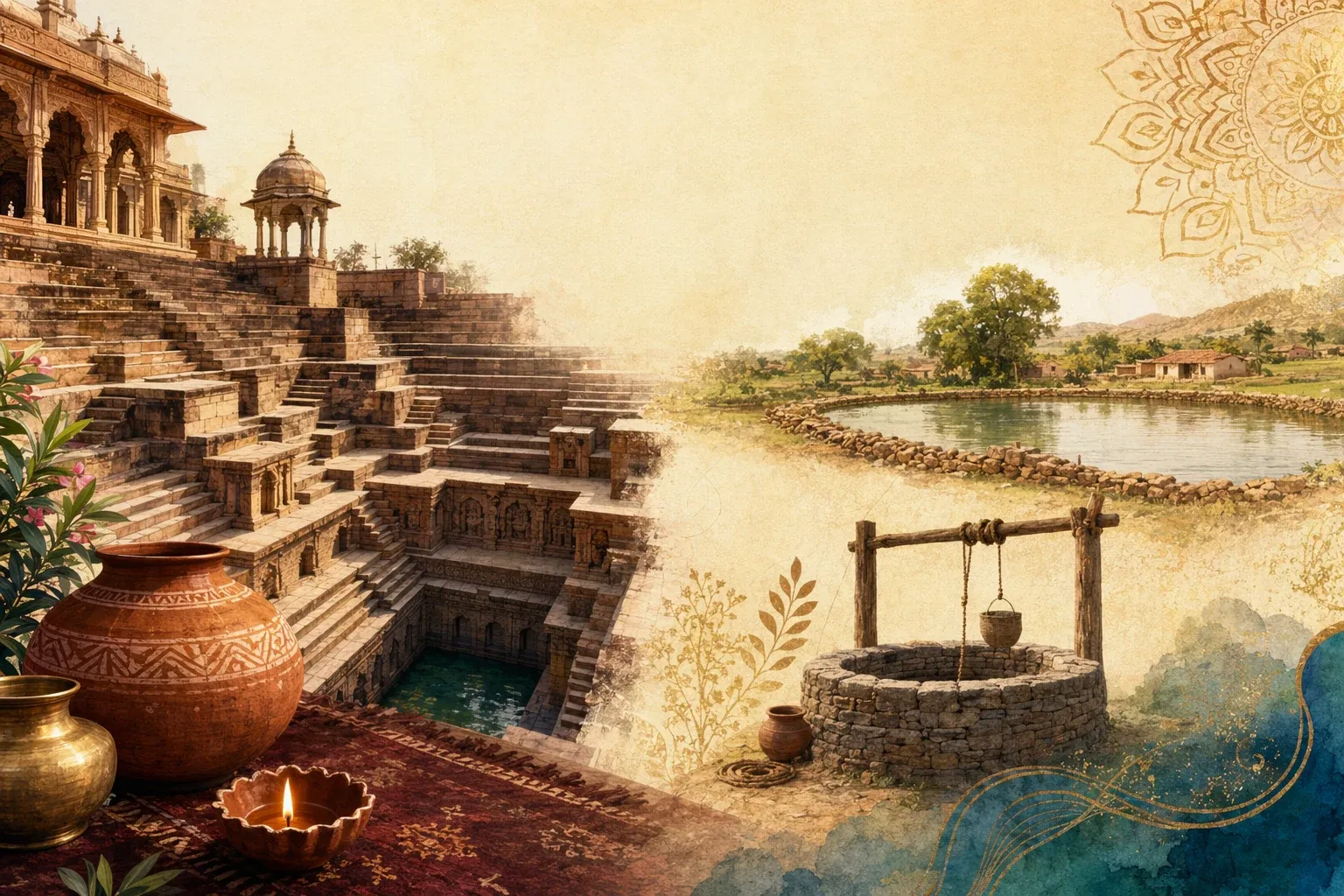
India’s older water systems were never one single idea. In a dry village, a family might draw daily water from a well. A farming community might repair a small earthen johad before the monsoon. A traveller, trader, pilgrim, or queen’s attendant might descend into a stone stepwell, where water, shade, architecture, and community life met in one place. These structures can look similar at first because all of them deal with water, but they solved different problems.
Understanding the difference matters because it shows how practical Indian water wisdom was. People did not build only for beauty, and they did not build only for storage. They observed rainfall, soil, slope, groundwater, heat, cattle needs, farming cycles, travel routes, and public life. Stepwells, wells, and johads are three useful windows into that thinking.
The basic difference in one clear view
A well is mainly a vertical access point to groundwater. It is usually a circular or lined shaft dug down until it reaches water below the surface. People draw water from it using a rope, pulley, bucket, leather bag, or later a pump. Wells can be private, shared by a hamlet, or attached to a temple, field, caravan route, or settlement.
A stepwell is also connected to water below ground, but it is built as an accessible, descending structure. Instead of standing at the top and pulling water up, people can walk down flights of steps toward the water level. This matters in regions where the water table rises and falls sharply across seasons. A stepwell also creates a cooler underground space and often becomes a social, ritual, and architectural landmark.
A johad is different again. It is usually a small rainwater-harvesting pond or earthen check-dam system, especially associated with parts of Rajasthan, Haryana, western Uttar Pradesh, Delhi, and nearby dry zones. Its main job is to catch monsoon runoff, slow it down, store some water, and allow more of it to seep into the ground. A johad may help nearby wells recharge, support cattle, and keep moisture in the landscape.
Wells: the everyday lifeline
The ordinary well is one of India’s most widespread water technologies. It may not always look grand, but its value is enormous. A village well could support cooking, drinking, washing, animals, and small-scale irrigation. In many places, wells were lined with stone, brick, or later concrete so that the sides did not collapse. Their shape was simple because the purpose was direct: reach water safely and bring it up.
Wells also carried social meaning. Many settlements had named wells, temple wells, palace wells, and shared wells maintained through local duty. This history is not always pleasant; access to water also reflected hierarchy. The engineering can be admirable while the social realities still need honest reading.
Compared with a stepwell, a normal well needs less land and less architectural labour. It can be built where groundwater is reachable and the settlement needs a regular source. But the user usually remains above the water. If the level drops too low, drawing water becomes harder.
Stepwells: water, shade, and architecture together
Stepwells are among the most memorable forms of Indian water architecture. They are especially famous in Gujarat, Rajasthan, Madhya Pradesh, Delhi, and parts of western and central India, though related stepped water structures exist in other regions too. Names vary by language and region: vav or wav in Gujarat, baoli or baori in north India, and similar local terms elsewhere.
The key feature is the descent. People can walk down as the water level changes. During the monsoon, water may rise higher; in summer, the same stairways still allow access. This makes stepwells clever seasonal architecture, not just decorative monuments.
Many stepwells also offered shade. Below ground level, stone corridors and deep walls reduce direct sun and create cooler resting spaces. That is why stepwells mattered on travel routes and near towns. They could serve travellers, animals, merchants, pilgrims, and local women collecting water. Some included pillared pavilions, carved panels, niches, and shrines.
Rani ki Vav at Patan in Gujarat is a famous example. It is widely discussed as both a water structure and a high achievement of sculptural architecture. Chand Baori at Abhaneri in Rajasthan is another well-known example, famous for its dramatic flights of steps. Agrasen ki Baoli in Delhi shows how a stepped water structure could exist inside an urban setting. These examples remind us that stepwells were public infrastructure with artistic ambition.
Johads: small structures with landscape-level impact
A johad looks much simpler than a grand stepwell, but its ecological role can be powerful. In many dry areas, rain arrives in a short monsoon burst. If the land is hard, sloping, or degraded, much of that water runs away quickly. A johad slows the water. An earthen embankment or small catchment pond holds runoff long enough for some water to collect and some to percolate into the soil.
This is why johads are often discussed with groundwater recharge. They may not be used like a household tap. Their importance is partly indirect: nearby wells can hold water for longer, soil moisture improves, and grazing or farming conditions may become less harsh. In Rajasthan, community-led revival of johads became closely associated with water conservation work in Alwar and nearby areas, including efforts by Tarun Bharat Sangh and local villagers.
Johads also show a different kind of intelligence from stone architecture. They depend on local slope, soil, catchment, maintenance, and community cooperation. If the embankment breaks, silt fills the pond, or people stop maintaining the catchment, the system weakens. In that sense, a johad is not only a structure; it is a habit of care before and after the monsoon.
How they helped conserve water
These three systems conserve water in different ways. A well gives access to groundwater, so its health depends on whether the aquifer is being replenished and not overdrawn. A stepwell combines access with storage, shade, and seasonal usability. A johad works more like a local sponge: it catches rain and encourages the land to absorb it.
In older India, these systems often worked together. A johad or tank could improve recharge, which helped wells nearby. A stepwell could serve a settlement or route where groundwater existed but seasonal access was difficult. Ordinary wells could supply daily needs. None of them should be treated as a magical solution by itself. Their strength came from matching structure to landscape.
That is also the lesson for today. Modern borewells can pull water quickly, but if recharge is ignored, groundwater falls. Traditional structures teach patience: slow water, store water, share water, and maintain water systems as community assets.
Why these structures were built in olden times
The reasons were practical first. People needed reliable water through hot summers and uncertain rainfall. Farmers needed moisture for crops and animals. Travellers needed safe halts. Towns, temples, and royal centres needed water for public use, ritual, cleaning, gardens, and daily life.
There were also cultural reasons. Giving water has long been treated in Indian traditions as a punya act, a form of public good. Building or repairing a well, tank, or stepwell could express duty, charity, kingship, memory, or devotion. Queens, merchants, local chiefs, guilds, and communities all appear in the wider story of water patronage. But we should read this carefully: the sacred feeling around water did not remove the need for engineering. Faith and practical design often worked side by side.
Common confusion to avoid
The biggest confusion is calling every old water structure a stepwell. A pond with steps is not automatically a stepwell. A well with a small platform is not the same as a baoli. A johad is not mainly an ornate staircase to water. And a tank, kund, talab, eri, ahar-pyne, zings, bamboo drip system, or surangam belongs to its own regional family of water wisdom.
Another mistake is assuming older means perfect. Many structures failed when neglected, silted up, polluted, or cut off from catchments by roads and construction. Respecting heritage means preserving what worked and learning from what failed.
Questions people often ask
What are stepwells, wells, and johads?
They are three different traditional water systems. A well is a vertical shaft for drawing groundwater. A stepwell is a stepped structure that allows people to descend toward changing water levels, often with architectural and social spaces. A johad is a rainwater-harvesting pond or small embankment system that stores runoff and supports groundwater recharge.
How are stepwells useful?
Stepwells helped people reach water during different seasons, provided shade in hot regions, and often served as community spaces. Some also became important works of architecture, with pavilions, carvings, and ritual associations.
How do johads help conserve water?
Johads slow monsoon runoff. Instead of letting rainwater rush away, they hold it in a catchment so that some water can seep into the ground. This can improve nearby wells, soil moisture, and village water security when the system is maintained well.
A simple way to remember it
Think of a well as access, a stepwell as access plus descent and architecture, and a johad as recharge through rainwater harvesting. All three belong to India’s larger water heritage, but each answers a different question. The well asks, “How do we reach groundwater?” The stepwell asks, “How do we reach changing water levels while creating a public place?” The johad asks, “How do we keep rain in the landscape?”
Seen together, they tell a practical story: water was not treated only as a resource to extract. It was something to approach, store, slow, share, honour, and maintain. That is the wisdom these old systems still carry.