
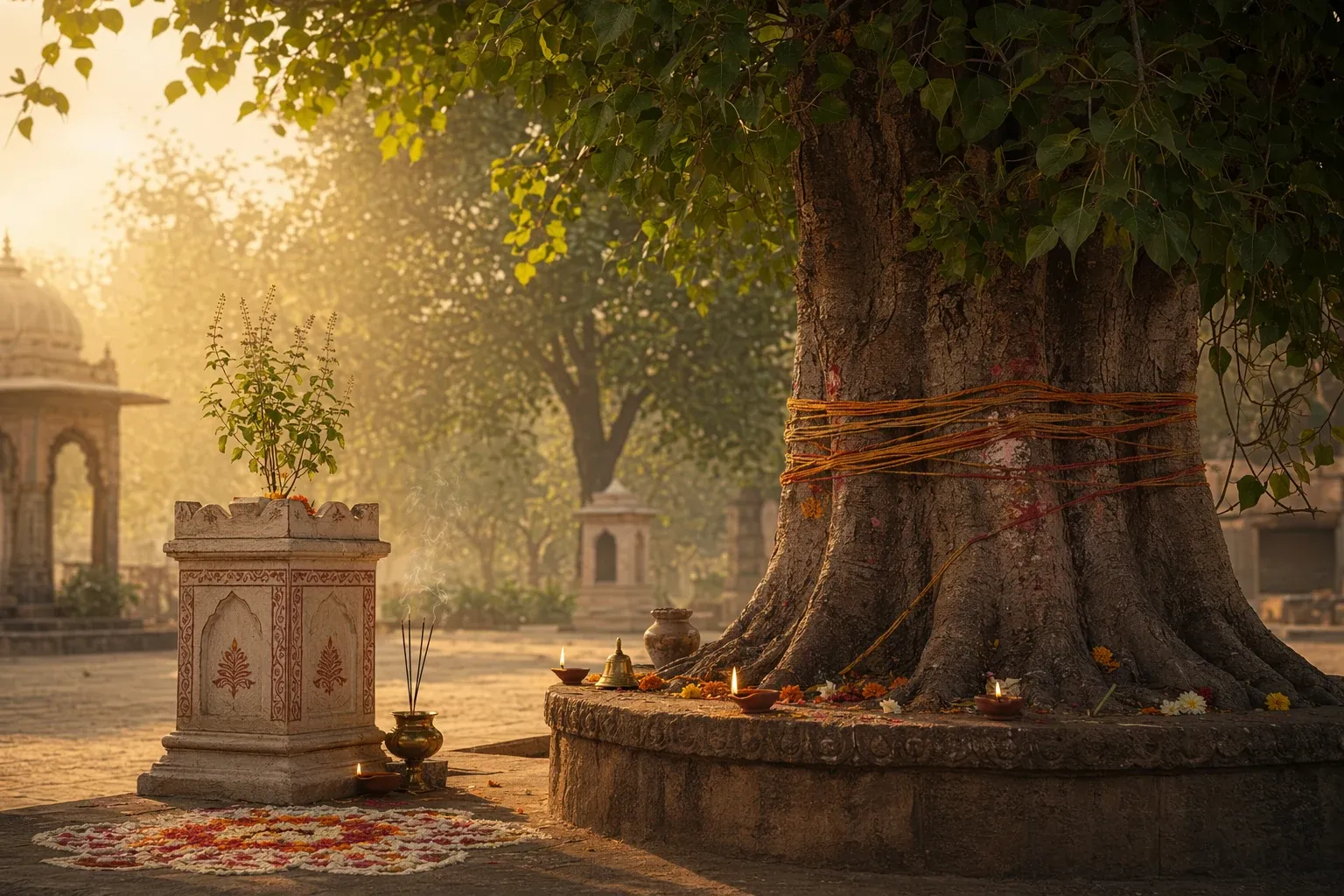
Yes, trees are still sacred in India today. The practice has changed with cities, apartments, roads, climate stress, and modern lifestyles, but it has not disappeared. You can still see tulsi plants in courtyards and balconies, peepal and banyan trees near shrines, neem trees beside homes, bael leaves offered in Shiva temples, shami worshipped in some Dussehra traditions, and sacred groves protected by local communities. The form may be old, new, rural, urban, domestic, temple-based, or environmental, but the emotion is still alive.
To understand sacred trees today, we should not imagine only a grand ancient forest. Sometimes the tradition survives in a small tulsi pot in a city flat. Sometimes it survives in an old village tree that nobody wants to cut. Sometimes it survives in a temple’s sthala vriksha, the sacred tree associated with that temple. Sometimes it survives in activism, when people protect a grove, old avenue, or community tree from careless destruction.
Homes still keep sacred plants close
In many Hindu households, tulsi remains the most visible sacred plant. Families may water it, light a lamp near it, offer leaves in worship, or keep it in a small raised structure known as a tulsi vrindavan. In apartments, the same practice may appear as a potted plant on a balcony. The setting has changed, but the idea is familiar: a living plant is cared for as part of daily spiritual life.
Neem, banana, coconut, mango leaves, and other plants also appear in household rituals and festival decorations. Some are used as auspicious symbols at doors or mandaps. Some are connected with seasonal customs. Some are valued for shade, health traditions, or protective associations. Modern families may not know every story behind them, but the habit often continues.
Temples and old trees still belong together
Across India, temples and trees often share space. A peepal or banyan may stand near a shrine. A bilva tree may be associated with Shiva worship. A temple may have a sthala vriksha, a sacred tree connected with the temple’s origin, deity, or local story. Devotees may walk around the tree, tie threads, light lamps, offer water, or simply sit in its shade.
This matters because a temple tree is not only decorative. It shapes the emotional atmosphere of the place. A stone shrine under a living canopy feels different from a bare concrete courtyard. The tree creates shade, sound, movement, birdsong, and a sense of age. It reminds visitors that worship in India has often lived outdoors as well as inside buildings.
Village groves and regional traditions continue
Sacred groves are still found in many parts of India, though many are under pressure. In these groves, community belief protects a patch of vegetation associated with a deity, ancestor, guardian, or local spirit. Names and customs differ: devrai in Maharashtra, devarakadu in Kodagu, kavu in Kerala, sarna in parts of eastern and central India, and sacred groves in Meghalaya are some examples of a wider pattern.
These groves can preserve old trees, medicinal plants, birds, insects, small animals, streams, and local memory. The rules may not be written like a modern environmental law, but they can be powerful when the community respects them. Cutting, hunting, or disturbing the grove may be avoided because the place is treated as sacred.
Festivals keep tree memory alive
Many festivals and vrata traditions keep sacred-tree memory active. Vat Savitri is associated with the banyan in several regions. Tulsi Vivah marks the ceremonial wedding of Tulsi and Vishnu or Krishna in many communities. Bilva leaves are offered in Shiva worship, especially during important Shiva festivals. Shami leaves may be exchanged or worshipped in some Dussehra customs. Banana, mango, coconut, and betel leaves appear in many auspicious settings.
These practices vary by region, caste, sect, family, and local custom. That variety should be respected. There is no need to force one neat list on all of India. The living tradition is more like a forest than a spreadsheet: many species, many stories, many local meanings.
Conservation memory gives the tradition a modern voice
Sacred-tree respect also appears today through conservation memory. The Khejarli story in Rajasthan, where Amrita Devi and hundreds of Bishnois are remembered for protecting khejri trees in the eighteenth century, remains a powerful example of tree protection rooted in religious and community values. The later Chipko movement is often remembered as a modern environmental movement where people embraced trees to prevent cutting.
These stories show that reverence is not only private worship. It can become public courage. When people say a tree is sacred, they may also be saying that life cannot be measured only by immediate profit. A tree may be older than a building plan, more useful than a parking spot, and more meaningful than a short-term convenience.
Urban India is changing the practice
In cities, sacred trees face a complicated situation. On one side, people still build small shrines around peepal or banyan trees, keep tulsi at home, and protest when old trees are cut. On the other side, concrete, pollution, road widening, real estate pressure, and careless construction can damage roots and reduce tree health. Sometimes a tree is ritually respected but ecologically suffocated by cement around its trunk.
This is where modern understanding should improve old devotion. If a tree is sacred, it needs soil, water, air, space for roots, and protection from nails, paint, fire, plastic, and excess decoration. Real reverence should help the tree live, not merely turn it into a crowded shrine.
Tradition and science can work together
Sacred-tree practices do not need to fight modern ecology. They can support each other. Tradition gives emotional connection and community memory. Ecology explains how trees cool cities, store carbon, shelter biodiversity, protect soil, and support water cycles. Together, they can create stronger care than either one alone.
For example, a school can teach children why peepal, banyan, neem, amla, bael, and native regional trees matter culturally and ecologically. A temple can protect its old tree with proper soil space. A housing society can keep a tulsi corner while also planting native shade trees. A village can document its sacred grove and prevent waste dumping. These are modern forms of an old respect.
Questions people ask
Are trees sacred in India today?
Yes. Sacred trees remain part of Indian life through household tulsi worship, temple trees, sacred groves, festival customs, local shrines, conservation movements, and community memory.
What trees are considered sacred today?
Common examples include peepal, banyan, tulsi, bael, neem, amla, shami, ashoka, mango, coconut, banana, kadamba, and region-specific trees inside sacred groves. The exact list changes by tradition and locality.
How can young people respect sacred trees now?
They can learn the stories, avoid unsupported miracle claims, protect old trees, plant native species, keep soil around trunks open, reduce plastic and fire near trees, and treat ritual care as real ecological care.
The living answer
Sacred trees in India are not only memories from old books. They are still present in balconies, courtyards, temple grounds, groves, festivals, village boundaries, and environmental struggles. The challenge today is to make reverence honest. If we call a tree sacred, we should help it breathe, grow, shelter life, and outlive us. That is where tradition becomes action.