
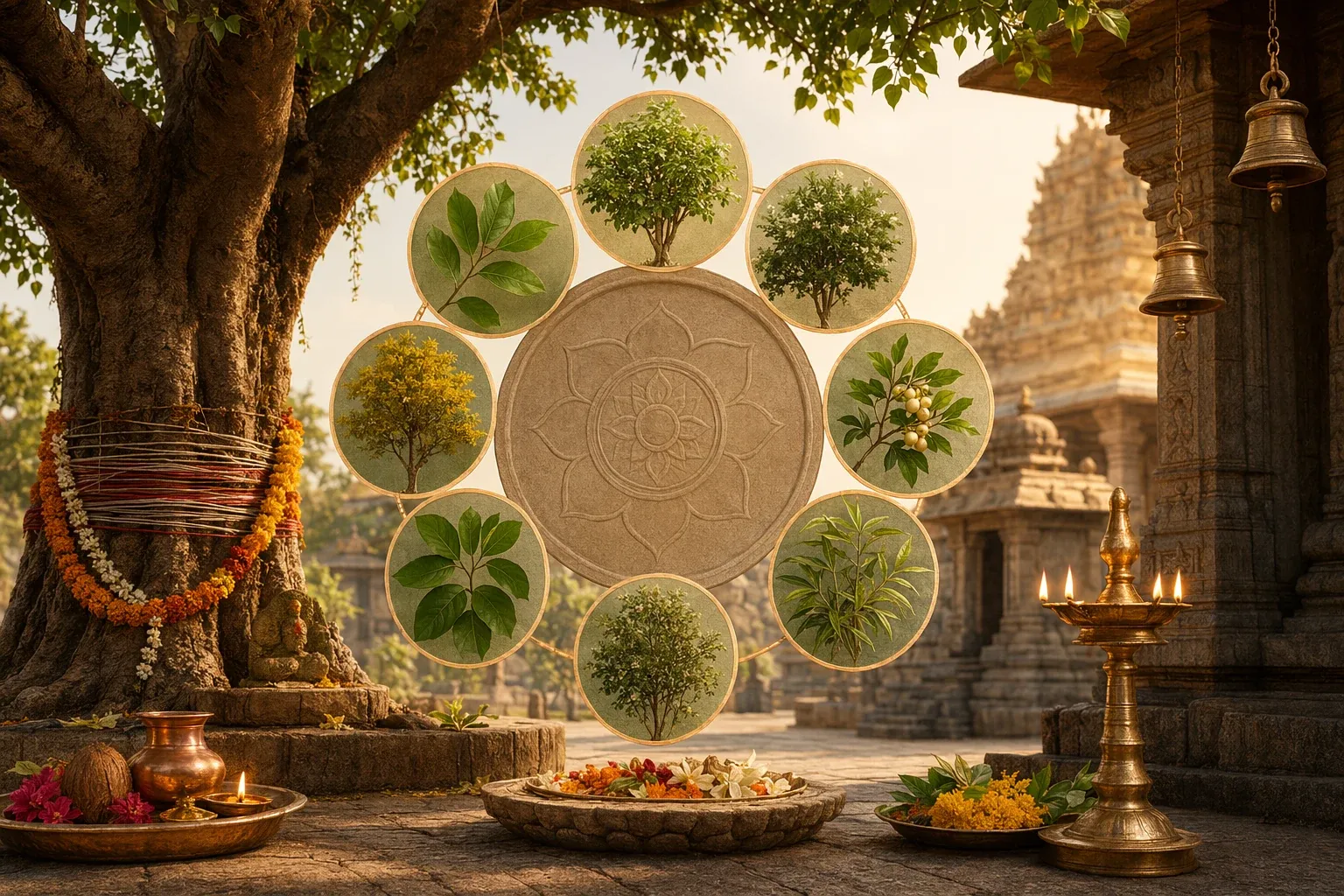
When people ask for the “nine sacred trees”, they are usually meeting two Indian ideas at once. The first is Navagraha: the nine grahas or planetary powers remembered in Hindu tradition, usually Surya, Chandra, Mangala, Budha, Brihaspati, Shukra, Shani, Rahu, and Ketu. The second is the Indian habit of connecting cosmic order with plants, temples, gardens, and ritual memory. Together, these ideas produce Navagraha gardens, Navagraha vanams, and plant lists used by temples, astrologers, nurseries, and cultural educators.
The careful answer is this: there is no single nine-tree list that is identical everywhere. Some lists include true trees, some include shrubs, grasses, or sacred plants. Names may change by Sanskrit, Tamil, Hindi, Malayalam, Kannada, Telugu, Marathi, or local plant usage. Even botanical identification can vary. So the phrase “nine sacred trees” should be handled as a tradition-specific guide, not as one universal Indian rule.
Navagraha means nine grahas, not simply nine trees
Navagraha literally points to nine grahas. In temple practice, Navagraha shrines are common, often arranged so devotees can offer prayers connected with planetary influences. The grahas are not “planets” in the modern astronomy-only sense. The list includes the Sun, Moon, visible planets, and the lunar nodes Rahu and Ketu. In religious life, they represent forces that shape time, karma, temperament, difficulty, and blessing according to tradition.
Plants enter the picture because Indian ritual often uses material symbols to make large ideas touchable. A lamp makes light visible. A river makes purification visible. A leaf makes devotion visible. In the same way, a Navagraha garden gives each graha a living plant association. It turns a cosmic idea into a walkable, waterable, protectable space.
Why the lists vary from place to place
Variation happens for several reasons. First, India’s ecology changes dramatically from Tamil Nadu to Rajasthan, from Kerala to Himachal, from Bengal to Maharashtra. A plant common in one region may not grow easily in another. Second, local languages may use the same name for different plants or different names for the same plant. Third, temple traditions may follow different inherited lists. Fourth, some modern lists are designed for practical planting, so they may adapt to what nurseries can actually supply.
This is why a responsible article should not present one neat table as if it ends the discussion. A table can help, but it should come with humility. If you are planting a Navagraha garden, you should ask a local temple authority, botanist, nursery expert, or traditional practitioner in your region. Cultural meaning and plant identity both matter.
A common pattern readers may encounter
In many South Indian Navagraha plant lists, readers may see associations roughly like these: Surya with Arka or Erukku, Chandra with Palasha or related regional names, Mangala with Khadira or Karungali-type names, Budha with Apamarga or Nayuruvi, Brihaspati with Peepal or Arasu, Shukra with Udumbara or Athi, Shani with Shami or Vanni, Rahu with Durva-type grasses in some lists, and Ketu with Darbha or Kusha-type grasses. This is not a final national list. It is a doorway into how such gardens are often explained.
Notice something important: not every item here is a large tree. Arka is commonly a shrub. Durva and Darbha are grasses. That means the popular phrase “nine sacred trees” is sometimes a simplification. A more accurate phrase would be “nine sacred plants associated with Navagraha traditions”. For a beginner, this small correction prevents confusion.
Peepal, Shami, and the familiar sacred-tree links
Some Navagraha lists include plants already familiar from wider Indian sacred-tree culture. Peepal, for example, is widely respected as Ashvattha or sacred fig and is often connected with presence, longevity, and spiritual memory. In some lists it is linked with Brihaspati or Guru, the graha associated with wisdom and teaching. Even where the exact association differs, the symbolic fit is easy to understand: a long-lived tree of learning and shade sits naturally with the idea of guidance.
Shami or Vanni is another important example. It is remembered in some regions during Vijayadashami and is linked with courage, restraint, and rightful action. In Navagraha plant lists, Shami is commonly connected with Shani, a graha associated with discipline, delay, endurance, and karmic seriousness. Again, this is interpretation within tradition, not a scientific claim that a tree controls a planet. The plant becomes a cultural language for reflecting on time and action.
Nakshatra gardens and the wider sacred-plant imagination
Navagraha gardens are not the only plant-and-cosmos tradition. Nakshatra gardens connect the 27 lunar mansions with trees or plants. A checked example from Sringeri’s Nakshatravana tradition lists 27 associated trees and many medicinal plants of the Western Ghats. These gardens show a broader Indian habit: mapping the sky into the earth, not to reduce the sky, but to make relationship visible.
For young learners, this is a beautiful idea when understood carefully. A star, a planet, a tree, a temple, a story, and a human life are placed in conversation. The point is not to make exaggerated claims. The point is to remember that humans live inside larger rhythms: seasons, rain, sunlight, lunar calendars, family rites, and moral choices. Sacred plants become reminders of those rhythms.
Tradition, interpretation, and historical context
In tradition, Navagraha worship can be devotional, astrological, temple-based, or family-based. People may offer prayers, lamps, flowers, grains, or circumambulation according to custom. In interpretation, the associated plants may represent qualities: heat, coolness, strength, wisdom, beauty, discipline, shadow, release, or protection. In historical context, plant lists also reflect local ecology and the practical work of maintaining temple gardens.
Separating these layers helps us avoid two mistakes. The first mistake is blind dismissal: calling everything superstition without understanding the cultural intelligence behind it. The second mistake is blind certainty: claiming that one plant list is perfect for everyone and must produce guaranteed results. A respectful middle path studies the tradition, honours the devotion, checks the plant names, and avoids fake promises.
How to use a nine-plant list responsibly
If you find a Navagraha tree list online, read it as a starting point. Check whether the writer gives regional names and botanical names. See whether grasses and shrubs are being called trees for convenience. Compare with a local source before planting. If a temple near you has a Navagraha vanam, observe how it labels the plants. Ask respectfully why those plants were chosen. You may learn more from one temple gardener than from ten copied lists.
For a simple answer, say this: “The nine sacred trees usually refer to plants associated with the Navagraha tradition, but the exact plants vary. Some lists include Peepal, Shami, Arka, Udumbara, Palasha, Khadira, Apamarga, Durva, and Darbha-type associations, depending on region.” That answer is careful, useful, and honest.
The deeper meaning of nine sacred plants
The beauty of the nine-plant idea is that it asks us to care for the living world while thinking about time and karma. A graha may feel distant in the sky, but a plant needs water today. A ritual may speak of destiny, but the act of planting is karma in the most practical sense. You choose, you dig, you protect, you return, you wait.
That is the Bhaktilipi takeaway. Whether your local list has nine trees, seven trees, five trees, or a whole sacred grove, the heart of the tradition is relationship. Indian culture often taught cosmic ideas through things close to the hand: a leaf, a lamp, a tree, a courtyard, a temple path. When we understand that, the “nine sacred trees” are no longer just a search query. They become a gentle invitation to connect sky, soil, devotion, and responsibility.