
The ashrama system may come from an ancient Hindu setting, but many people still find it useful because it asks timeless questions. How should we learn? How should we handle responsibility? When should ambition soften? What does freedom mean after worldly duties have been lived? These questions remain relevant even when modern life looks very different from traditional society.
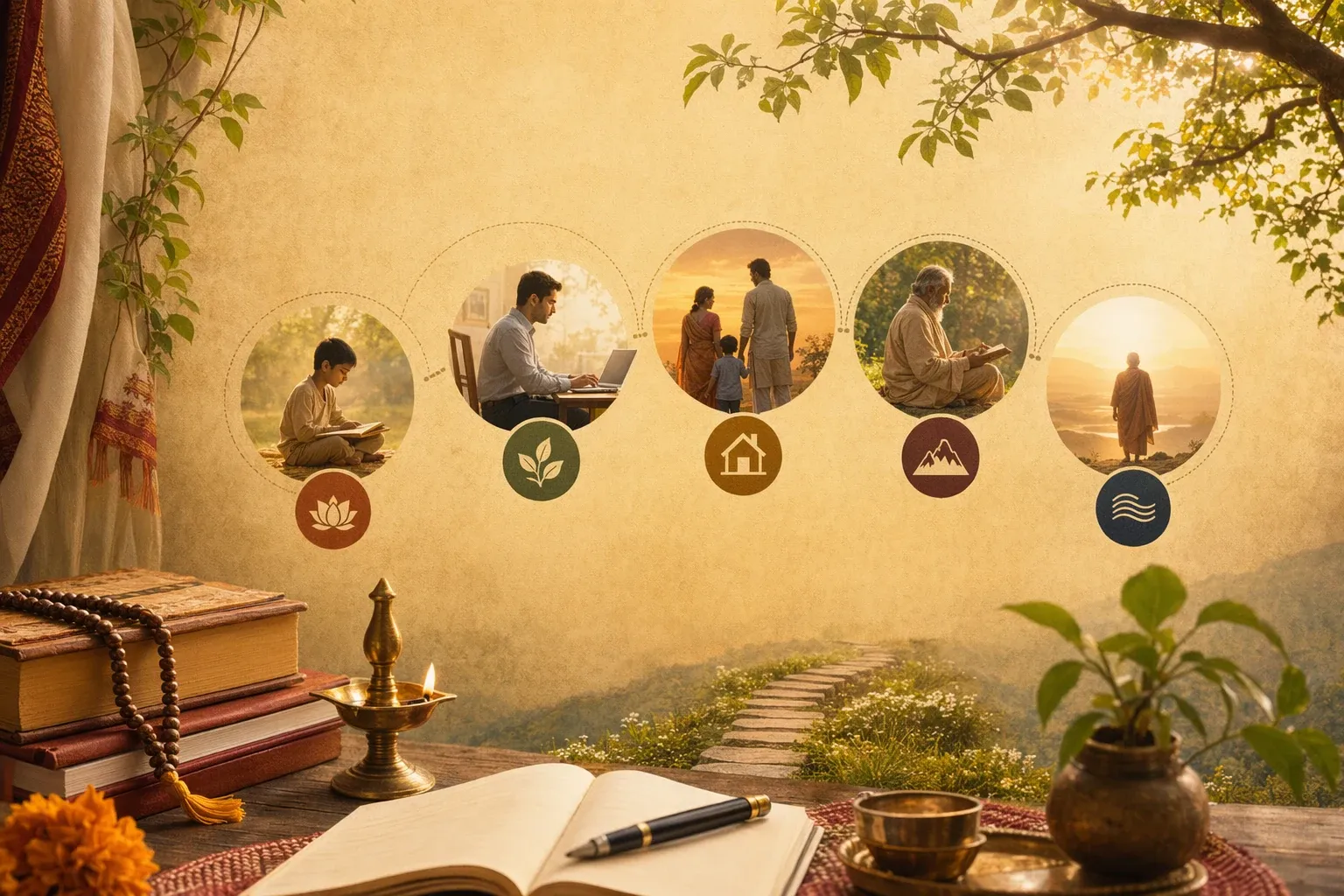
The four ashramas are brahmacharya, grihastha, vanaprastha, and sannyasa. A simple overview is available in What Is the Ashrama System?. This article focuses on modern relevance: how the spirit of the model can guide personal development without forcing everyone into the same life pattern.
A life map, not a rigid schedule
The first modern lesson is that life needs seasons. Many people try to do everything at once: study, earn, build status, enjoy pleasure, care for family, heal emotionally, and seek meaning. The result can be exhaustion. The ashrama system suggests that different responsibilities deserve different kinds of attention.
This does not mean every person must marry, retire at a fixed age, or formally renounce. Modern circumstances vary. Some people remain single. Some care for parents early. Some change careers. Some begin spiritual practice young. The value of the ashrama system is not rigid timing; it is the idea of conscious transition.
Brahmacharya today: protecting attention
Modern student life is filled with distraction. Notifications, comparison, entertainment, and pressure to succeed can scatter the mind. Brahmacharya offers a counter-principle: protect attention so learning can become deep.
For a modern person, brahmacharya may mean setting study routines, limiting digital noise, respecting teachers, learning from books and elders, caring for the body, and developing self-control. It also means remembering that education is not only a path to income. It is a way to shape character.
This lesson applies beyond school. Anyone learning a craft, rebuilding life, or entering a new discipline needs the spirit of brahmacharya: humility, practice, and focus.
Grihastha today: responsible participation
Grihastha is the householder life. Its modern relevance is clear because most people live through work, family, friendship, bills, care, and community. The ashrama system does not dismiss these duties as spiritually empty. It asks us to live them with dharma.
That means earning honestly, using resources wisely, caring for dependents, keeping promises, and practicing generosity. It also means enjoying life without letting pleasure destroy responsibility. Modern grihastha can include many forms of adult commitment, not only one traditional household shape. The key is ethical participation in the world.
Vanaprastha today: learning to step back
Modern culture often celebrates constant growth, productivity, and visibility. Vanaprastha challenges that habit. It asks: can we step back before we become attached to control? Can we mentor without dominating? Can we simplify before life forces us to let go?
A modern vanaprastha spirit may appear when parents allow adult children to lead, when professionals mentor younger colleagues, when elders reduce unnecessary possessions, or when a person chooses reflection over endless competition. It is not about disappearing. It is about becoming spacious enough to guide others wisely.
Sannyasa today: remembering inner freedom
Formal sannyasa is a serious spiritual path, not a lifestyle trend. Still, its message can help modern people. Sannyasa reminds us that identity cannot depend only on job title, wealth, beauty, influence, or social approval. All of these can change.
In daily life, the spirit of sannyasa can mean practicing non-attachment, giving without seeking praise, simplifying desires, meditating, praying, or asking what remains when ego becomes quiet. Even householders can learn from this ideal without abandoning their duties.
Personal development through balance
Many modern self-improvement systems focus on productivity. The ashrama system offers a broader view. It includes discipline, yes, but also duty, love, detachment, and liberation. It does not ask only, “How can I become more successful?” It also asks, “How can I become more responsible, wise, and free?”
This is a helpful correction. A person can achieve much and still feel restless. Another person can renounce outwardly but remain full of ego. The ashrama model teaches that growth must include the whole person.
Avoiding misuse of the model
The ashrama system should not be used to judge everyone by one script. It should not pressure people into unhealthy relationships, excuse neglect, or make elders feel useless. It should also not become nostalgia for a perfect past. Ancient ideals need thoughtful interpretation.
A respectful modern reading keeps the wisdom and avoids rigidity. It asks what each ashrama teaches: focus, responsibility, simplification, and freedom. These values can be adapted with compassion.
A simple conclusion
The ashrama system is relevant today when read as a guide to life balance. It teaches students to protect attention, adults to live responsibly, elders to guide with wisdom, and seekers to remember inner freedom. Its modern power lies not in copying every old custom, but in asking whether our lives are moving from distraction toward maturity, and from maturity toward peace.
Questions the model asks us today
The ashrama system becomes useful when it turns into honest self-inquiry. Am I learning with attention, or only collecting information? Am I using work and money to support life, or letting them define my worth? Am I caring for relationships with maturity? Am I willing to let younger people grow? Do I make any space for silence, prayer, study, or inner freedom?
These questions do not require a person to recreate ancient society. They require awareness. Modern life gives many choices, but choice without direction can become confusion. The ashrama system offers direction by reminding us that growth has layers: train the mind, serve responsibly, simplify wisely, and remember the search for freedom.