
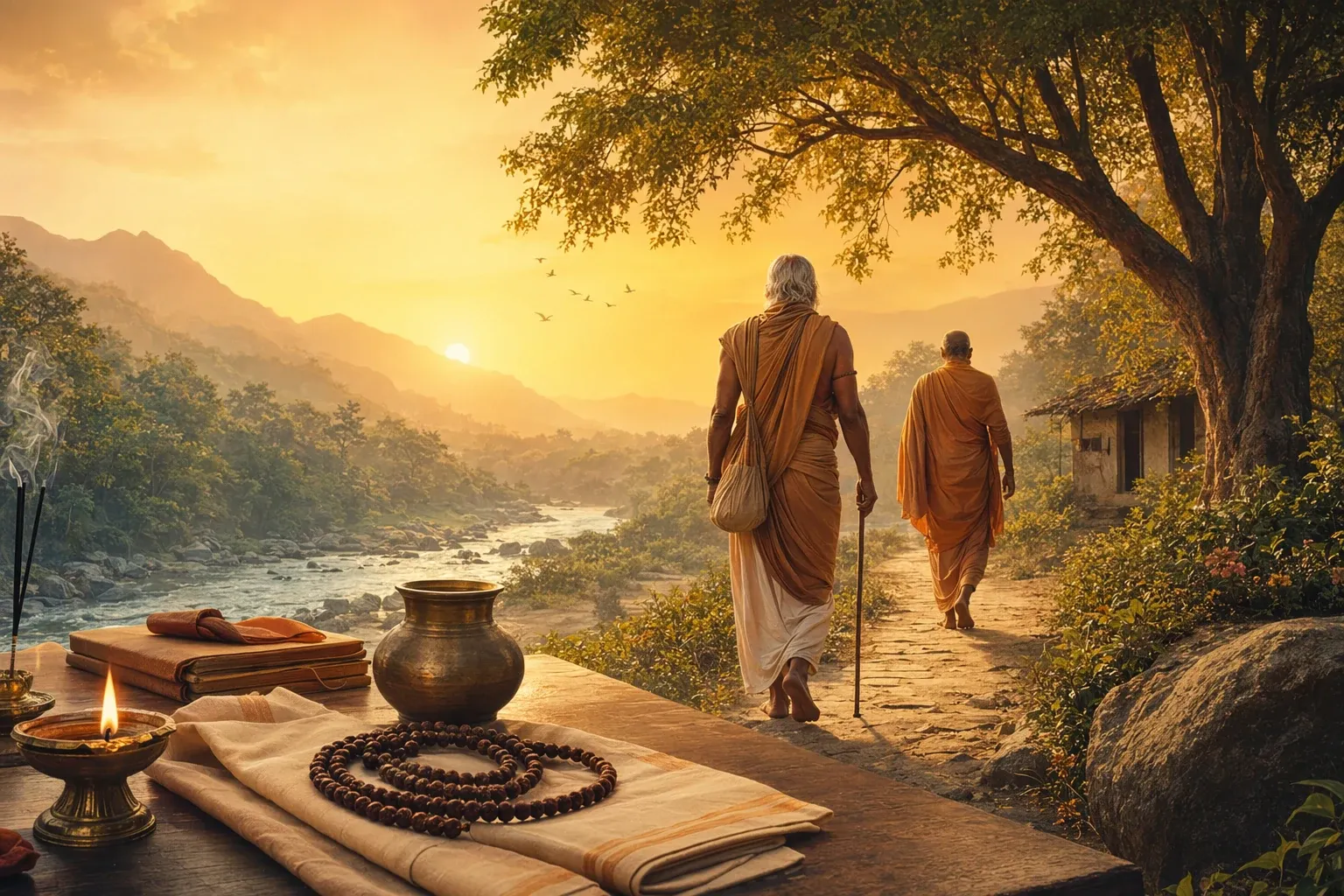
Vanaprastha and sannyasa are the later-life paths in the traditional ashrama system. They come after the student life of brahmacharya and the householder life of grihastha. Together, they show that Hindu thought does not see aging only as decline. Later life can become a time of simplification, wisdom, guidance, and spiritual freedom.
Vanaprastha is often translated as the forest-dweller life. Sannyasa is renunciation. These words can sound distant from modern life, but their inner meaning is still understandable. Vanaprastha asks a person to loosen the grip of ambition and turn toward reflection. Sannyasa points to a life centered on liberation rather than possession or status.
Vanaprastha: stepping back with maturity
Vanaprastha traditionally suggests withdrawing from the busy center of household life. The image of going to the forest is powerful, but it should not be understood only as a physical relocation. The deeper movement is inward. A person begins to reduce attachment to control, wealth, praise, and constant activity.
This is not an angry rejection of family. Ideally, it is a graceful transition. Responsibilities are handed over to the next generation. The elder becomes a guide rather than a controller. Time once spent on building and managing can be used for study, prayer, pilgrimage, service, and reflection.
Why vanaprastha matters
Many societies struggle to give later life a meaningful place. People may feel useful only while they are earning, commanding, or producing. Vanaprastha offers another vision. It says that a person with experience can become a source of calm advice and spiritual depth.
The ashrama also protects the younger generation. If elders never step back, children and younger adults may not learn responsibility. If elders withdraw with bitterness, wisdom is lost. Vanaprastha asks for a middle path: reduce control, but continue to bless, teach, and guide.
Sannyasa: renunciation and freedom
Sannyasa is a more radical movement. The renouncer gives up ordinary claims of property, status, and identity in order to seek moksha, or liberation. In traditional images, a sannyasi may wander, meditate, teach, or live with very little. The outer form varies across Hindu traditions, but the inner aim is freedom from ego and attachment.
Sannyasa does not mean life is worthless. It means the deepest self is not limited to social role, wealth, family name, or public respect. The renouncer asks: what remains when all temporary labels fall away?
Difference between vanaprastha and sannyasa
Vanaprastha is gradual withdrawal. Sannyasa is renunciation with single-minded focus. Vanaprastha may still include family connection, advice, study, and a simplified home life. Sannyasa moves more completely beyond household identity.
Another way to see the difference is this: vanaprastha loosens the knot, while sannyasa cuts it. The first prepares the mind for detachment. The second places liberation at the center of existence.
Connection with dharma and moksha
The later ashramas are closely connected with dharma and moksha. Dharma continues as right conduct, compassion, truthfulness, and non-harm. Moksha becomes increasingly important because the person sees more clearly that worldly achievements cannot provide final freedom.
This does not insult earlier life. Grihastha has its own dignity. Family care, honest work, and social service are meaningful. But after these duties have been lived, the tradition encourages a deeper question: how can the mind become free from clinging?
A modern way to understand vanaprastha
Most modern people will not literally retire to a forest. Still, vanaprastha can be practiced in spirit. It may mean simplifying possessions, mentoring without controlling, spending more time in study, reducing unnecessary arguments, giving resources wisely, and preparing emotionally for aging.
It can also mean allowing identity to soften. A person who was once known mainly by job title, wealth, or authority may begin to live more quietly. The goal is not loneliness. The goal is spaciousness.
A modern way to understand sannyasa
Formal sannyasa belongs to specific spiritual traditions and should not be casually imitated. But its message can still challenge everyone. It asks whether we are owned by what we own. It asks whether reputation has become a cage. It asks whether spiritual freedom is postponed forever.
Even a householder can learn something from sannyasa by practicing non-attachment, simplicity, compassion, and remembrance of the divine. The outer life may differ, but the inner lesson can inspire humility.
A simple conclusion
Vanaprastha and sannyasa teach that later life can be purposeful. Vanaprastha turns experience into wisdom. Sannyasa points toward liberation beyond ego and possession. Together, they complete the ashrama system by reminding us that life is not only for achievement. It is also for understanding, surrender, and freedom.
Detachment without neglect
A key point is that detachment should not become neglect. Vanaprastha does not mean abandoning people who still need care. Sannyasa, when formally undertaken, belongs to a serious spiritual commitment and is guided by tradition. The ethical spirit is to reduce selfish attachment, not to escape responsibility carelessly.
This distinction is important for modern readers. A person may simplify life while still acting kindly. An elder may step back from control while remaining loving. A seeker may value silence without becoming indifferent to suffering. The later ashramas are not about cold withdrawal. At their best, they teach warm detachment: less ego, less possessiveness, and more space for truth.
Seen this way, the later ashramas give aging a spiritual vocabulary. They invite a person to become lighter, kinder, and less ruled by old ambitions. Their message is not despair, but ripening. This makes them relevant wherever people seek dignity after active duty.