
Simple answer
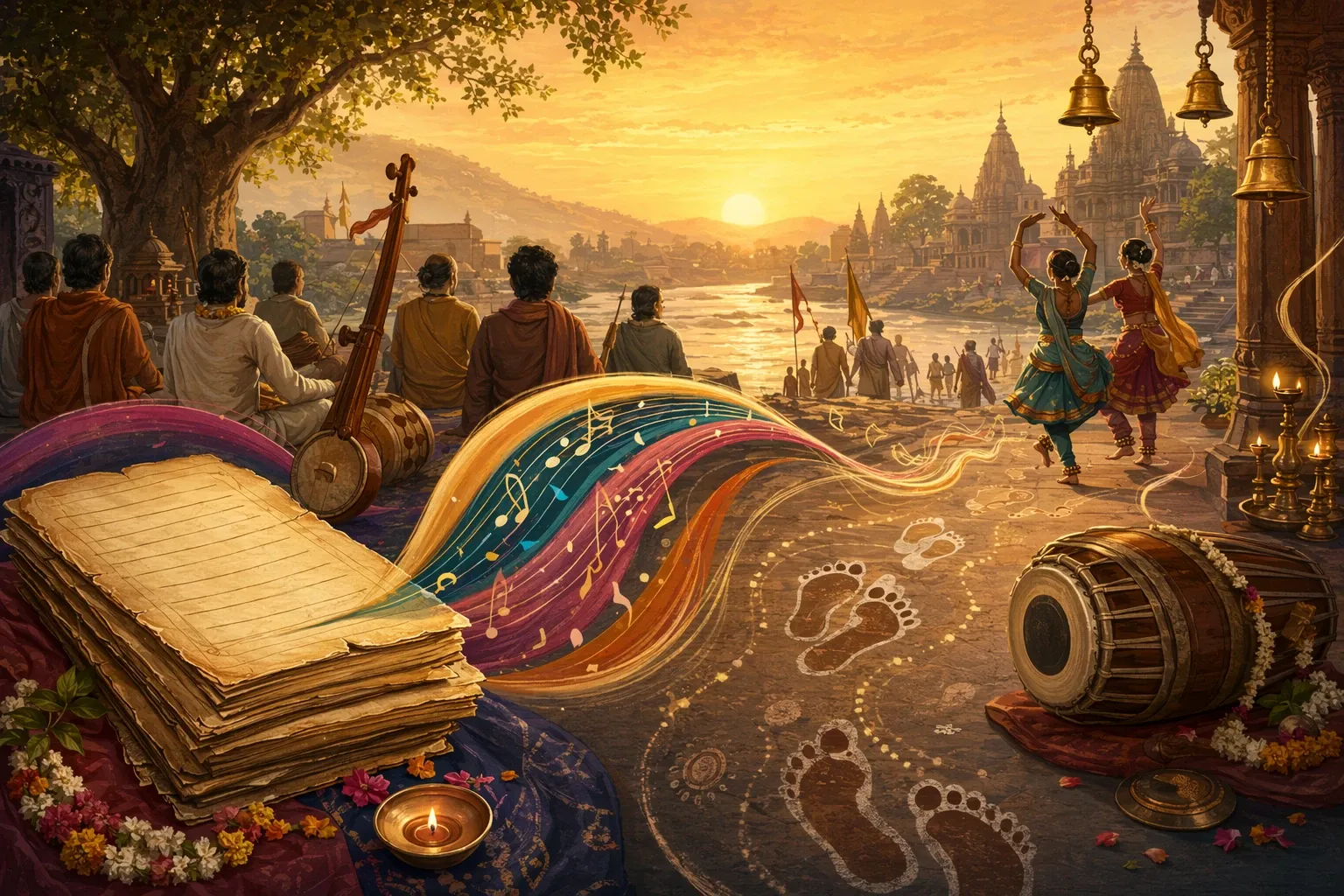
The Bhakti Movement shaped Indian culture by encouraging devotional expression in regional languages, strengthening poetry and song traditions, and influencing storytelling, music, dance, pilgrimage, and temple culture.
It helped sacred ideas travel through the voice, not only through manuscripts. A bhajan, abhang, kirtan, or pada could carry philosophy into ordinary life.
Regional languages became sacred vehicles
Bhakti showed that deep devotion did not need to speak only in elite language. Tamil, Marathi, Braj, Awadhi, Bengali, Assamese, Kannada, Gujarati, Punjabi, and many other languages carried sacred emotion.
This helped many regional literatures grow. People could hear devotion in the language of mothers, markets, fields, streets, and homes.
Poetry and saint songs
Saint-poets created memorable verses that people could sing and repeat. Kabir’s dohas, Tukaram’s abhangs, Mirabai’s songs, Tulsidas’s Rama devotion, Surdas’s Krishna poetry, and many other traditions made bhakti literary and musical at once.
This poetry often used simple images: weaving, grinding grain, walking, longing, rain, rivers, friendship, and separation. That made spiritual truth feel close to life.
Bhajan, kirtan, and abhang
Bhajan is devotional singing, kirtan often includes call-and-response or storytelling, and abhang is especially associated with Marathi Varkari devotion. These forms helped communities remember sacred stories and values together.
Music made learning emotional. Even a person who did not know formal philosophy could feel love, surrender, and courage through song.
Dance and storytelling
Bhakti influenced performance traditions by giving them devotional themes, emotional moods, and stories of Krishna, Rama, Shiva, Devi, saints, and devotees. Kathak, for example, has important links with storytelling, rhythm, and Krishna themes in many discussions of Indian performance history.
The influence varied by region and period, so we should avoid claiming one simple origin for every dance form. But devotion clearly gave Indian performance a huge storehouse of themes and emotions.
Modern cultural legacy
Today, bhakti lives in temple singing, classical music compositions, folk songs, film bhajans, festival performances, home playlists, school recitations, and pilgrimage groups.
Its cultural gift is this: devotion became art that ordinary people could remember. When culture carries love with dignity, it stays alive for centuries.
Additional beginner context
The next sections add plain-language context so the article is more useful as a complete beginner guide.
A beginner-friendly way to read this
This guide is mainly about How the Bhakti Movement Shaped Indian Languages, Music, and Dance. The useful way to read it is not as a final verdict, but as a beginner-friendly map: learn the key idea, notice the context, and then connect it with the wider Indian cultural world. Important terms in this article include Bhakti, Movement, Shaped, Indian, Languages. The central angle is: A culture-first article for Bhaktilipi: bhajans, kirtan, abhangs, poetry in regional languages, temple performance, storytelling, and Kathak/devotional expression where relevant.
Indian classical dance is not only entertainment. It brings together rhythm, gesture, facial expression, costume, music, devotion, regional memory, and storytelling. A beginner should look beyond the stage photo and ask: what story is being shown, what mood is being created, and how does the body become a language?
What to remember
Each form has its own history and personality. Bharatanatyam, Kathak, Odissi, Kuchipudi, and the other recognised forms should not be flattened into one generic ‘Indian dance’ image. Their postures, costumes, musical settings, temple or court associations, and training methods all matter.
For modern readers, the safest approach is to keep curiosity and humility together. A tradition can be meaningful without being reduced to a slogan, and a complex topic can be made simple without pretending that every region, family, school, or teacher follows the exact same wording.
For students, the respectful approach is to learn vocabulary slowly: mudra, abhinaya, tala, costume, guru, repertoire, and practice. Once those words become familiar, performances stop looking like decoration and start becoming readable cultural expression.
Where to go next
For a wider base before going deeper, read our Indian classical dance beginner guide. It gives the surrounding context so this article feels less isolated.
More context for careful readers
Common misunderstandings to avoid
A common mistake is to treat How the Bhakti Movement Shaped Indian Languages, Music, and Dance as only one sentence or one social-media definition. In reality, Indian classical dance topics usually carry many layers: language, practice, regional memory, family tradition, teacher explanation, and modern interpretation. A beginner guide should simplify the entry point, but it should not erase that depth.
Another mistake is to assume that one version explains every community. Indian traditions often travel through many regions and languages, so examples may differ. That does not make the topic confused; it means the tradition is alive and has been remembered in more than one way.
The safest reading habit is to keep the main idea clear and hold details gently. Start with what the word means, then notice where it appears, who practices or discusses it, and what value it is trying to teach. This makes How the Bhakti Movement Shaped Indian Languages, Music, and Dance easier to remember without forcing a narrow answer.
Why this matters today
This topic still matters because young readers are meeting Indian culture through school, family stories, social media, travel, music, health conversations, and festival posts. Without context, the same idea can look either too mysterious or too casual. A clear explanation helps readers respect the subject without feeling lost.
For Bhaktilipi readers, the practical value is not just information. The goal is better cultural literacy: knowing enough to ask good questions, avoid lazy stereotypes, and recognise why earlier generations preserved these ideas through stories, songs, rituals, debates, art, and daily habits.
Good learning also means knowing the limits of a short article. This guide gives a reliable starting point, but deeper study can come from teachers, trusted books, temple or community elders, museums, performances, and careful reading of primary traditions where possible.
Simple takeaway
If you remember only one thing, remember this: How the Bhakti Movement Shaped Indian Languages, Music, and Dance becomes meaningful when the definition, the cultural setting, and the human purpose are read together. That balanced view protects the topic from both blind rejection and blind romanticisation.
Use this article as a first map. Revisit the key words, compare them with real examples, and keep learning patiently. Dharma-oriented learning is not about collecting facts quickly; it is about understanding what those facts ask us to value and practice.