
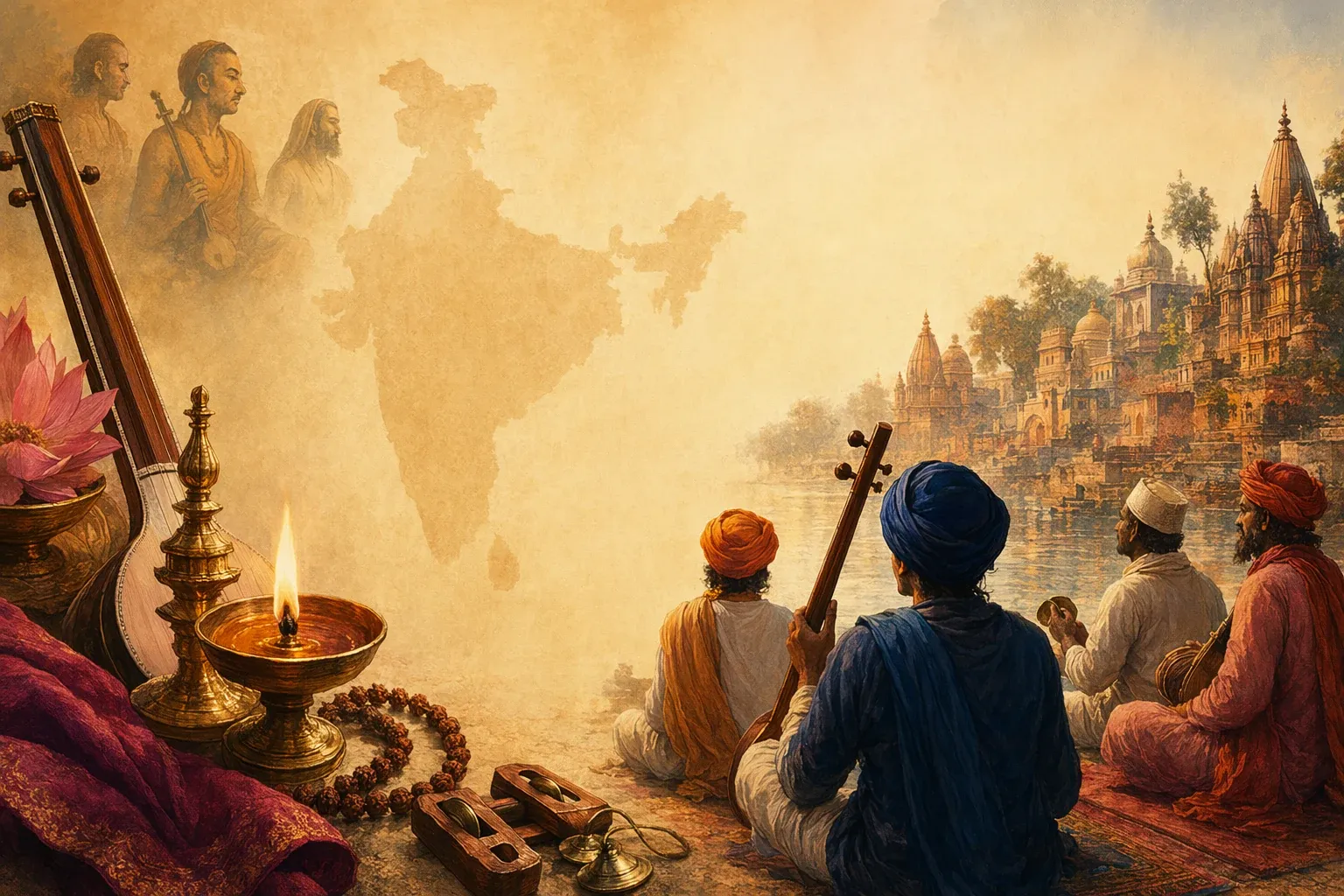
No single person founded the entire Bhakti Movement across India. It grew through many regions and centuries, shaped by saint-poets, temple communities, teachers, singers, household devotees, and local languages. The better beginner answer is not one name, but a map: early Tamil Alvar and Nayanar traditions were deeply important in South India, and later saints in Maharashtra, North India, Bengal, Odisha, Assam, Karnataka, and other regions gave bhakti many powerful voices.
Simple answer
If someone asks “who started the Bhakti Movement?”, say this carefully: the movement did not have one founder for all of India. It developed in different regions at different times. The Alvars, associated with Vishnu devotion, and the Nayanars, associated with Shiva devotion, are among the most important early devotional communities in South Indian memory. Later, figures such as Ramananda, Kabir, Ravidas, Mirabai, Tulsidas, Surdas, Dnyaneshwar, Namdev, Tukaram, Janabai, Chaitanya, Shankaradeva, Akka Mahadevi, Basavanna, and many others shaped regional bhakti traditions.
That answer may feel less neat than a one-line exam response, but it is more honest. Bhakti was not a company with a founder. It was a devotional current that flowed through poetry, song, pilgrimage, temple culture, public memory, and personal longing for the Divine.
Why one-founder answers are risky
Modern students often want one founder because short notes, quizzes, and social media videos prefer simple labels. But the Bhakti Movement was too wide for one founder label. Tamil, Marathi, Hindi, Bengali, Assamese, Kannada, Telugu, Gujarati, Punjabi, and other devotional worlds each had their own voices and histories.
Saying “this one saint started everything” hides the regional richness of bhakti. It also creates confusion because different textbooks highlight different periods. A South Indian discussion may begin with Alvars and Nayanars. A North Indian discussion may focus on Ramananda, Kabir, Mirabai, Tulsidas, Surdas, or Ravidas. A Maharashtra-focused account may begin with the Varkari tradition, Dnyaneshwar, Namdev, Eknath, Tukaram, and Janabai. A Bengal or Odisha discussion may place Chaitanya at the centre.
South Indian devotional foundations
The Alvars are remembered for intense Vishnu devotion, and the Nayanars for passionate Shiva devotion in Tamil tradition. Their hymns helped make devotion emotional, poetic, public, and accessible. They are among the most important early figures in the broad bhakti story because they show devotion moving through language, music, temple worship, pilgrimage, and community memory.
Their influence was not only religious in a narrow sense. They shaped sacred geography, temple culture, literary expression, and the idea that love for God could be sung by ordinary devotees, not only discussed by specialists. For young readers, this is one of the most important points: bhakti made devotion feel close, personal, and emotionally alive.
North Indian voices
In North India, many people associate the Bhakti Movement with saints such as Ramananda, Kabir, Ravidas, Mirabai, Tulsidas, Surdas, and Guru Nanak in wider devotional history. These names do not all fit one box. Kabir is often linked with nirguna bhakti, where the Divine is spoken of beyond form and image. Tulsidas and Surdas are strongly remembered in Rama and Krishna devotion. Ravidas is honoured for devotion that also speaks to dignity and social equality. Mirabai gave an unforgettable voice to personal Krishna devotion, longing, courage, and refusal to reduce devotion to social approval.
This diversity matters. Bhakti was not only temple ritual, and it was not only anti-ritual poetry. It included many moods: love, surrender, protest, humility, longing, music, service, and moral courage.
Western, eastern, and regional saints
Maharashtra remembers Dnyaneshwar, Namdev, Eknath, Tukaram, Janabai, and the Varkari tradition around Vithoba. Bengal and Odisha are strongly linked with Chaitanya and Vaishnava devotional currents. Assam remembers Shankaradeva and powerful cultural forms of devotion. Karnataka’s devotional landscape includes important Virashaiva and vachana traditions associated with Basavanna, Akka Mahadevi, Allama Prabhu, and others, though each needs its own careful context.
These regional stories show why bhakti is not one straight line. It is more like many rivers flowing toward devotion. Some rivers moved through temples, some through poetry, some through songs in public spaces, some through household practice, and some through sharp criticism of pride and hypocrisy.
Simple saint map for beginners
For a quick memory map: Alvars and Nayanars are key for early South Indian devotion; Ramananda, Kabir, Mirabai, Tulsidas, Surdas, and Ravidas are important in many North Indian discussions; Dnyaneshwar, Namdev, Eknath, Tukaram, and Janabai matter deeply in Maharashtra; Chaitanya shaped major Vaishnava devotional currents in eastern India; Shankaradeva shaped Assamese devotional culture; and Basavanna and Akka Mahadevi are central to Kannada vachana and Virashaiva devotional memory.
This map is not a ranking. It is a beginner-friendly doorway. Each saint belongs to a specific language, region, community, and historical setting. The respectful approach is to learn names without flattening them into one slogan.
What many bhakti leaders had in common
Even with all this diversity, many bhakti voices shared a few themes. They taught that devotion should be sincere, not only outwardly impressive. They often used local languages instead of limiting spiritual expression to elite circles. Many criticized pride, hypocrisy, and empty ritualism. Many gave ordinary people songs and stories through which they could remember the Divine in daily life.
That is why the Bhakti Movement still speaks to young readers. It says spiritual life is not only about status, birth, scholarship, or public image. It is about love, truthfulness, humility, and a heart turned toward the Divine.
For a wider yoga context, see our guide to types of yoga including bhakti and karma.
For devotional wisdom connected with action, read our Bhagavad Gita meaning guide.
Common misunderstandings
The first misunderstanding is that bhakti began suddenly in one year. It did not. The second is that all bhakti saints taught the same doctrine. They did not. The third is that bhakti was only emotional singing without philosophy. Many traditions had deep theology, discipline, and social vision. The fourth is that bhakti automatically erased every social problem. It challenged many forms of pride and exclusion, but social change was uneven and complicated.
A fair beginner answer should honour both devotion and history. Bhakti was spiritually powerful because it made love for the Divine central, but it was historically rich because that love appeared differently across India.