
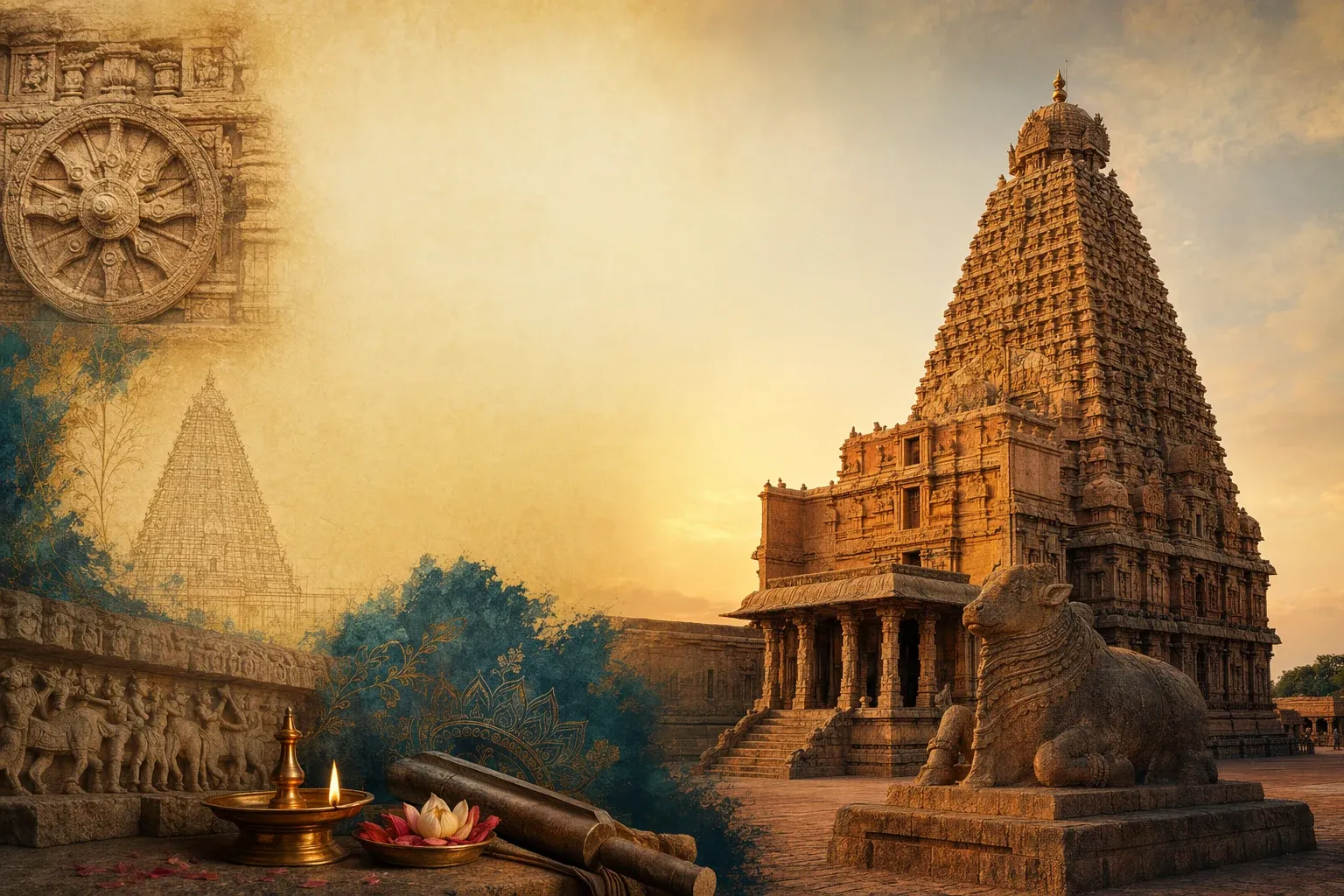
Brihadeshwara Temple at Thanjavur feels grand even before one knows its history. The open courtyard, the long axis, the massive stone forms, and the soaring tower over the sanctum all create a sense of scale. This is why many people call it the “Big Temple” of Thanjavur. Its size is not just physical. It also carries the ambition of the Chola empire, the devotion to Shiva, and the skill of artists, engineers, accountants, dancers, priests, metalworkers, and stone craftsmen.
The temple was built under Rajaraja Chola I around 1003–1010 CE and was known in inscriptions as Rajarajesvaram. It is dedicated to Shiva and stands today as part of the UNESCO-listed Great Living Chola Temples, along with the temples at Gangaikonda Cholapuram and Darasuram. For beginners, Brihadeshwara is one of the clearest examples of how South Indian temple architecture could combine devotion, royal power, geometry, and public administration.
Chola architecture in one powerful example
Brihadeshwara belongs to the Dravida or South Indian temple tradition. Unlike many later South Indian temples where the entrance gopurams dominate the skyline, here the main visual focus is the towering vimana above the sanctum. The temple draws the eye toward Shiva’s central presence and then upward through a carefully proportioned tower. The whole composition feels disciplined, not crowded.
The plan is strongly axial. A visitor approaches through gateways, moves across the large courtyard, sees the great Nandi, and then faces the main shrine. The spaces are arranged to create directness and grandeur. There is no confusion about the centre. The architecture keeps saying: this is the house of the great lord, and everything around it recognises that centre.
Granite, height, and engineering confidence
One of the remarkable facts about Brihadeshwara is its use of granite on a huge scale. Thanjavur is not a place where granite was simply lying everywhere at the building site. Moving, shaping, lifting, and placing so much hard stone required organisation and technical skill. The tall vimana, often described as around 216 feet or about 66 metres high, became a statement of what Chola builders could achieve.
Popular stories often focus on the heavy stone placed near the top of the tower and how it may have been raised. Such stories are part of the temple’s public fascination, but they should be handled carefully. What we can say with confidence is already impressive: the Cholas built a large granite temple with a soaring superstructure, stable proportions, sculptural detail, and a plan that still commands attention after a thousand years.
The sanctum and the upward pull
At the heart of the temple is the Shiva linga in the sanctum. The vimana rises above this sacred centre. In temple symbolism, the vertical form can be read as a cosmic mountain or axis, connecting earth and the divine. The devotee does not need an academic explanation to feel the effect. The tower’s height, the open space around it, and the strong base make the building feel rooted and rising at the same time.
This is different from simply building something tall for pride. In a Hindu temple, height, direction, enclosure, and centre carry ritual meaning. The architecture is not only seen; it is moved through. The body walks, pauses, looks up, approaches, circles, and receives darshan. Brihadeshwara uses scale to make this movement unforgettable.
Nandi, courtyard, and sacred procession
The great Nandi facing the main shrine is one of the most memorable parts of the complex. Nandi is Shiva’s bull and devotee, and his position is not ornamental. He faces the sanctum, becoming a model of focused devotion. The official Tamil Nadu tourism description notes the large Nandi statue and the temple’s impressive stone setting, which helps visitors understand the visual drama of the approach.
The courtyard also matters. The space around the main shrine gives the temple room to breathe. It allows the vimana to be seen clearly from many angles. It supports circumambulation, gathering, festivals, and the sense that the shrine is both royal and sacred. The experience is not only inside the sanctum; it is built through the entire complex.
Inscriptions: the temple as a record of society
Brihadeshwara is famous not only for stone height but also for inscriptions. Chola inscriptions record gifts, lamps, lands, jewels, ritual arrangements, personnel, and details connected with temple service. This tells us that the temple was not a silent monument. It was an organised institution with economy, art, ritual, and administration woven together.
For young learners of history, this is very important. A temple like Brihadeshwara was not only a place where kings showed devotion. It was also a place where resources were recorded, performances were supported, artisans were valued, and community life was structured. The inscriptions turn the stone walls into historical documents.
Art, dance, and Chola sacred imagination
The Chola period is also famous for bronze sculpture, especially images of Shiva as Nataraja, the Lord of Dance. Brihadeshwara’s world includes sculpture, painting, ritual, music, and performance. The temple’s frescoes and sculptural programme show that Chola art was not limited to one material. Stone, bronze, pigment, movement, and sound all belonged to the sacred environment.
This helps us understand why Chola temples are called living temples. Their value is not only archaeological. They continue to carry devotion, festival rhythm, Tamil memory, and artistic inheritance. When UNESCO recognises the Great Living Chola Temples, the word “living” matters. These are heritage sites, but they are also connected to continuing worship and community identity.
Rajaraja Chola I and the meaning of scale
Rajaraja Chola I was one of the most powerful rulers of the Chola empire. Building Brihadeshwara was not just a personal act of piety. It expressed imperial strength, control over resources, artistic confidence, and sacred kingship. The temple’s old name, Rajarajesvaram, itself links the king’s identity with Shiva’s lordship in a carefully framed way.
At the same time, it would be too simple to say the temple is only royal propaganda. For devotees, it is Shiva’s temple. For historians, it is a Chola archive in stone. For architects, it is a masterwork of Dravida form. For Tamil cultural memory, it is Peruvudaiyar Kovil, a beloved symbol of Thanjavur. These meanings can stand together if we read them with care.
What to notice on a first visit
Begin with the whole view. Stand back and see how the main tower dominates without needing clutter. Then notice the axial path: gateway, Nandi, courtyard, sanctum, tower. Look at the base and proportions, not only the top. Observe how the open space makes the building feel even larger. Notice inscriptions and sculptural details as evidence of a temple that functioned as a complete cultural institution.
Most of all, remember that Brihadeshwara is about stone and scale serving a sacred centre. The Cholas did not build big only to impress. They built big to organise devotion, empire, art, and memory into one unforgettable form. That is why, after a thousand years, the temple still feels less like an old building and more like a disciplined mountain of presence.