
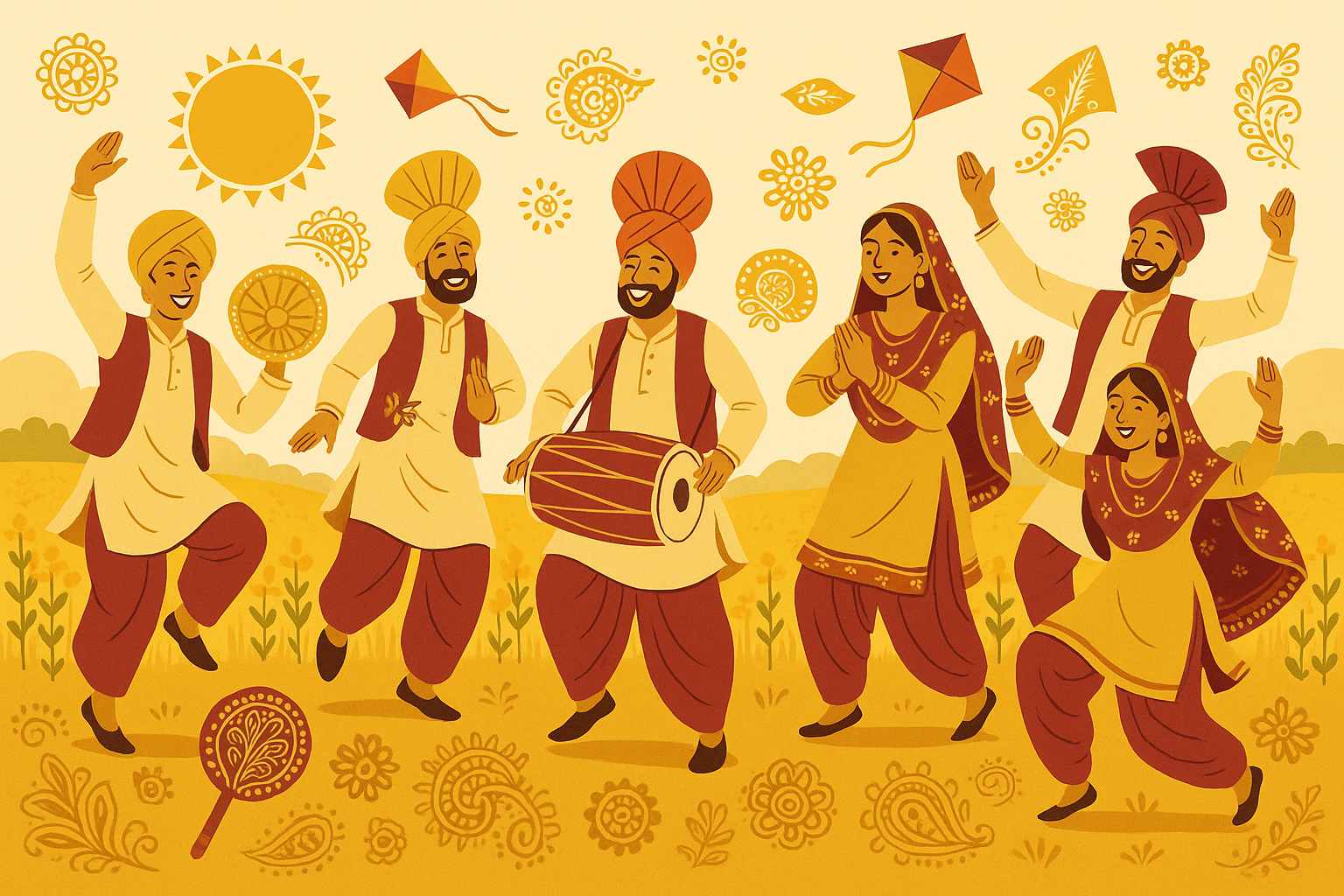
Punjab’s folk-dance traditions include the internationally familiar Bhangra and Giddha as well as Jhumar, Sammi, Luddi, Kikli and other local forms. They are connected with seasonal festivities, weddings, social gathering, song, agricultural life and regional memory—but they do not all share one origin, costume or performance community.
The Government of Punjab identifies Bhangra, Jhumar and Sammi among popular dance genres and describes Giddha as a humorous song-and-dance tradition performed by women.
Punjab is a region as well as a state
Historical Punjab was divided between India and Pakistan in 1947. Some traditions, repertoires and place associations cross today’s border, and Punjabi communities have also reshaped dance in Britain, North America and elsewhere. A guide about “Punjab” should therefore say whether it means the wider cultural region, the Indian state, Pakistani Punjab or a diaspora setting.
Folk practice also changes between villages, families, professional troupes and stage competitions. A polished college Bhangra set is real Punjabi cultural expression, but it is not a frozen copy of every earlier rural performance.
Bhangra: folk dance, stage form and global genre
Bhangra is strongly associated with Punjabi celebration, dhol rhythm and spring or harvest festivity. Traditional performance has often been described as male, while present-day teams and social dancers include people of different genders. Vigorous jumps, shoulder movement, expansive arms and calls give many staged forms their recognisable energy.
Origin stories that reduce every step to sowing or reaping are too neat. Agricultural celebration is important, but modern Bhangra choreography draws from multiple regional dance movements and has been reshaped through festivals, schools, cinema, competitions and migration.
The word can also name a popular music genre. A SOAS exhibition traced how Punjabi Bhangra developed through British Asian music and culture from the 1970s onward. Folk dance, competitive choreography and a dance-music track overlap, but they are not identical objects.
Giddha: song, dance and social commentary
Giddha is traditionally performed by women, commonly in a circle or group, with clapping, movement and sung couplets called boliyan. Weddings and seasonal or women’s gatherings are important contexts. Clothes, tempo and choreography vary rather than following one mandatory template.
Boliyan and women’s expression
Boliyan can be affectionate, teasing, satirical or sharply observant. Their subjects include kinship, marriage, romance, village relations, everyday frustration and social behaviour. The performers do not merely decorate a pre-recorded song: singing, response, humour and embodied performance are central.
Calling Giddha only “graceful” misses its wit and force. Calling it simply the female counterpart of Bhangra also hides its distinct song structure and performance history.
Jhumar
Jhumar is associated with a swaying rhythmic quality and with areas of the wider Punjabi region, including western Punjab. It is generally gentler in pacing than the most athletic staged Bhangra sequences. The form should not be claimed exclusively for one modern border or reduced to a single romantic legend.
Sammi
Sammi is a women’s dance associated in many accounts with the Sandal Bar region and with sung refrains. Circular formation, clapping and gestures can feature in performance. Stories explaining the name through a woman or heroine belong to oral tradition and should be labelled as such rather than treated as a securely dated biography.
Luddi
Luddi is associated with celebration and victory, with characteristic upper-body and hand movements in many presentations. It appears both as a named folk form and as material incorporated into larger stage suites.
Kikli
Kikli is a paired spinning activity traditionally associated with girls. Partners hold hands or arms and turn around a shared centre while singing. It sits at the boundary between game, song and dance, reminding us that folk performance is not limited to ticketed stages.
Music and instruments
The double-headed dhol is central to many Bhangra settings, but Punjabi folk sound is broader. Tumbi or tumba, algoza, chimta, dholki, clapping and the singing voice may appear in different genres. An instrument list should not imply that the same ensemble accompanies every dance.
For Giddha, performers’ voices, boliyan and clapping can carry the event. For staged shows, arrangers may add amplified or recorded instrumentation. The sound tells you something about the performance context.
Festivals, weddings and the stage
Folk dances can mark Baisakhi, weddings and other seasonal or community celebrations, but no single festival explains every form. Institutional festivals and cultural troupes have also helped standardise costumes, durations and combinations for an audience.
The Ministry of Culture’s folk-dance roster lists active Punjabi groups performing Bhangra, Jhumar, Luddi and Malwai Giddha, evidence that named traditions continue through working performers rather than only through old descriptions.
How to watch and learn respectfully
- Ask which regional or stage style is being presented.
- Credit teachers, singers, musicians and choreographers, not only lead dancers.
- Do not treat costume as a generic party disguise or imitate accents for humour.
- Learn the meaning and context of boliyan before performing them.
- Recognise that gender conventions have histories while contemporary participation can change.
- Avoid declaring one competition rulebook the only authentic tradition.
Frequently asked questions
Is Bhangra the only folk dance of Punjab?
No. Giddha, Jhumar, Sammi, Luddi, Kikli and other local practices are also part of Punjabi dance culture.
Are Bhangra and Giddha male and female versions of the same dance?
They have historically gendered performance associations, but they are distinct traditions with different relationships to song, movement and occasion. Contemporary participation is also more varied.
Did Bhangra remain unchanged after leaving the villages?
No. Stage presentation, cinema, competitions and diaspora music transformed it. Change does not automatically make a form inauthentic; it should be documented.