
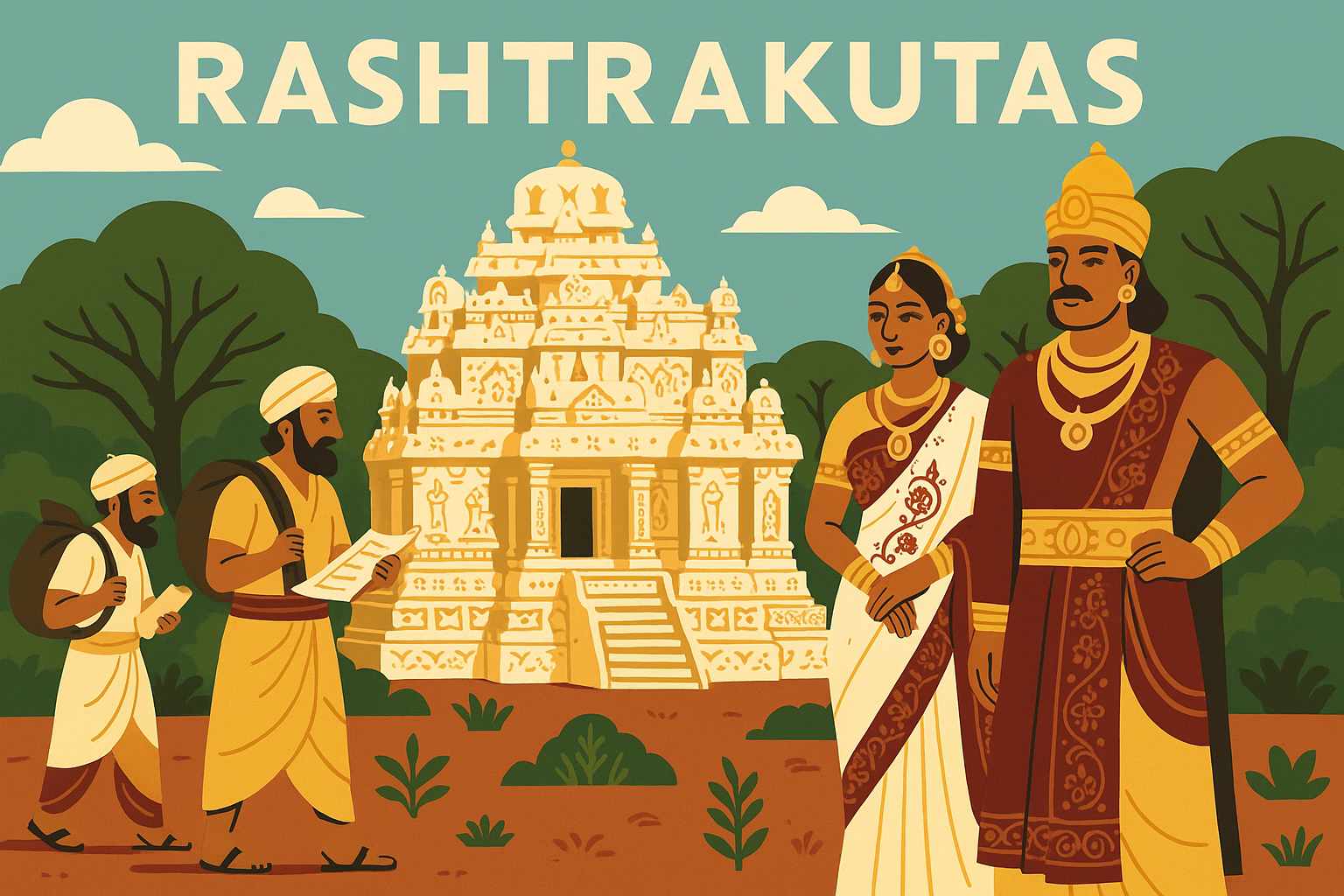
The imperial Rashtrakutas became the dominant power of much of the Deccan in the mid-eighth century and remained a major dynasty until the later tenth century. Their history matters not only for warfare and territory, but also for inscriptions, Kannada and Sanskrit scholarship, Jain and Brahmanical patronage, and the extraordinary rock-cut monuments associated with Ellora.
Because more than one family used the Rashtrakuta name, this guide focuses on the imperial line founded by Dantidurga and continued by rulers including Krishna I, Dhruva, Govinda III, Amoghavarsha I, Indra III and Krishna III.
How the imperial dynasty emerged
The earlier members of Dantidurga’s family were probably feudatories of the Badami Chalukyas. Maharashtra’s Nashik district history describes Dantidurga as the founder of Rashtrakuta imperial power and Krishna I as the ruler who completed the overthrow of Early Chalukya authority.
The Samangad plates dated 753–54 and an inscription at Ellora are key evidence for Dantidurga. Their praise of conquest must be read critically: royal inscriptions advertised legitimacy and victory, so they are evidence both for events and for how kings wanted their rule remembered.
A short political chronology
- Dantidurga: established independent imperial authority in the Deccan by the middle of the eighth century.
- Krishna I: consolidated the new power and is associated with the Kailasa temple at Ellora.
- Dhruva and Govinda III: campaigned beyond the dynasty’s Deccan centre and entered wider struggles involving northern and southern powers.
- Amoghavarsha I: ruled for a long period in the ninth century and is especially associated with literature, Jain scholarship and the capital at Manyakheta.
- Indra III and Krishna III: renewed major campaigns in northern and southern India during the dynasty’s later phase.
- Karka II: was displaced in 973 by Tailapa II, whose Western Chalukya power succeeded the imperial Rashtrakutas.
This outline avoids treating every claimed conquest as permanently annexed territory. Medieval campaigns could produce tribute, prestige or short-lived submission without stable administration.
The struggle over Kannauj
Rashtrakuta campaigns intersected with the Gurjara-Pratiharas and Palas in the long contest for influence in northern India, often called the tripartite struggle. The phrase is useful, but it can make a changing series of campaigns sound like one continuous three-sided war.
The Rashtrakutas demonstrated an ability to project military power far beyond the Deccan. They did not, however, permanently shift the centre of their empire to Kannauj or hold all northern conquests for generations.
Kailasa and the Ellora caves
Kailasa, Cave 16 at Ellora, is a monolithic temple complex excavated from the basalt rock rather than assembled from separate masonry blocks. A retrospective statement adopted by UNESCO attributes the famous temple to Rashtrakuta king Krishna I.
The UNESCO World Heritage Centre describes Ellora’s 34 Buddhist, Brahmanical and Jain monuments as an artistic and technological achievement spanning centuries. Kailasa belongs to that larger, multi-period complex; it should not be used to credit the Rashtrakutas with every cave at Ellora.
The site is also evidence of several religious communities working and worshipping in the same landscape. That supports a history of coexistence at Ellora, but it does not by itself prove that every Rashtrakuta ruler followed one uniform policy called “religious tolerance.”
Language and literature
Rashtrakuta courts supported scholarship in Kannada and Sanskrit, including Jain intellectual traditions. Kavirajamarga, produced in the time of Amoghavarsha I or Nripatunga, is the earliest surviving major Kannada work on poetics and literary culture. Its authorship has been discussed by scholars, so it is safer to connect it with the king’s court and patronage than to insist that he wrote every line alone.
The work is important evidence that Kannada literary practice and geography were already sufficiently developed to be described, evaluated and theorised. Sanskrit and Prakrit scholarship also continued; the court cannot be reduced to one language.
Patronage and religious life
Rashtrakuta evidence includes Brahmanical temples and grants as well as important Jain authors and institutions. Amoghavarsha I is closely connected with Jain teachers and literature, while Kailasa is a monumental Shaiva work.
Patronage was shaped by individual rulers, courts, local elites and political circumstances. Rather than saying all religions received equal support at all times, the evidence shows multiple traditions participating in the dynasty’s cultural world.
Governance, grants and regional power
The empire worked through kings, royal officers, feudatories, provincial and local authorities, and networks of landholding and revenue. Copper-plate grants record gifts, boundaries, titles, genealogies and administrative vocabulary. They are invaluable but not neutral: a grant documents a legal act while also praising the donor.
Claims that Rashtrakuta government became a direct “blueprint” for every later kingdom go beyond the evidence. Their political system belonged to a wider early-medieval landscape in which dynasties relied on layered authority and negotiated relationships with subordinate rulers.
Reading inscriptions carefully
- Separate the dated legal portion of a grant from its poetic royal praise.
- Check whether a victory meant annexation, tribute or a temporary campaign.
- Distinguish the imperial line from other families bearing the Rashtrakuta name.
- Use modern place identifications cautiously when historians disagree.
- Compare inscriptions with monuments, literary texts and records of neighbouring powers.
Why the Rashtrakutas remain significant
The dynasty reshaped Deccan politics and connected its courts to wider contests across the subcontinent. Its surviving evidence joins political history to art, religious institutions, languages and the material work of excavation and construction.
Kailasa at Ellora is the most visible monument associated with Rashtrakuta rule, but the legacy is broader: inscriptions reveal land and authority; literature reveals a multilingual intellectual world; and campaigns reveal both the reach and limits of imperial claims.
Frequently asked questions
When did the imperial Rashtrakutas rule?
Their independent imperial phase began in the mid-eighth century and ended in the later tenth century, conventionally around 753–973 CE.
Who founded Rashtrakuta imperial power?
Dantidurga established it after rising from a feudatory position and displacing Early Chalukya supremacy.
Did the Rashtrakutas build all of Ellora?
No. Ellora developed over several centuries under different patrons and religious communities. Kailasa is the major monument specifically associated with Krishna I.
Was Amoghavarsha the author of Kavirajamarga?
The work belongs to his reign and court and is traditionally associated with him. Scholarship discusses the role of the poet Srivijaya, so absolute single authorship should not be asserted casually.