
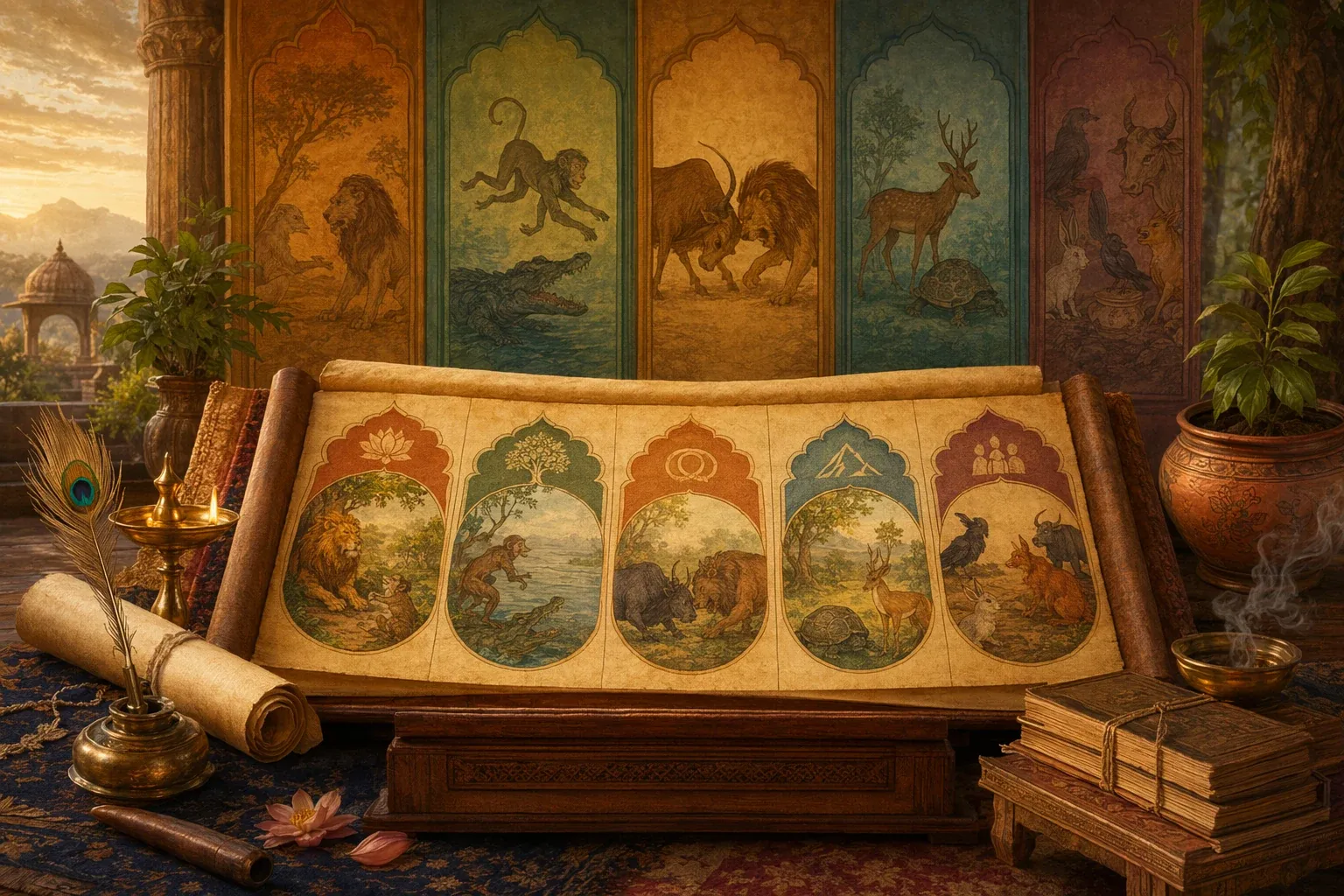
The Panchatantra is not just a pile of animal stories. Its name points to a clear design: pancha means five, and tantra here means a section, method, or teaching framework. The collection uses memorable fables to train the reader in practical judgement. Instead of giving a dry lecture on friendship, bad advice, rash action, or political sense, it lets jackals, crows, lions, turtles, monkeys, and merchants act out the mistake in front of us.
For beginners, the five tantras are the easiest way to understand the book. Each section gathers stories around one kind of life problem. Some stories warn us about losing good friends. Some show how trust can be built. Some expose the danger of acting before thinking. Together they make the Panchatantra feel less like a random storybook and more like a compact school of worldly wisdom.
1. Mitra-bheda: losing friends through bad counsel
The first tantra is usually called Mitra-bheda, or the separation of friends. Its famous frame story shows how suspicion can be planted between two beings who should have remained allies. This is where the Panchatantra begins because broken trust is one of the oldest social dangers. A powerful person can be misled. A loyal friend can be made to look like a threat. A clever but selfish adviser can profit from confusion.
The lesson is not simply “never trust anyone.” It is more careful than that. The section asks readers to notice who benefits when two friends start doubting each other. It teaches young readers to pause before believing gossip, especially when the speaker has something to gain. In modern life, this can apply to school friendships, family arguments, office politics, and online rumours.
2. Mitra-labha: gaining friends and allies
The second tantra, Mitra-labha, turns from loss to gain. It is about forming useful and sincere friendships. The stories often show small creatures surviving because they cooperate. A mouse, a crow, a deer, and a turtle may not have the same strengths, but together they can solve problems that would defeat them alone.
This is one reason the Panchatantra still feels fresh. It does not say friendship is only about liking the same things. It shows friendship as shared reliability. One friend may be quick, another patient, another alert, another good at cutting a trap. The point is that friendship becomes strong when each person’s ability is respected. A reader can also connect this with Bhaktilipi’s broader guides to dharma and everyday conduct, where duty is shown through practical behaviour rather than abstract slogans.
3. Kakolukiyam: conflict, caution, and strategy
The third tantra is often known as Kakolukiyam, the section of crows and owls. It explores rivalry, conflict, spying, negotiation, and the cost of poor planning. The bird-world setting makes the stories easy to remember, but the concerns are serious: how do groups handle enemies, secrets, leaders, and sudden danger?
A beginner should read this section carefully, not as a call to manipulation, but as a warning that intelligence can be used well or badly. The Panchatantra belongs to a tradition that does not pretend the world is always simple. It tells readers that courage without planning can fail, and planning without ethics can become cruel. That balance makes the stories more mature than ordinary bedtime tales.
4. Labdha-pranasam: losing what has been gained
The fourth tantra is about losing gains after success. A person may win a position, a friendship, a treasure, or a safe place, but then lose it through carelessness, vanity, or bad speech. These stories are especially useful for students because they show that success is not the end of the lesson. How we behave after success matters just as much.
This section often feels painfully realistic. Someone escapes danger but boasts too much. Someone gets a good chance but misunderstands the situation. Someone trusts a flattering voice instead of observing facts. The message is simple: protect what you have earned with humility, attention, and self-control.
5. Aparikshitakarakam: acting without examination
The fifth tantra, Aparikshitakarakam, warns against rash action. Its title points to deeds done without proper examination. This may be the most relatable section for modern readers because impulsive decisions are everywhere: forwarding a message without checking it, judging a friend after one comment, buying something because of pressure, or reacting angrily before the full story is known.
The Panchatantra does not ask readers to become fearful. It asks them to become alert. Look once more. Ask what is missing. Test the claim. Notice whether emotion is rushing ahead of reason. A small pause can save a large regret.
Why animal stories work so well
Animals make the lessons less embarrassing. If a story says, “A proud lion made a foolish decision,” we can laugh and learn without feeling personally attacked. The animal world also lets the writer show power differences clearly. A small animal can outthink a large one. A weak creature can survive through timing. A strong creature can fall through arrogance.
This is why the Panchatantra has travelled across languages and centuries. The five tantras offer a map of human behaviour through stories that children can enjoy and adults can still recognise. Read section by section, the book becomes a guide to friendship, caution, leadership, speech, and thoughtful action.
Reading the five tantras as a set
A helpful way to read the collection is to pause after each section and ask what danger it trained you to recognise. One section may teach caution about gossip, another about alliance, another about rash judgement. Seen together, the five tantras become a progressive lesson in attention. The reader learns not only a moral, but a habit of looking more carefully at people, motives, speech, and consequences.