
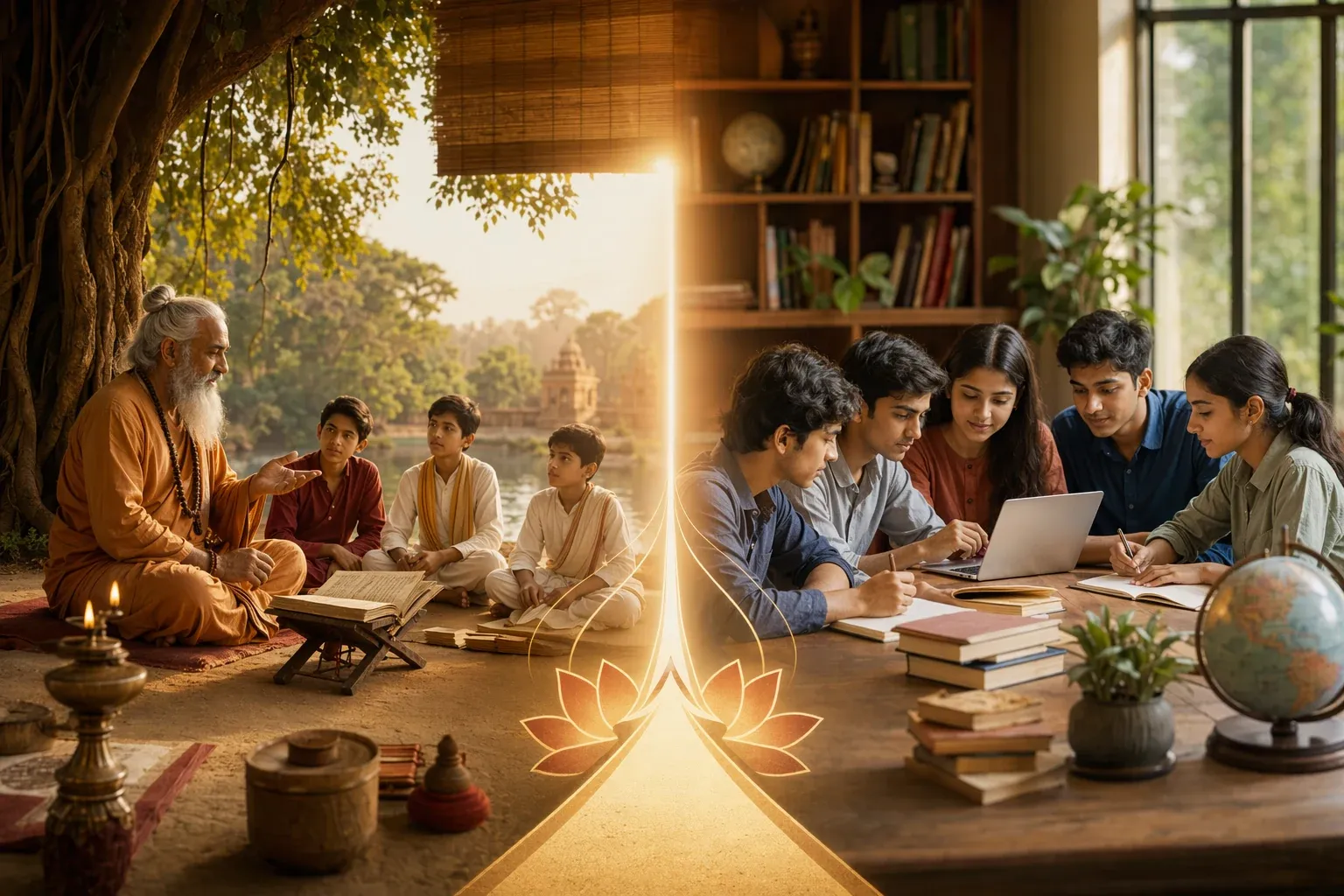
Guru-shishya and modern education are often compared as if one must defeat the other. That is not very useful. The guru-shishya model grew around close mentorship, practice and personal formation. Modern education grew around scale, standard syllabi, institutions, exams and access for large numbers of students. Both can be powerful. Both can also fail if handled without care.
A fair comparison begins by asking: what kind of learning are we talking about? If a student wants to preserve a Vedic chant, understand a raga, refine dance abhinaya, learn yoga practice safely, or enter a philosophical lineage, personal guidance matters deeply. If a country must teach millions of children mathematics, science, languages and civic skills, the modern school system is necessary. These are not identical tasks.
The heart of guru-shishya learning
In the guru-shishya tradition, the learner does not receive only information. The learner receives correction, rhythm, discipline and a way of seeing. The guru watches how the student practises. A small mistake in pronunciation, posture, timing or attitude can be corrected before it becomes habit. This is why oral and artistic traditions value the teacher’s presence so much.
UNESCO’s note on Vedic chanting shows the seriousness of such learning: sound, accent and pronunciation were protected through detailed recitation techniques taught from childhood. In music and dance, the same idea appears differently. A teacher may stop a student after one phrase and say, “not like that; listen again.” The lesson is not only in the words. It is in the demonstration, repetition and correction.
The strength of modern education
Modern education has a different strength: it can reach scale. A classroom, textbook, examination board, university and public policy system can teach large numbers of students across villages, towns and cities. It can create common standards, professional qualifications and pathways into work. It also gives students access to subjects that were not always available through hereditary or local training.
This matters for social justice. A child should not be denied mathematics, science, history, literature or digital skills because there is no local master nearby. A modern institution can also create records, grievance systems, scholarships and safeguards. When it works well, it opens doors beyond family background.
Close mentorship and large classrooms
The biggest difference is intimacy versus scale. Guru-shishya learning is close. The teacher may know the student’s strengths, laziness, fear and talent. This can make learning very deep. It can also become unhealthy if the teacher misuses authority or if the student is expected to obey without question. Trust is powerful only when paired with responsibility.
Modern classrooms are larger and more standardised. This protects fairness in some ways: everyone gets the same exam, the same timetable and the same basic syllabus. But a large class can miss the individual. A student may pass tests without developing love for the subject, or may remain silent because the system has no time for personal attention. Good schools try to add mentoring, projects, labs and arts practice to solve this gap.
How each model treats knowledge
Guru-shishya learning often treats knowledge as lived practice. You learn by doing, watching, repeating and absorbing. The student becomes part of a parampara, a stream. In a music gharana, for example, the student may inherit not just compositions but taste: how to approach a raga, when to hold back, when to open a phrase, what not to overdo.
Modern education often treats knowledge as organised content. That is not a weakness by itself. Organised content helps students compare ideas, read many authors, study evidence and move between fields. A biology student, a law student and an engineering student cannot depend only on one teacher’s memory. They need libraries, labs, peer review, data and shared methods.
Accountability is not optional
One honest criticism of romantic guru-shishya talk is that it can hide power imbalance. A teacher may be loved, but love should not remove accountability. Any learning relationship needs dignity, consent, boundaries and the right to ask questions. Tradition cannot be used as a shield for exploitation, humiliation or blind obedience.
Modern institutions also have problems: exam pressure, coaching culture, rote learning, unequal access and sometimes cold bureaucracy. A certificate does not guarantee wisdom. But institutional systems at least make it possible to demand written rules, complaint channels and public standards. The future should not choose blind hierarchy or soulless bureaucracy. It should combine depth with safeguards.
What students can borrow today
From guru-shishya learning, students can borrow regular practice, respect for a serious teacher, patience with basics, and humility before a subject. Do not treat every lesson as content to consume quickly. If you are learning music, Sanskrit, yoga, dance, philosophy or craft, find someone who can correct you. Recordings and notes help, but feedback matters.
From modern education, students can borrow curiosity across fields, critical thinking, documentation and fairness. Read more than one source. Ask how we know something. Respect your teacher, but do not surrender your conscience. If a tradition is valuable, it can survive thoughtful questions.
A simple way to compare them
Guru-shishya is strongest where knowledge needs personal transmission: voice, gesture, discipline, taste, spiritual practice or subtle judgement. Modern education is strongest where knowledge must be shared widely, tested openly and connected to many fields. One is like sitting near a master craftsperson. The other is like entering a public institution with many teachers, books and systems.
India needs both. A young learner may go to school in the morning, attend music class in the evening, learn coding online, ask grandparents about family rituals, and read the Gita with a teacher on weekends. Real learning is already mixed. The question is not old versus new. The question is whether the learning makes us more skilled, thoughtful and responsible.
Questions people ask
How does guru-shishya differ from modern education?
Guru-shishya learning is usually close, practice-based and shaped by personal guidance. Modern education is usually institutional, syllabus-based and designed to reach many students with common standards.
Is guru-shishya relevant today?
Yes, especially in fields where correction and lived practice matter, such as classical music, dance, yoga, Sanskrit chanting, philosophy and crafts. It becomes healthier when combined with modern accountability and open learning.